Harness the Strategy House Used by McKinsey, Bain, and BCG (Free Template)
Master the Strategy House Framework! Learn how to align your team & goals. Download our free PDF & PPT template now!

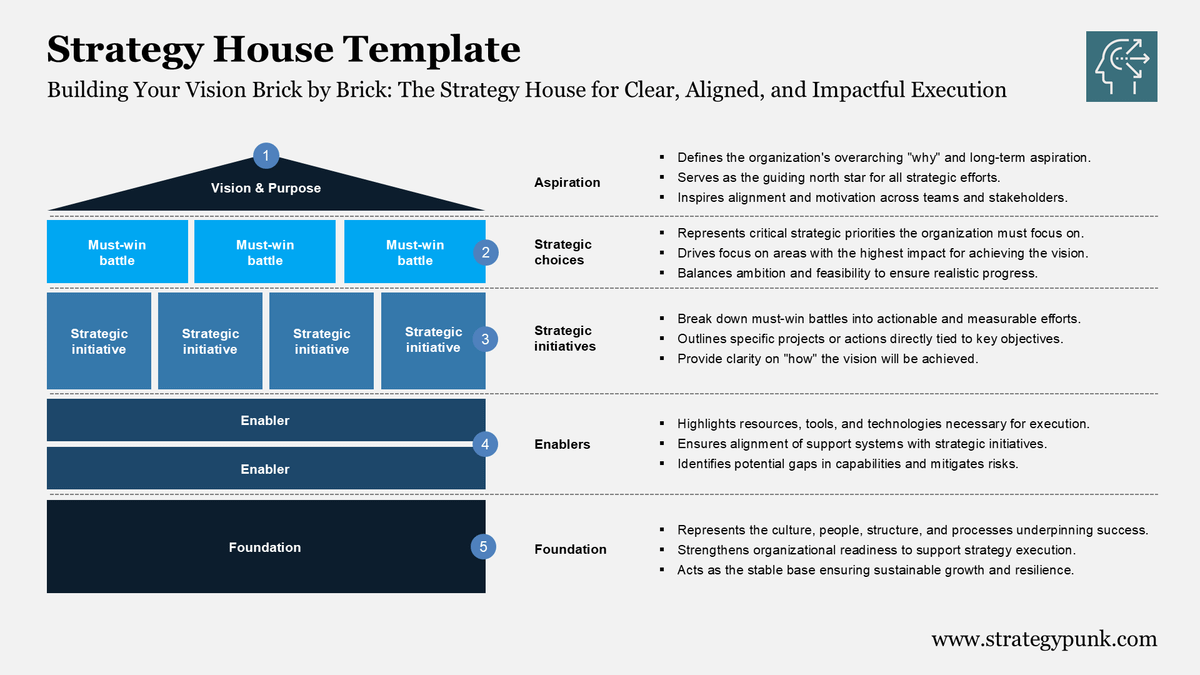
Strategy House Template & Framework
In the competitive world of strategy consulting, clarity and alignment are the foundation of success.
Tools that effectively communicate strategic priorities, initiatives, and enablers have become essential for businesses aiming to achieve long-term goals.
One such framework is the Strategy House, a visual structure popularized by top consulting firms like McKinsey, Bain, and BCG.
This blog post will unpack the Strategy House concept, explain its components, and guide you in using it within your organization.
Plus, we’ll provide a free PowerPoint template at the end to jumpstart your strategic discussions.
What is a Strategy House?
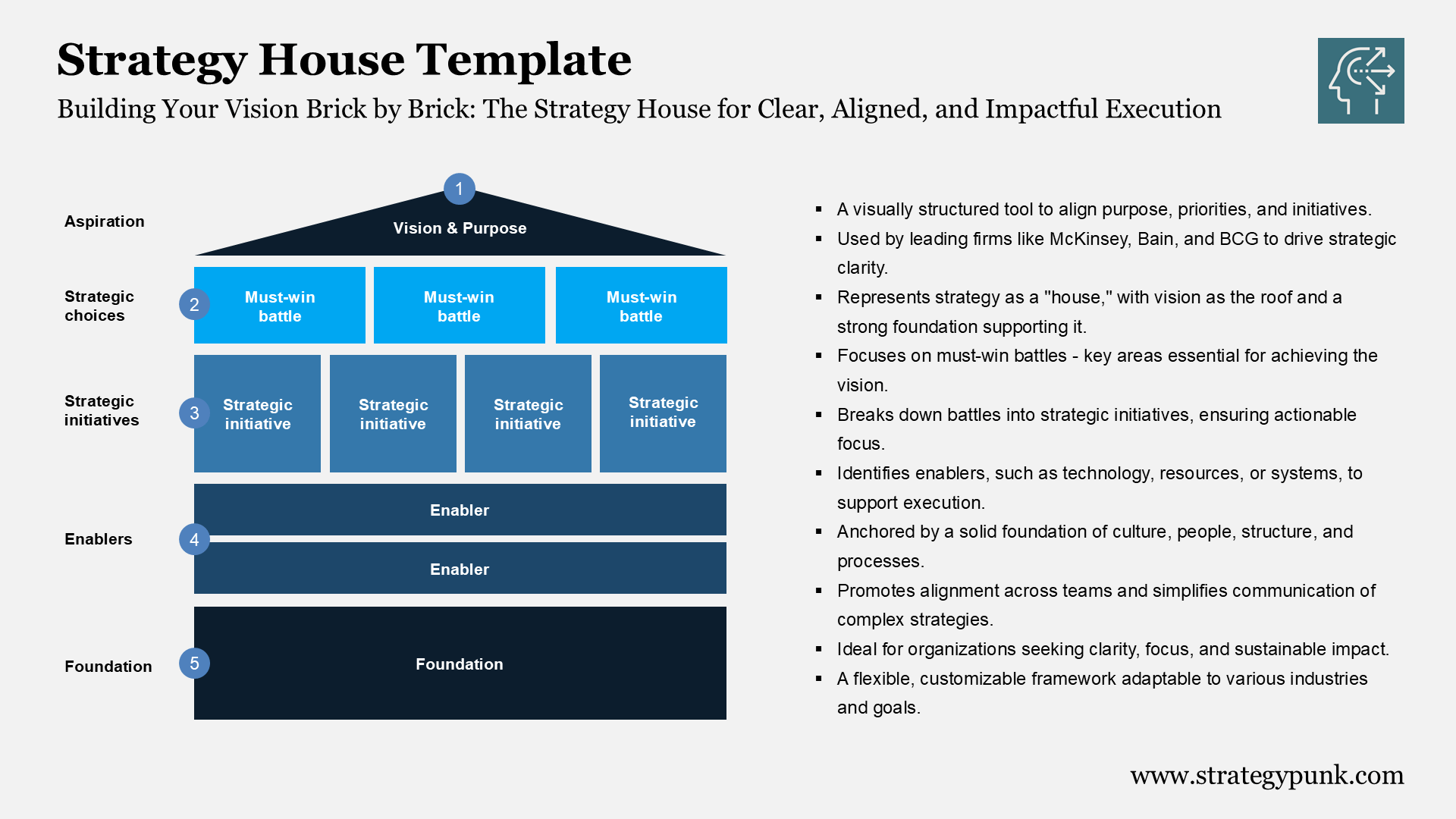
The Strategy House is a strategic framework that organizes a company’s overarching purpose & vision, key priorities, initiatives, and foundational enablers into a simple, visual structure resembling a house.
The "roof" represents the organization's vision and purpose, while the pillars and foundation beneath illustrate the key battles, initiatives, and enablers required to achieve that vision.
Leading consultants and strategy teams worldwide use the Strategy House to clarify, align, and communicate.
Why the Strategy House Works
Most strategy documents fail for one of two reasons. Either they are too abstract to act on, or they are a list of unrelated initiatives pretending to be a strategy.
The Strategy House solves both problems.
It forces you to answer four questions in sequence:
- What are we trying to achieve? The roof states the vision.
- Where will we focus? The pillars define the few must-win battles.
- What will we do? The sub-blocks list specific, measurable initiatives.
- What must be true for this to work? The enablers and foundation expose gaps in capability, technology, talent, or culture.
When built correctly, the Strategy House functions as a decision filter for the entire organization. Every new project, budget request, or opportunity gets tested against the house: Does this strengthen one of our pillars? Does it advance one of our initiatives? Do we have the enablers to execute it? If the answer is no, it is either a "not yet" or a "not us."
This is what separates a Strategy House from a strategy slide. The slide communicates. The house disciplines.
Breaking Down the Strategy House
The Strategy House consists of five key components, each with a distinct purpose:
1. Purpose and Vision (Roof)
The roof of the Strategy House defines the organization's overarching vision and purpose. This is the guiding north star for all activities and initiatives. It answers questions like:
- Why does the organization exist?
- What long-term goal are we striving to achieve?
2. Must-Win Battles (Pillars)
The "pillars" represent the must-win battles - critical strategic priorities or objectives the organization must focus on to achieve its vision. These are broad areas of focus, often tied to market opportunities, competitive positioning, or transformational goals.
Examples of must-win battles include:
- Expanding into new markets.
- Achieving operational excellence.
- Driving digital transformation.
3. Strategic Initiatives (Sub-Blocks)
Under each must-win battle, you’ll find specific strategic initiatives. These are actionable, measurable projects or efforts directly contributing to the must-win battles.
For instance:
- If the must-win battle is "Expand into new markets," strategic initiatives could include launching new products, establishing regional offices, or forging strategic partnerships.
4. Enablers (Beams)
The enablers are the supportive structures that underpin strategic initiatives. They provide the resources, technology, and systems required to execute initiatives effectively.
Typical enablers include:
- Digital and technology infrastructure.
- Financial investments.
- Cross-functional collaboration.
5. Foundation
At the base of the Strategy House is the organizational foundation - culture, people, structure, and processes. Without a strong foundation, even the best strategies risk collapse. This layer emphasizes:
- Building a strong and adaptive culture.
- Developing talent and leadership.
- Designing efficient structures and processes.
How to Use the Strategy House Framework
Here’s a step-by-step guide to implementing the Strategy House in your organization:
Step 1: Define Your Vision and Purpose
Start by articulating a clear and compelling vision that resonates with your organization. Ensure it aligns with your company’s values and long-term aspirations.
Step 2: Identify Must-Win Battles
Brainstorm and prioritize the critical areas where your organization must succeed. To maintain clarity and impact, limit these to three to five focus areas.
Step 3: Develop Strategic Initiatives
For each must-win battle, identify the specific initiatives that will drive success. Ensure these initiatives are actionable, measurable, and aligned with your vision.
Step 4: Determine Key Enablers
Assess what resources, technologies, or systems are necessary to execute your initiatives. Address potential gaps early to mitigate risks.
Step 5: Strengthen the Foundation
Evaluate your organizational culture, talent, and processes, and ensure they are equipped to support the execution of your strategy.
Step 6: Visualize and Share
Communicate your strategy to stakeholders in a clear, visually appealing format (such as the Strategy House template). Encourage feedback and foster alignment across teams.
A Worked Example: GreenTech Manufacturing
Roof (Vision): Become the top 3 European provider of sustainable packaging solutions by 2028, reaching EUR 200M revenue with 15% EBIT margin.
Pillar 1: Win in Food & Beverage Packaging
- Launch molded fiber product line for dairy segment (Q3 2025)
- Secure 5 anchor OEM customers with multi-year contracts
- Achieve cost parity with conventional plastics by 2027
Pillar 2: Build Operational Scale
- Commission second production line at Czech facility (Q1 2026)
- Reduce unit cost by 25% through process automation
- Implement a real-time quality monitoring system
Pillar 3: Lead on Sustainability Credentials
- Obtain EU Ecolabel and Cradle to Cradle certification
- Publish annual life cycle assessment for all product lines
- Build a recycled content supply chain with 3 verified partners
Enablers:
- EUR 40M capex facility investment (secured from parent company)
- ERP integration across all sites by Q2 2026
- Strategic partnership with the material science research institute
Foundation:
- Hire VP Operations and 12 production engineers
- Shift culture from project-based to process excellence
- Implement agile stage gate for new product development
This example shows what a completed house looks like. Every initiative traces to a pillar. Every enabler supports execution. The foundation addresses the required organizational changes. A blank house with no worked example leaves teams guessing. This removes the guesswork.
Pro Tips for a Successful Strategy House
- Keep it to one page. If it does not fit on one page, it is too complex. Simplify.
- Involve stakeholders early. The house is only useful if the people who execute it helped build it.
- Use it in meetings. Project the house in quarterly reviews. Reference it in resource allocation debates. Make it the operating system, not a document that lives in a shared drive.
- Pair it with a roadmap. The house shows what and why. A roadmap shows when and who. Together, they form a complete strategic operating model.
- Take inspiration from some of the best companies, like Siemens and Unilever, that have built powerful Strategy Houses to align and execute at scale.
Common Mistakes
Mistake 1: Using Pillars for Org Units
The most frequent misuse. Teams label pillars as 'Sales', 'Operations', 'R&D' and then each department fills in its own wish list. The result is not a strategy. This looks like a budget request presented as a framework.
Pillars should represent cross-functional outcomes. 'Win in the mid-market segment' cuts across sales, product, marketing, and operations. 'Sales' does not.
Mistake 2: Confusing Tactics with Strategy
A list of good ideas is not a strategy. If the house contains 20 initiatives per pillar with no filtering logic, it is a project portfolio, not a strategic framework.
The test: can you explain why initiative X is in the house and initiative Y is not? If you cannot, the strategic logic is missing.
Mistake 3: Ignoring the Enabler Layer
Teams spend 80% of their time on vision and initiatives, skipping the enablers entirely. Then they wonder why execution stalls. The enabler audit is where the Strategy House earns its value.
Mistake 4: Building Once and Filing
The Strategy House is a living document. Markets shift. Competitors move. New data arrives. Review the house quarterly. Update it when assumptions change. A house that does not evolve with the business is decoration, not strategy.
Mistake 5: A Vague Roof
"Be the best" is not a vision. "Grow profitably" is not a vision. The roof must be specific enough that the organization can measure progress against it. If the roof is vague, the pillars will be vague, and the initiatives will be a grab bag.
The Strategy House as a Decision Filter
The real power of the framework is not in building it. It is in using it.
Once the house is complete, every new request, every budget proposal, every urgent initiative gets filtered through three questions:
- Does this strengthen one of our pillars?
- Does it advance a specific initiative?
- Do we have the enablers to execute it now?
If the answer to all three is yes, proceed. If not, the request goes into a parking lot or gets rejected entirely.
This is what makes the Strategy House different from a strategy presentation. A presentation communicates intent. The house creates discipline. It gives leaders a shared language to say no without it feeling arbitrary.
Over time, the house also reveals strategic drift. If most new requests fall outside the pillars, either the market has shifted (and the house needs updating) or the organization is losing focus.
Where the Strategy House Fits in the Broader Strategy Toolkit
The Strategy House does not replace other frameworks. It synthesizes them.
Use Porter's Five Forces to analyze industry structure before defining pillars. Use the Win Growth Matrix to classify business units before deciding which ones get strategic investment. Use the Market Attractiveness vs Ability to Win Matrix to prioritize where to play. Then use the Strategy House to turn those choices into an executable, communicable one-page plan.
The house sits at the end of the analytical chain. It is the output, not the starting point.
FAQ
hat is a Strategy House??
The Strategy House is a one-page visual framework used by consulting firms like McKinsey, Bain, and BCG to structure and communicate organizational strategy. It organizes vision, must-win battles, strategic initiatives, enablers, and the organizational foundation into a single, coherent view.
How many pillars should a Strategy House have?
Three to five. Fewer than three, and the strategy lacks definition. More than five, and it becomes too complex for teams to internalize and act on. The discipline is in choosing the few battles that matter most.
What is the difference between the Strategy House and a strategic plan?
A strategic plan is typically a multi-page document covering analysis, objectives, tactics, and timelines. The Strategy House compresses the core strategic logic into one page. It is designed for communication and decision-making, not for detailed project planning. The two work best together.
How often should the Strategy House be updated?
Review quarterly. Update when a major assumption changes: a market shift, a competitive move, a capability gap discovered during execution. The house should reflect the current strategic reality, not the reality from the last offsite.
Can the Strategy House be used for a department or business unit?
Yes. The framework scales. A corporate Strategy House defines the enterprise-level vision and pillars. Business units and departments can build their own houses that cascade from and align with the corporate house. This creates strategic coherence across the organization.
What is the most common mistake when building a Strategy House?
Using organizational units (Sales, Marketing, R&D) as pillars instead of cross-functional strategic outcomes. This turns the house into a departmental wish list instead of an integrated strategy.
Download Your Free Strategy House PDF Template
To help you get started, we’re providing a free Strategy House PowerPoint template.
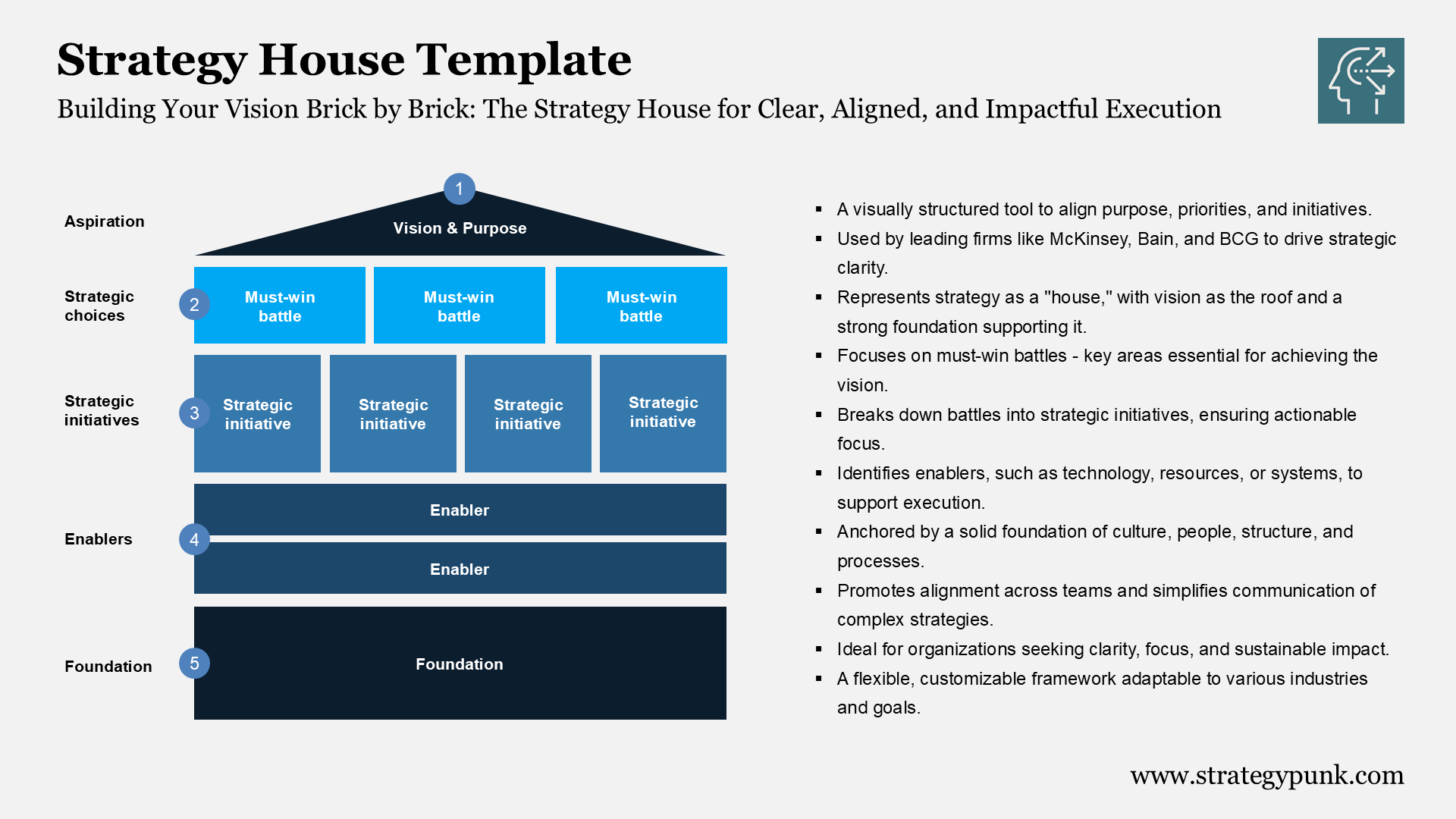
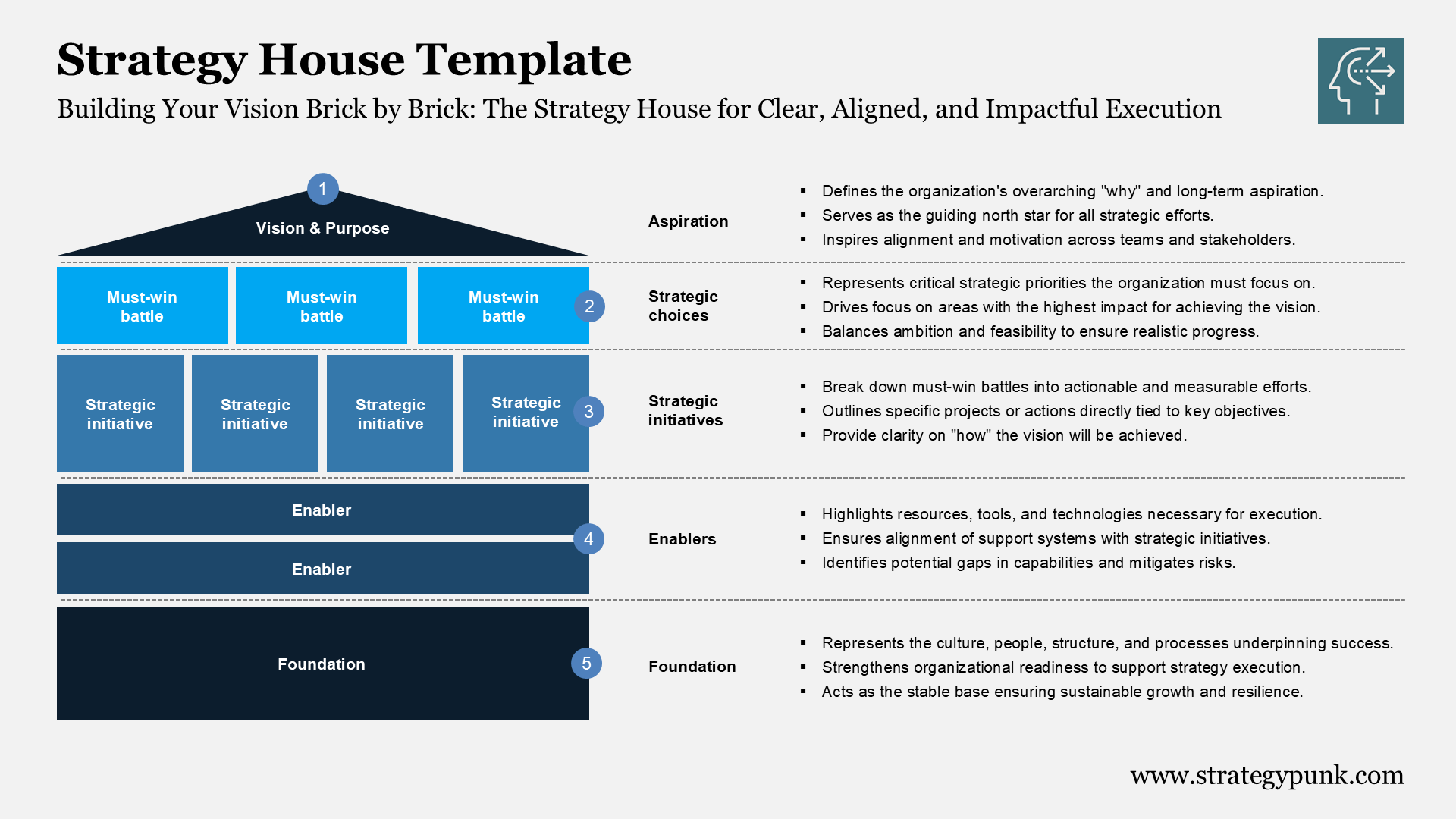
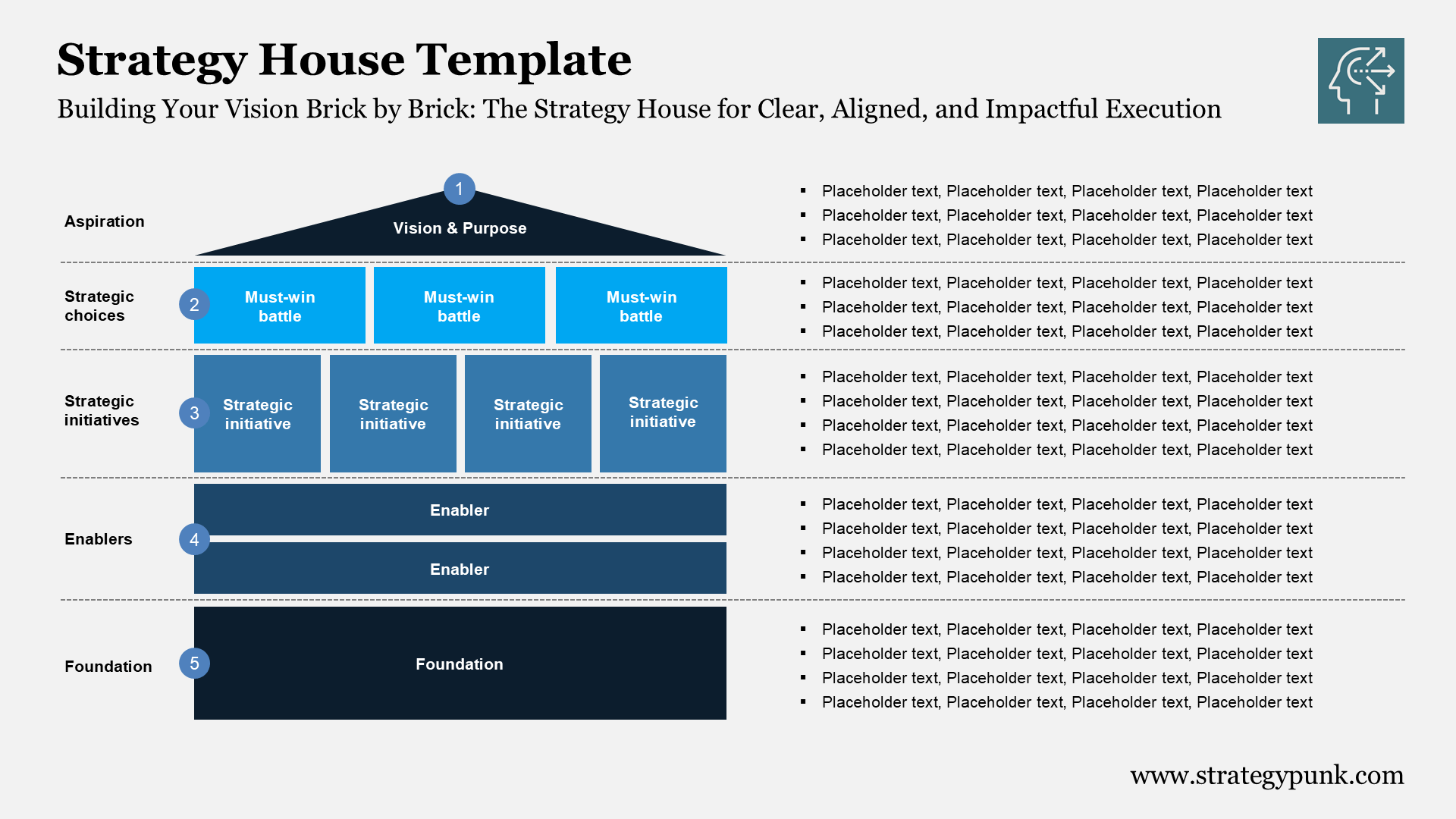
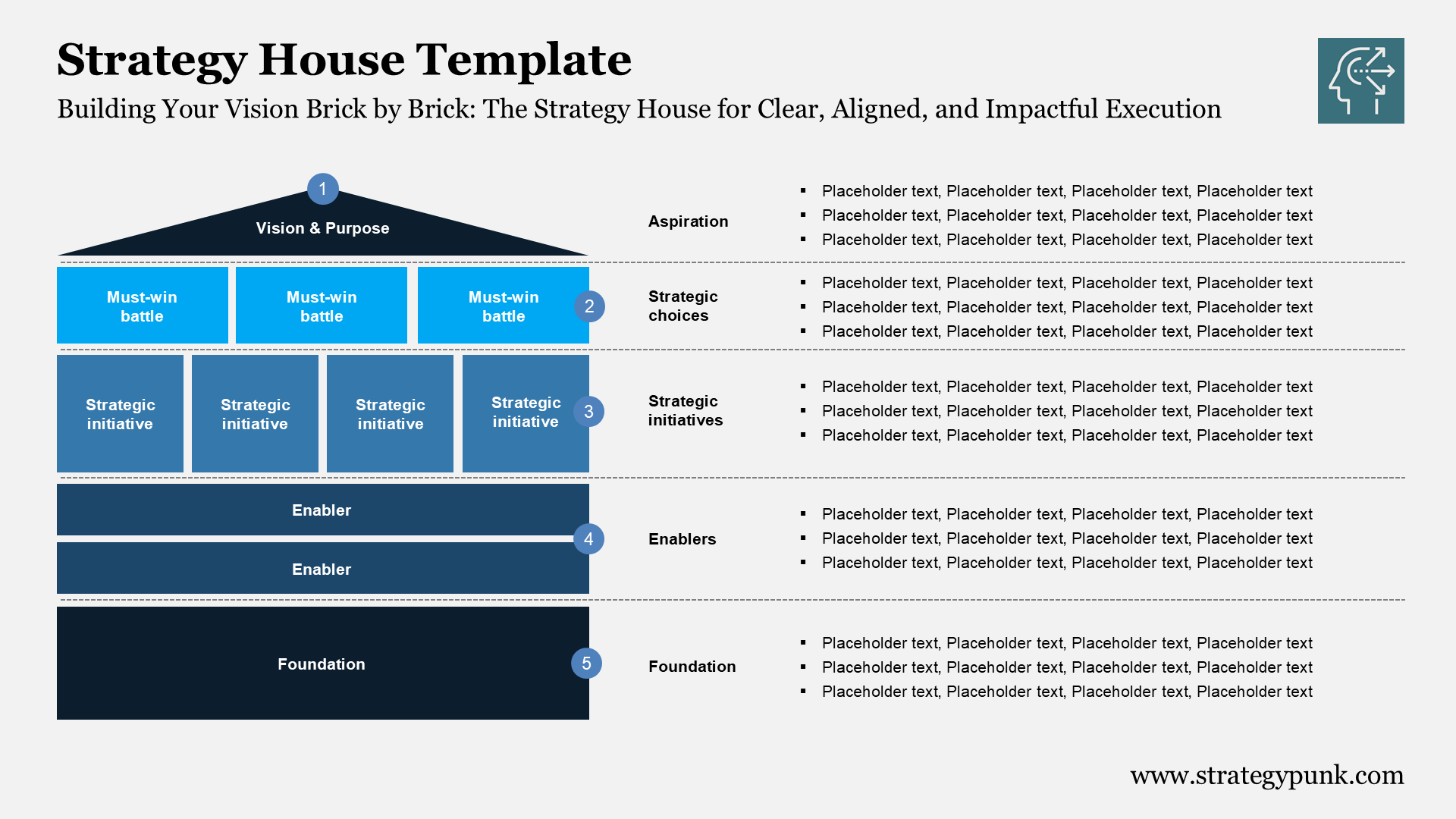
Free Strategy House template slide - PowerPoint and PDF, Editable Strategy House PPT template with blank pillars, etc.
This customizable template allows you to plug in your vision, must-win battles, initiatives, enablers, and foundation to create a strategy that resonates with your organization.