What makes a great leader? The HBR ABCs of leading innovation
The ABCs of leading innovation - Harvard Business Review Leadership Framework: Be an Architect, Bridger, and Catalyst. Free PDF download.

Great leaders inspire, challenge, and support those around them. Great leaders do this every day at work. Leadership is not a title or position but rather a set of authentic behaviors anyone can adopt at any point in their career.
Great leaders can see challenges as opportunities instead of roadblocks, build strong relationships with team members, and inspire trust and confidence in their teams.
So, what makes a great leader? Nowadays, it is less about setting direction and getting people to follow you to the future. It's about working with your team to co-create it, enabling you to be innovative and agile in today's dynamic world. If organizations are more elegant and creative than they are, they usually need more leadership.
Becoming a great leader isn’t something that happens overnight. It’s a process. Learn from Harvard Business Review's new ABCs of leadership: Architect, Bridger, and Catalyst by Linda A. Hill.
Linda A. Hill is a Harvard Business School professor and co-author of "Collective Genius: The Art and Practice of Leading Innovation.
How Leadership Has Evolved: From Strategy to Co-Creation
The concept of great leadership has fundamentally shifted over the past century. A hundred years ago, leadership was primarily about strategy — setting a clear direction and ensuring people followed it.
By the 1980s, influential thinkers like John Kotter and Warren Bennis moved the conversation toward vision, arguing that leaders needed a larger ambition beyond tactical execution.
Today, the game has changed again. While vision remains important, the rise of the innovation economy demands something different: shaping culture and capabilities. As Harvard Business School professor Linda A. Hill — co-author of Collective Genius: The Art and Practice of Leading Innovation — explains, modern leadership is less about getting people to follow you and more about getting them to co-create the future with you. This evolution is what gave rise to the ABCs of leadership.
A Great Leader Is an Architect
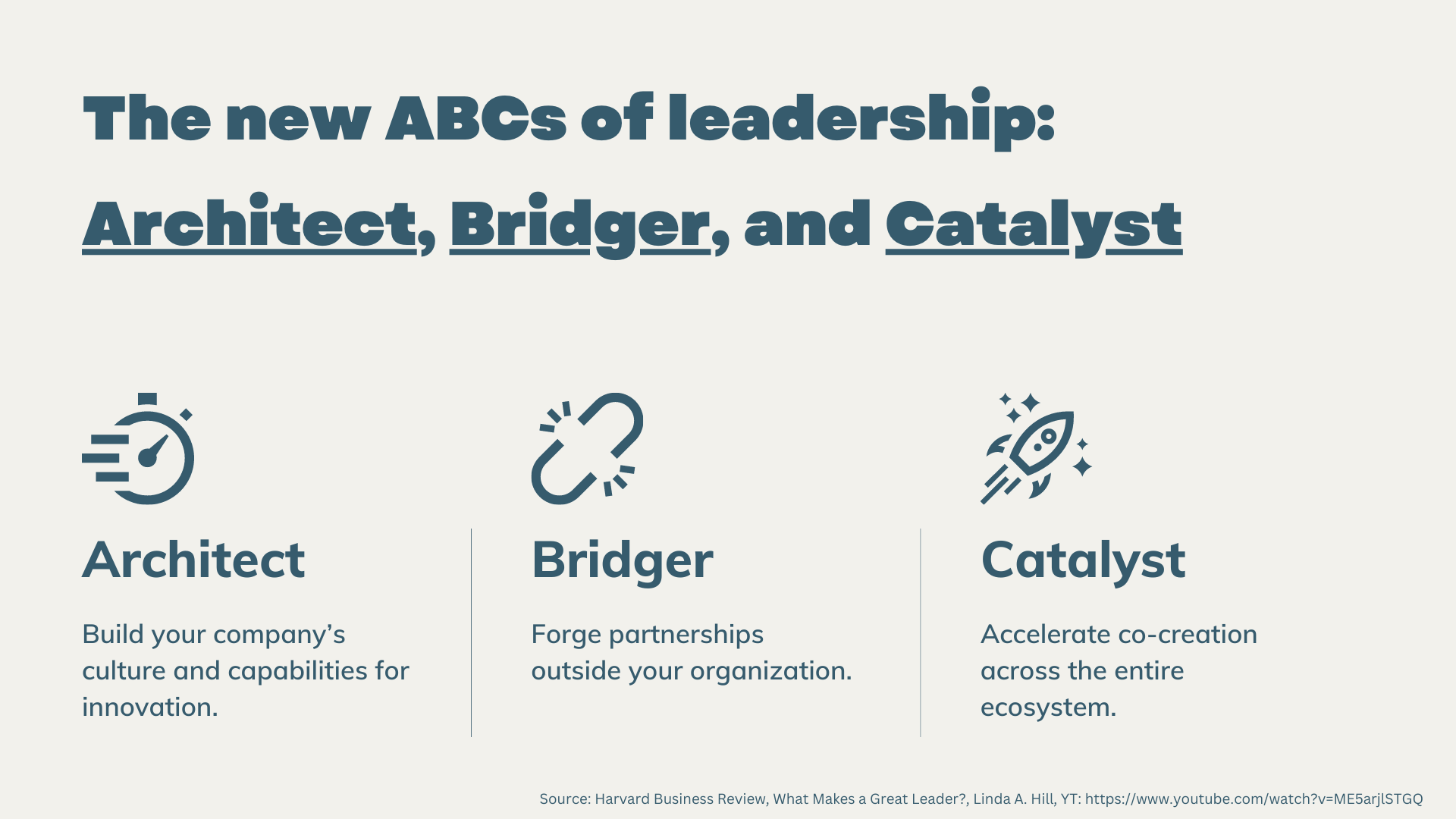
A great leader is an architect who builds up a company's culture and capabilities for innovation.
Innovation is not about a single person having an "aha" moment. It is all about collaboration between individuals with different expertise and knowledge. A leader who sees challenges as opportunities will inspire their team members to collaborate, experiment, and find creative solutions to problems (with some speed). A great leader will create an open, collaborative environment so their team members feel empowered to solve problems in the way that makes the most sense for their specific situation. The role of a great leader is to unleash collective genius and harness the diverse expertise in his team.
A Great Leader Is a Bridger
A great leader is a bridger who forges partnerships outside his organization.
A leader driving innovation goes outside the organization to access talent and tools. A great leader knows he needs all the skills and tools inside the organization to innovate at speed and scale. This is especially true in the digital space, where companies are typically embedded in interdependencies. A great leader focuses on his team's core capabilities and helps his team build strong relationships with external partners, leveraging their knowledge, skills, and strengths to maximize impact.
A Great Leader Is a Catalyst
A great leader is a catalyst who accelerates co-creation across the entire ecosystem.
A leader driving innovation ensures his partners innovate in ways that advance his purpose. We achieve this by building capabilities and competencies across the entire ecosystem. A great leader lifts the entire ecosystem so everyone benefits from the collaboration. Nobody is perfect, but an ecosystem can be.
The ABCs in Action: How Pfizer Achieved the Impossible
These three roles are not just theory. Linda Hill cites the leader of Pfizer's clinical trials as a powerful example of the ABC framework in practice.
As a Bridger, he transformed the company's relationship with its vendors — turning transactional arrangements into genuine partnerships built on deep connection, trust, and mutual commitment. The result? Pfizer completed clinical trials in just 266 days, a timeline previously considered impossible in the pharmaceutical industry.
He then stepped into the Catalyst role, working to form consortia across the industry to set new standards and collaborate with regulators. His ambition extended beyond Pfizer's walls — he wanted to lift the entire ecosystem so that breakthrough treatments could reach patients faster. This example shows how a single leader, operating as Architect, Bridger, and Catalyst, can produce results that no one organization could achieve alone.
Together, All Three Behaviors Create Great Leadership
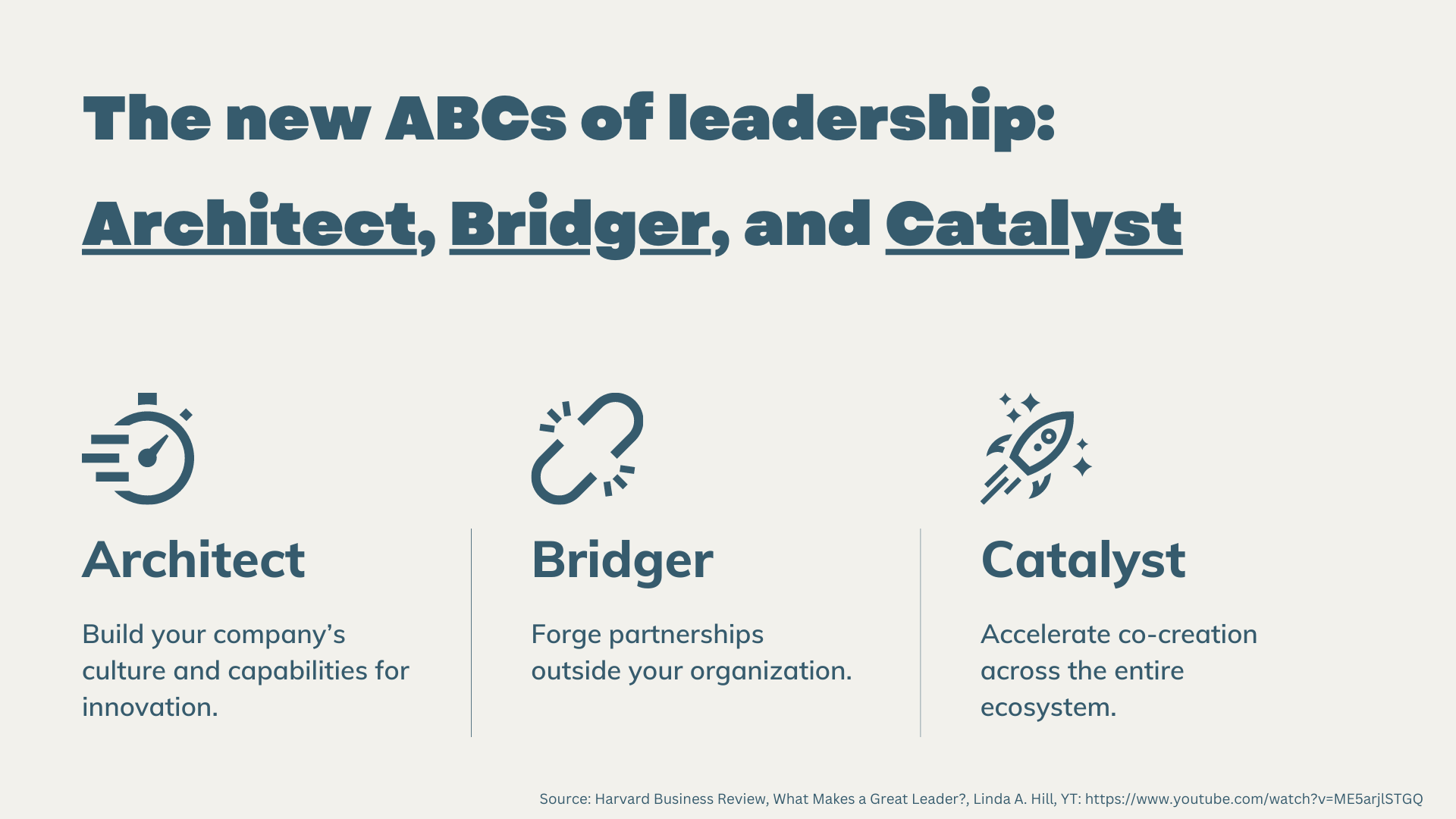
The ABCs - Architect, Briger, Catalyst - are very interconnected. When someone exhibits all three behaviors, they are a great leader. When we combine these three characteristics, a leader creates more capacity across the entire ecosystem to do more innovative work.
Organizations, therefore, have to look outside themselves to get what they need. This role requires new ways of thinking about power. New leaders don’t use formal authority as the source of power and influence. They shape culture, capabilities, and connections between diverse parties to create an environment of mutual trust and joint commitment. Leaders know they can’t force innovation. However, they work to build partnerships and encourage each partner to commit fully to achieving new, breakthrough innovations.
A New Kind of Power: Why Innovation Cannot Be Commanded
The ABC framework demands a fundamental shift in how leaders think about power. Traditional leadership relies on formal authority — but authority, while it can control behavior, cannot mandate the commitment that innovation requires.
Innovation involves significant risk. People must choose to take those risks voluntarily — no one can be ordered into creativity. This is why leaders who master the ABCs move beyond command-and-control. Instead, they shape culture, build capabilities, and connect diverse parties to create environments of mutual trust and shared commitment.
The leader's job is to help people move beyond what they should be doing and explore what they could be doing — to unleash the individual "slices of genius" within every team member and harness them for the collective good.
As Linda Hill puts it: "You cannot tell people to innovate. You can only invite them to. It is a voluntary act."
Watch the full Harvard Business Review: What Makes a Great Leader? Youtube Video.
YouTube
HBR ABCs Leadership Framework
Architect, Briger, Catalyst - Free PDF template
Download our HBR ABCs of leading innovation framework: Free PDF template.
What makes a great leader? The HBR ABCs of leading innovation
Architect, Briger, Catalyst Framework - Download the free PDF template
It's about working with your team to co-create it so you can