The FLOCKS Framework: How Sequoia's CEO Coach Spots Founders Worth Betting On
HubSpot co-founder Brian Halligan uses six traits to decide if a founder can build something durable. Here's what FLOCKS means — and the uncomfortable question it ends with.

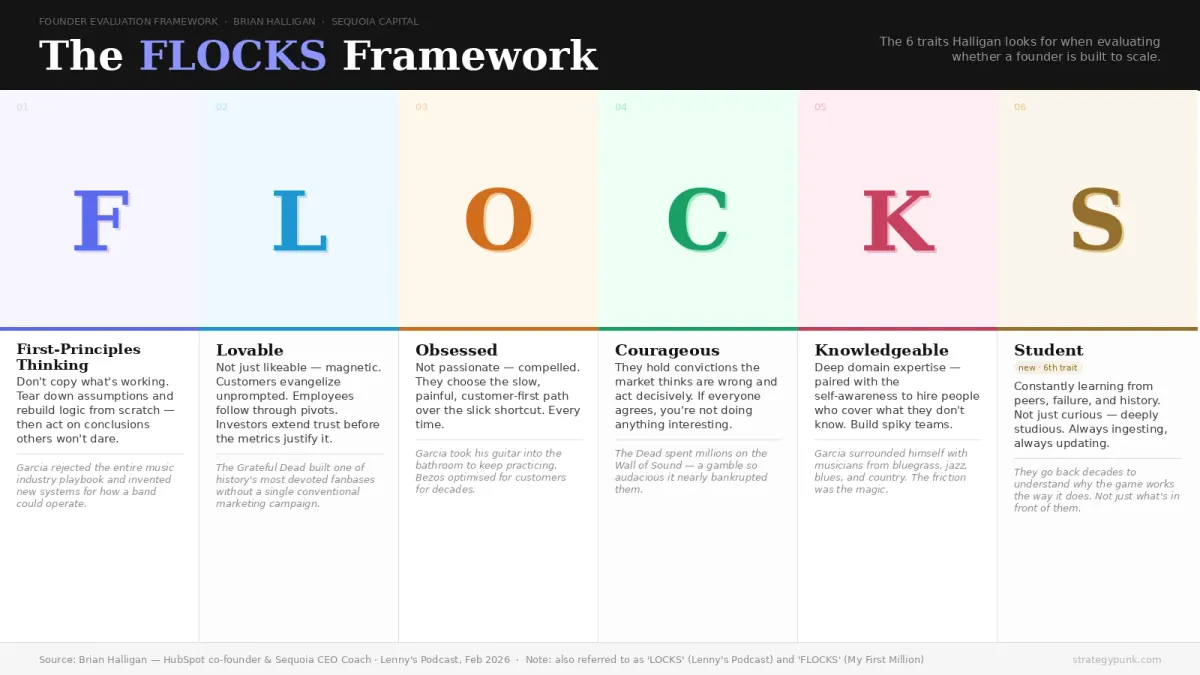
Most investor frameworks evaluate markets, traction, or business models. Brian Halligan evaluates the person. As HubSpot's co-founder and Sequoia's in-house CEO coach, he's developed a surprisingly simple mental rubric for spotting founders capable of building something durable.
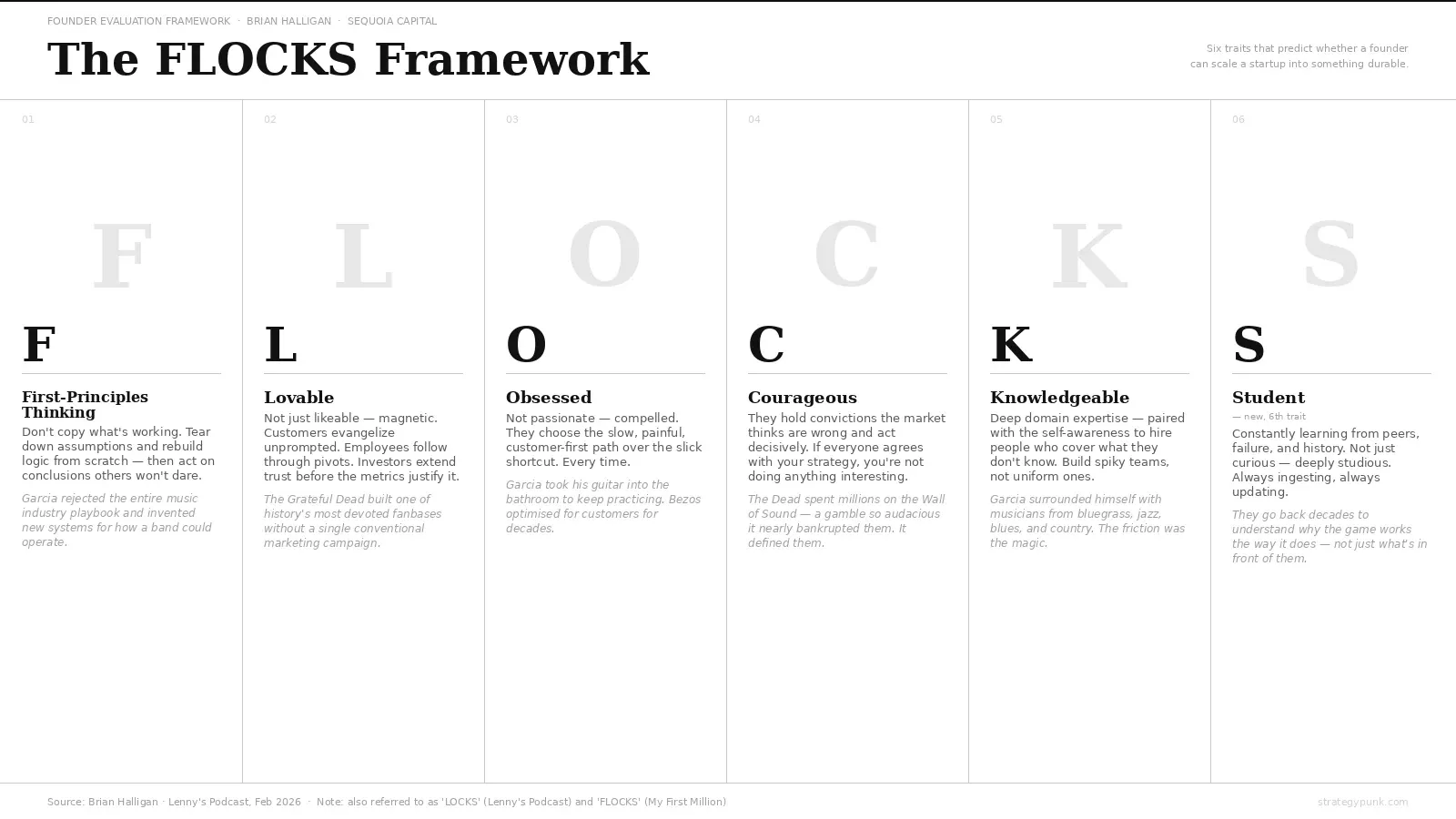
He calls it FLOCKS.
F — First-Principles Thinking
Great founders don't look at competitors' actions and iterate. They tear down assumptions entirely. Halligan's unlikely reference point: Jerry Garcia, who ignored the music industry playbook and invented entirely new systems for how a band could operate, distribute music, and build an audience.
The question to ask yourself: Why does this have to work the way everyone assumes it does?
L — Lovable
This goes beyond being well-liked. Halligan means genuinely magnetic — the kind of founder who attracts customers who evangelize without being asked, employees who'd follow them through a pivot, and investors who extend trust before the metrics justify it.
The Grateful Dead never ran a conventional marketing campaign. They built one of the most fanatical fanbases in history through authentic connection. Founders who are lovable don't have to sell nearly as hard.
O — Obsessed
Not passionate. Obsessed. There's a difference. Garcia took his guitar into the bathroom to keep practicing. Bezos chose the slow, painful, customer-first path over the slick, margin-maximizing shortcut — for decades.
Halligan looks for founders who feel compelled, not just motivated. Obsession is what sustains the mission when the market doesn't cooperate.
C — Courageous
The Dead spent millions building the Wall of Sound — a custom speaker system so ambitious it nearly bankrupted the band. No one else would have tried it. That's the point.
For founders, courage means holding a conviction the market thinks is wrong and acting on it anyway. Halligan has noted that HubSpot's early bet on inbound marketing was a good idea precisely because it was polarizing.
"You're onto a good idea if it's a little bit polarizing."
If everyone agrees with your strategy, you're probably not doing anything interesting.
K — Knowledgeable
Deep domain expertise — but paired with the self-awareness to know its limits. Garcia surrounded himself with musicians from completely different traditions: bluegrass, jazz, blues, and country. The friction between them was the source of the magic.
Halligan gives founders the same advice. The temptation is always to hire people like you. But innovation comes from "spiky" teams — complementary, not uniform.
S — Student
This is the sixth trait Halligan added, expanding the framework from FLOCK to FLOCKS. He describes the best founders as "students of the game" — not just curious, but deeply curious.
These are leaders who study history, learn from peers, and mine their own failures for signal. Halligan compares them to LLMs: constantly ingesting, constantly updating. The best ones don't just learn from what's in front of them — they go back decades to understand why the game works the way it does.
The FLOCKS framework is useful precisely because it ignores the things most pitch decks try to sell you on — addressable markets, growth curves, competitive moats. Halligan is asking a simpler, harder question: Is this person built to go the distance?
Which raises an uncomfortable question for anyone building or backing companies right now: if you ran yourself through FLOCKS honestly, which letter would you give yourself the lowest score on?
FLOCKS Framework PDF Guide
HubSpot co-founder Brian Halligan has spent years coaching the fastest-growing CEOs at Sequoia. When he evaluates a founder or CEO, he uses a six-trait framework he calls FLOCKS.
It's not about traction or market size. It's about the person. Are they reasoning from first principles or copying convention? Are they lovable enough to attract missionaries, not mercenaries? Are they obsessed in the way that sustains a mission through years of resistance?
Download the PDF GUIDE below for a quick reference for anyone building or backing companies.
Sources
Sequoia Capital’s Secret "FLOCK" Framework For Founders (Credits: My First Million)
The Lenny's Podcast episode from February 15, 2026 (link) appears to be calling it LOCKS — likely a renaming or slight reformulation of the same underlying idea.