Amazon's 7 Step Innovation Framework: How a $638B Company Operates Like a Startup (2026 Update)
Amazon grew from $89B to $638B in a decade. The engine behind that growth is a 7 step innovation framework Andy Jassy first outlined in his 2021 shareholder letter. Three years and three more letters later, the framework has evolved.

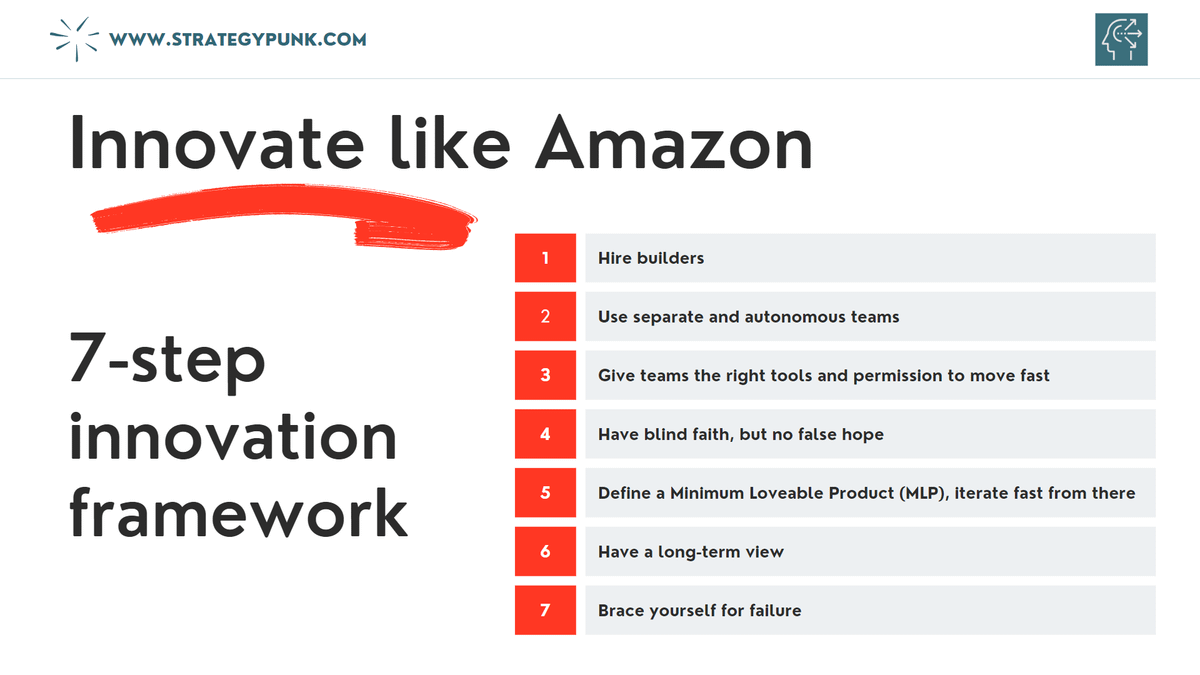
Amazon is a $638 billion company with over 1.5 million employees. It should be slow. It should be political. It should be drowning in approvals.
Instead, Andy Jassy wants it to operate like the world's largest startup.
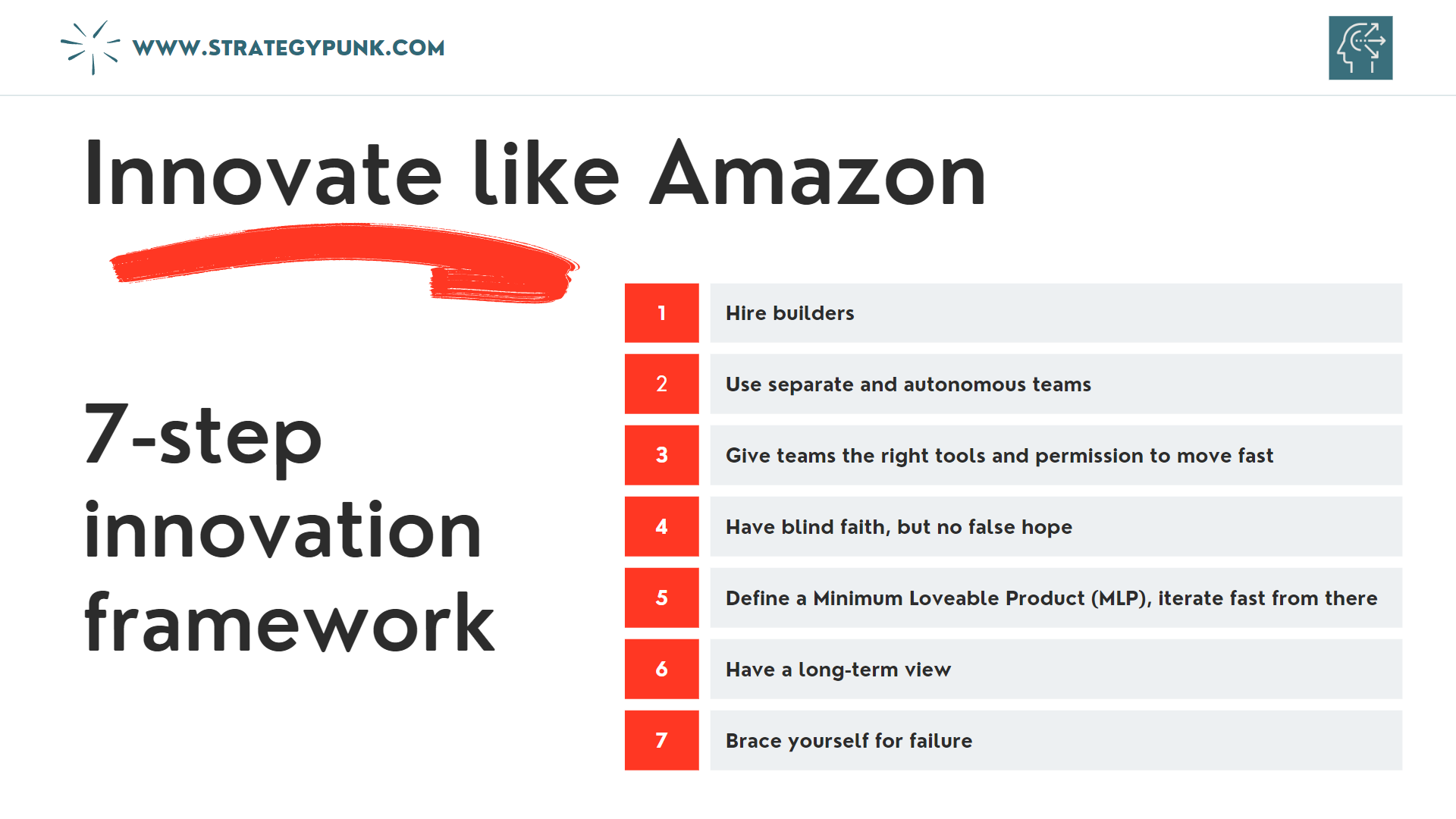
In his 2021 shareholder letter, Jassy outlined a 7-step innovation framework that describes how Amazon builds, launches, and iterates on new products. That original framework was strong. But in the three shareholder letters since then (2022, 2023, 2024), Jassy has added layers that make the framework sharper, more concrete, and more applicable to teams outside Amazon.
This post covers the full updated framework. Each step includes the original principle, what Jassy has added since 2021, a real Amazon example, and a takeaway for your own organization.
You can download the updated framework template in PowerPoint, PDF, and Google Slides at the end of the post.
The Operating System: Amazon's "Why Culture" (YQ)
Before the seven steps, you need to understand what sits underneath all of them.
In his 2024 shareholder letter, Jassy introduced a concept he calls "YQ," short for "Why Quotient." It describes a culture of relentless curiosity. The willingness to challenge the status quo by asking why things are the way they are and why they cannot be different.
YQ is not a new step. It is the cultural operating system that makes all seven steps work. Without institutional curiosity, builders stop building. Autonomous teams become siloed. Speed becomes recklessness. Long term bets get killed by short term pressure.
Every principle below is an expression of YQ in action.
The 7 Steps
1. Hire Builders
Original principle: Seek people who are curious, eager to create, and who keep asking "why can't it be done?"
What Jassy added (2024): In his latest letter, Jassy elevated "builder" from a job description to a leadership philosophy. He warned against leaders who stop learning. At a certain point, some leaders seem to lose their thirst to learn. It is hard to know the reason in each case, but it is as if some people find it too exhausting, too time-consuming, or too threatening not to have all the answers. The day a leader stops learning is the day they begin to lose relevance.
Jassy also connected hiring builders to a specific leadership principle: "Are Right a Lot." This does not mean the person whose idea wins. It means someone who seeks diverse perspectives, works to disconfirm their own beliefs, and treats disagreement as fuel rather than friction.
Amazon example: Amazon now employs over 1,000 people focused exclusively on generative AI applications. The team behind Rufus (Amazon's AI shopping assistant) was assembled from a mix of search engineers, ML researchers, and retail operators. It was not built by recruiting AI specialists alone. It was built by finding builders across disciplines who shared a common obsession: making product discovery feel like a conversation.
Takeaway: When you interview, test for curiosity and discomfort tolerance, not just domain expertise. Ask candidates to describe a time they changed their mind on something important. The answer reveals more than any technical test.
2. Organize Builders into Separable, Autonomous Teams
Original principle: Concentrate a team of builders on a single problem or customer. Single-purpose teams outperform shared resource teams.
What Jassy added (2024): The structural dimension became much more explicit. Jassy mandated a 15% increase in the ratio of individual contributors to managers across all senior leadership teams by Q1 2025. Fewer managers means fewer layers. Fewer layers mean faster decisions. He was specific about the dysfunction he wanted to eliminate: pre-meetings for pre-meetings of decision-making meetings, and large numbers of managers who feel they need to review an issue before it moves forward.
Amazon example: Amazon Stores now operates with over 21,000 AI agents deployed across the organization, achieving $2 billion in cost savings and a 4.5x increase in developer velocity. This only works because teams own their domains end-to-end. A centralized approval structure would have made it operationally impossible to deploy 21,000 AI agents.
Takeaway: Count how many people need to approve a decision in your organization. If it is more than two for a reversible decision, you have a structure problem, not a people problem.
3. Give Teams the Right Tools and Permission to Move Fast
Original principle: Allow teams to make two-way door (reversible) decisions themselves. Set an expectation that speed matters.
What Jassy added (2024): Jassy sharpened this into a philosophical statement. Speed is a leadership decision. The leadership team has to believe it is a priority, reinforce it constantly, organize and remove structural barriers, and build in modular ways that enable pace. Speed does not happen unless the entire company and culture embrace it.
He also introduced a powerful mechanism: the Bureaucracy Mailbox. Jassy created an internal email alias that allows any Amazon employee to flag unnecessary processes, excessive rules, or bureaucratic friction. By September 2025, the mailbox had received approximately 1,500 emails, and Amazon had changed about 455 processes based on that feedback. Examples include eliminating redundant approval chains, simplifying procurement workflows, and removing reporting requirements that no one actually reads.
Amazon example: During Prime Day 2025, the Rufus AI shopping assistant scaled to 80,000 Trainium and Inferentia chips, processing 3 million tokens per minute. Customers using Rufus were 60% more likely to complete purchases. That kind of elastic scaling under pressure requires teams that can move without waiting for permission. It requires tooling, infrastructure, and trust to all be in place before the event, not scrambled together during it.
Takeaway: Create your own version of the Bureaucracy Mailbox. Give your team a channel (Slack, email, anonymous form) to report processes that slow them down. Review it monthly. Kill or simplify at least two processes per quarter. The act of asking signals that speed matters to leadership.
4. Have Blind Faith, But No False Hope
Original principle: New ideas often get rejected because they have not been done before. Amazon validates ideas through customer feedback loops and teams that challenge each other.
What Jassy added (2024): The Press Release / FAQ mechanism received its most detailed public description yet. The Press Release is intended to ensure that what the team proposes to build is remarkable to customers. It forces the question: would a customer actually find this interesting? The FAQ is designed to force hard questions about which customers will use this capability, what they will like most, what they will be most disappointed with, why the launch line is drawn where it is, why it is better than current alternatives, how pricing should be structured, and why the team made the architectural decisions they made.
This is the core tension of Step 4. "Blind faith" means you believe the customer problem is real and solvable, even when others are skeptical. "No false hope" means you pressure-test the solution relentlessly before building it.
Amazon example: Project Kuiper (now Amazon Leo) is a satellite internet constellation requiring billions in capital investment. Amazon committed to this bet despite Starlink's massive head start. That takes blind faith. But Amazon did not just throw money at it. They wrote the press release. They answered the hard questions. They mapped the specific customer segments (rural connectivity, enterprise IoT, emerging markets) where the product would need to win on day one. By late 2025, the first production satellites were in orbit, and the enterprise preview was live.
Takeaway: Before greenlighting any significant initiative, write the press release first. Not a pitch deck. A press release, written as if the product has already launched. If it does not sound exciting to the customer you are targeting, the idea is not ready.
5. Define a Minimum Loveable Product (MLP) and Iterate Fast
Original principle: Launch products that are good enough to be loved from day one. Iterate quickly from there. This is why Amazon calls it an MLP, not an MVP.
What Jassy added (2023 and 2024): The MLP concept became more nuanced as Amazon began applying it to AI products, where "lovable" is harder to define. Rufus launched in early 2024 with known limitations. About 33% of shoppers reported inaccurate recommendations in its first year. Amazon did not wait for perfection. They shipped, measured, and improved. By 2025, accuracy had improved by 20%, conversion rates had increased by 12%, and 250 million customers were using the assistant.
The lesson: "loveable" does not mean "flawless." It means the core experience solves a real problem well enough that users want to come back, even when the edges are rough.
Amazon example: Amazon's AI content tools for third-party sellers followed the same pattern. The first version was basic. Sellers could generate product descriptions using AI, but the output was generic and often needed heavy editing. Amazon iterated on the underlying models, added category-specific training data, and integrated brand-tone controls. Each iteration shipped fast. Each iteration was better than the last. By early 2026, the tools had become a core part of the seller workflow.
Takeaway: Define "lovable" before you build. What is the one thing this product must do so well that users forgive everything else? If you cannot articulate that, you are not ready to build. Once you can, ship and fix in public.
6. Adopt a Long-Term Orientation
Original principle: Transformational invention takes multiple years. Be in it for the long haul.
What Jassy added (2024): Jassy put numbers behind the philosophy. He pointed out that AWS revenue was $4.6 billion just 10 years ago. In 2024, it was $108 billion. That is 23x growth, but only visible if you held the bet for a decade. He framed the current $100 billion annual capital expenditure plan for AI infrastructure in the same terms. The returns will not appear in the next quarter. They will appear over the next decade.
He also addressed the tension directly: during periods of unusually high demand, such as the current AI wave, you deploy a lot of capital. AI chips are much more expensive than CPU chips. Investors and employees see the spending before they see the returns. Maintaining conviction during that gap is what separates long-term orientation from a slogan.
Amazon example: Amazon's investment in custom silicon (Trainium and Inferentia chips) started years before the current AI boom. While competitors relied on Nvidia GPUs, Amazon was designing purpose-built chips that would eventually be 40% more cost-effective for training large language models. That bet only pays off if you start building before the market demands it.
Takeaway: Identify your organization's 10-year bet. What capability are you building today that will not generate returns for 3 to 5 years? If you cannot name one, you are optimizing the present at the expense of the future. If you can name one, but it keeps getting cut in budget reviews, your long-term orientation is a slogan, not a commitment.
7. Brace Yourself for Failure
Original principle: If you invent a lot, you will fail more often than you wish. Secure great landing places for team members who deliver well on failed projects.
What Jassy added (2022 to 2024): The failure principle became more honest as Jassy's cost-cutting era unfolded. Amazon laid off over 27,000 corporate employees and killed multiple Bezos-era projects, including Amazon Books, the Alexa office push, and Amazon Drive. These were not quiet sunsets. They were public acknowledgments that big bets sometimes do not pay off.
Jassy framed this as necessary pruning. The company had been prone to overbuilding during the pandemic. Some initiatives were not going to reach the scale or margin profile needed to justify continued investment. Cutting them freed resources for the best that were working, particularly AI and cloud infrastructure.
The harder lesson for leaders: failure is not just about tolerating it in your team. It is about having the discipline to recognize it in your own decisions and act on that recognition publicly.
Amazon example: Amazon's foray into physical retail with Amazon Go stores was a high-profile experiment that did not scale as expected. The "Just Walk Out" technology worked, but the unit economics did not support rapid expansion. Amazon pulled the cashierless technology from its Fresh grocery stores in 2024, replacing it with smart shopping carts. They did not pretend the original approach was working. They adapted.
Takeaway: Create a quarterly ritual where your leadership team reviews one initiative that is not working and makes an explicit decision: double down, pivot, or kill. The ritual matters more than the outcome of any single review. It normalizes the conversation about failure before failure becomes a crisis.
What Changed: The 2021 Framework vs. the 2026 Framework
The original 7 steps were principles. What Jassy has added since then are mechanisms.
A principle says, "move fast." A mechanism creates a Bureaucracy Mailbox that processes 1,500 employee reports and eliminates 455 bottlenecks.
A principle says "hire builders." A mechanism changes the IC-to-manager ratio by 15% to ensure builders are not buried under layers of management.
A principle says, "Have blind faith." A mechanism forces every team to write a press release and FAQ before writing a single line of code.
The difference between a company that talks about innovation and one that actually innovates is not in the principles. It is the mechanisms that make the principles unavoidable.
How AI Extends the Framework
One thing that was not in Jassy's 2021 letter and now dominates every subsequent one: AI is not a separate strategy. It is infrastructure that amplifies every step of the innovation framework.
Builders now have AI coding assistants that deliver a 4.5x increase in developer velocity. Autonomous teams can deploy AI agents without waiting for a centralized ML team to allocate resources. The Rufus shopping assistant lets Amazon iterate on customer experience at a pace that was impossible with manual merchandising. Long-term bets like custom silicon (Trainium, Inferentia) and foundation models (Nova) are compounding advantages that only grow over time.
For your organization, the question is not whether to use AI. It is where AI can remove the bottlenecks that prevent your teams from progressing through these seven steps more quickly.
Amazon's 7-step innovation framework
free template in PowerPoint, PDF, and Google Slides format
Subscribe and sign in to download the free, fully editable Amazon Innovation Framework template in PowerPoint, PDF, and Google Slides format.