The Corporate Athlete Framework: 6 Key Takeaways for Leaders
Most executives manage time. The best ones manage energy. The Corporate Athlete Framework by Loehr and Schwartz explains why. Here are 6 key takeaways from the performance pyramid. Includes a free PDF strategy guide.

Why the Best Executives Train Like Athletes (And Why You Should Too)
You manage your calendar down to the minute. You optimize workflows, delegate ruthlessly, and squeeze every ounce of productivity from your day. Yet by 3 PM, you're running on fumes, making reactive decisions, and wondering where your edge went.
Here's the uncomfortable truth: you've been optimizing the wrong thing. Time management is a ceiling. Energy management is a multiplier.
That's the central insight behind the Corporate Athlete Framework, developed by sports psychologists Jim Loehr and Tony Schwartz and first published in their landmark Harvard Business Review piece, "The Making of a Corporate Athlete."
Their argument is simple but radical: the demands placed on executives are at least as intense as those on professional athletes, yet almost no one in business trains systematically for sustained performance.
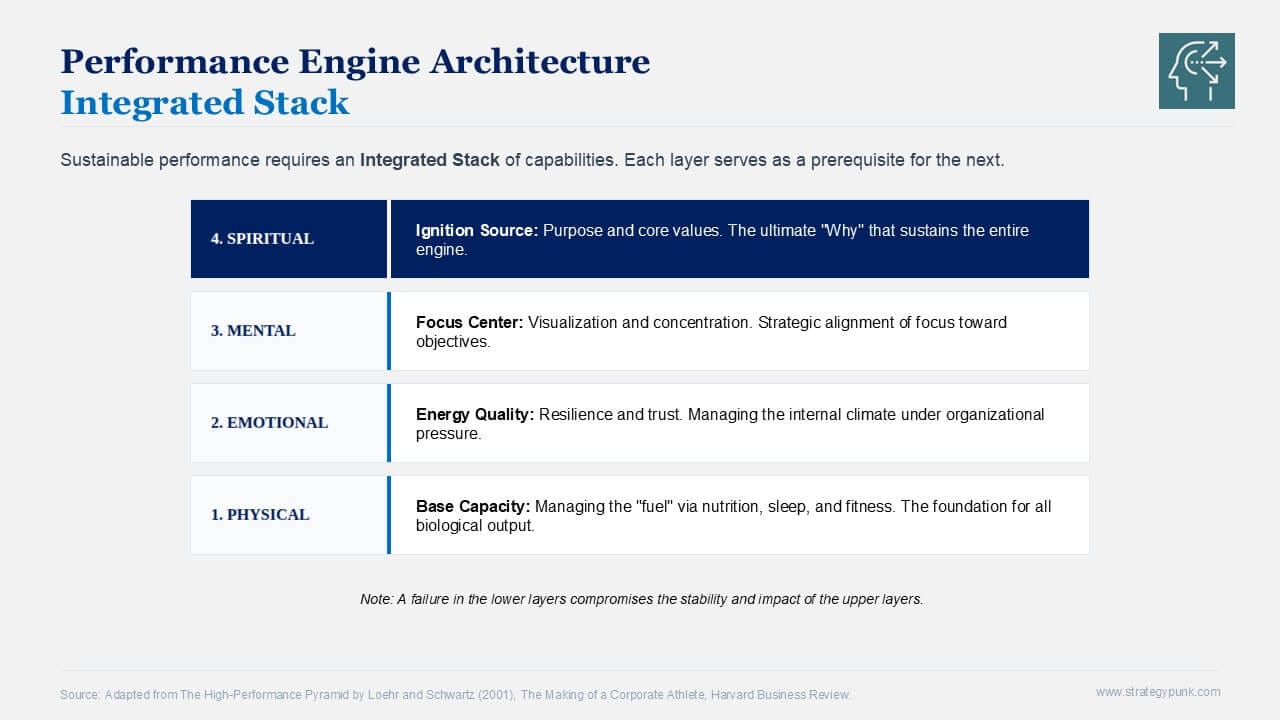
The framework is built on a four-layer performance pyramid. Each layer supports the one above it, and a crack in any foundation compromises everything higher. Here are the six most important takeaways, including a deep look at each layer of that pyramid.
Dive into our full collection of leadership frameworks.
 StrategyPunk
1. You Have an Energy Problem, Not a Time Problem
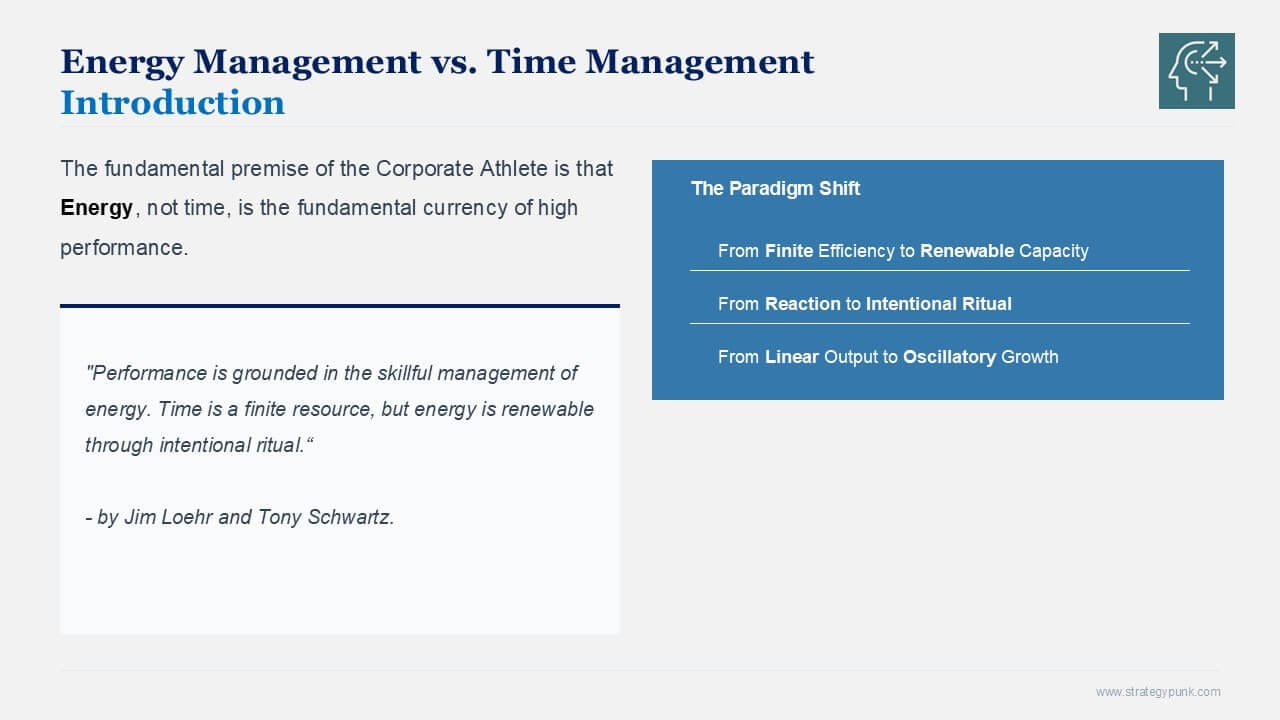
Most performance systems focus on efficiency. Do more in less time. The Corporate Athlete Framework flips that logic entirely.
The bottleneck isn't hours in the day. It's the quality of energy you bring to those hours. A distracted, depleted executive sitting through a two-hour strategy session produces less value than a focused, energized one in 45 minutes.
"Performance is grounded in the skillful management of energy. Time is a finite resource, but energy is renewable through intentional ritual." — Jim Loehr and Tony Schwartz.
The paradigm shift is threefold: from finite efficiency to renewable capacity, from reaction to intentional ritual, and from linear output to oscillatory growth. Stop asking "how do I fit more in?" and start asking "how do I show up with more capacity?"
2. Physical Capacity: Biology Is Strategy
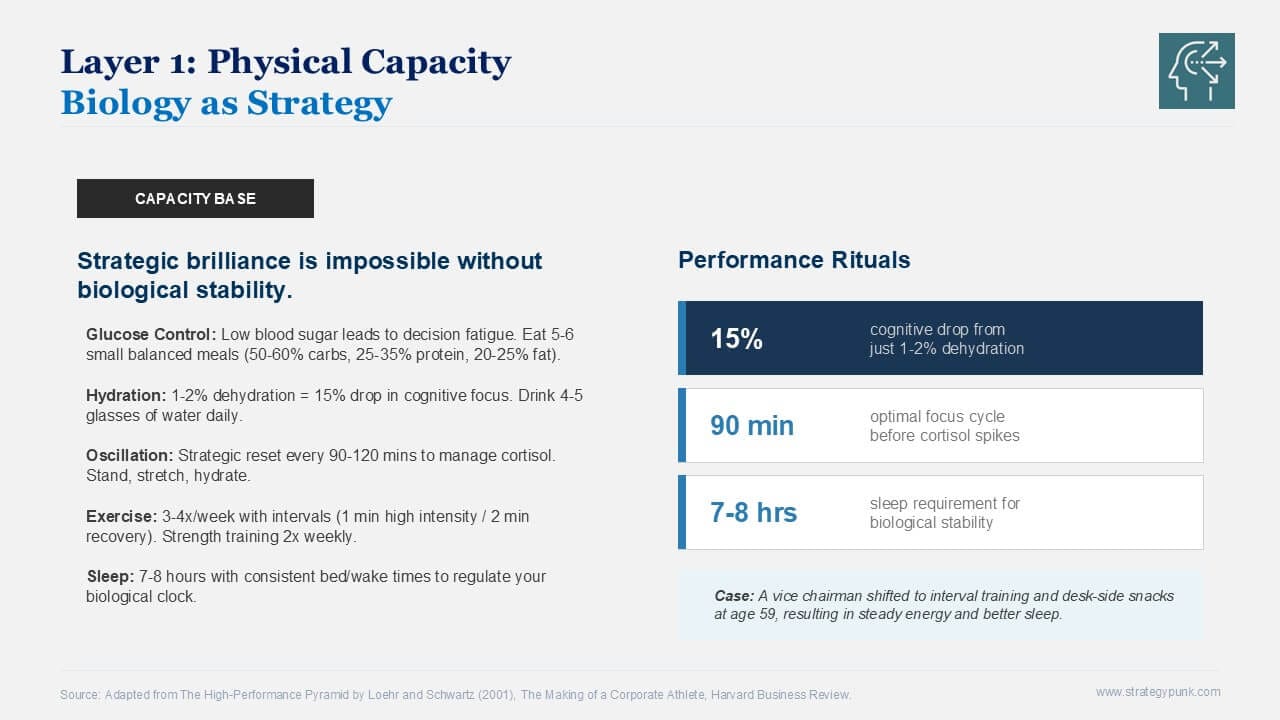
The base of the pyramid isn't strategic thinking or emotional intelligence. Its physical capacity: nutrition, exercise, sleep, and hydration. The framework calls this "managing the fuel," and the supporting data are difficult to dispute.
Consider: just 1-2% dehydration correlates with a 15% drop in cognitive focus. Low blood sugar leads directly to poor impulse control and decision fatigue. These aren't wellness talking points. They're performance variables that most leaders ignore while obsessing over dashboard metrics.
The specific protocols are practical. Eat five to six small balanced meals daily, roughly 50-60% complex carbs, 25-35% protein, and 20-25% fat. Always include breakfast. Drink four to five glasses of water daily, even when you're not thirsty. Exercise three to four times per week with interval training: one minute of high intensity followed by two minutes of recovery, plus strength training twice weekly.
Sleep seven to eight hours with consistent bedtime and wake times to regulate your circadian rhythm. Take recovery breaks every 90 to 120 minutes to manage cortisol spikes. Stand up, stretch, hydrate, and eat a small snack. Track your habits gradually, increasing intensity by 5-10% weekly.
None of this requires a personal chef or a home gym. It requires consistency. One vice chairman in the original HBR case studies shifted to interval training and desk-side snacks at age 59, resulting in steady energy and markedly better sleep.
3. Emotional Capacity: The Quality of Your Energy Matters
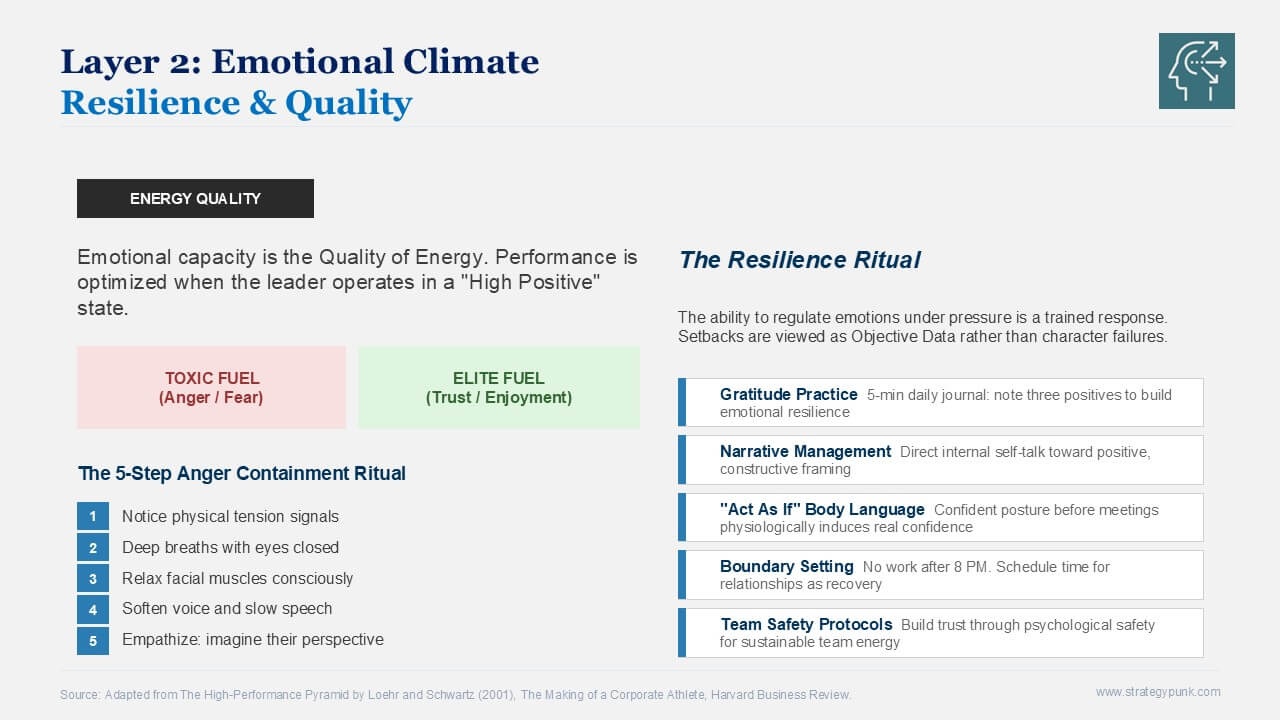
Physical energy gets you in the game. Emotional energy determines how you play it. The framework treats emotional capacity as the "quality of energy," and performance is optimized when a leader operates in what Loehr and Schwartz call a "High Positive" state: trust, enjoyment, and optimism rather than anger and fear.
The key insight here is that emotional regulation under pressure is a trained response, not a personality trait. Setbacks are reframed as objective data rather than character failures. That distinction alone changes how leaders process adversity.
The rituals are specific. There's a five-step anger containment protocol: notice physical tension, take deep breaths with eyes closed, relax facial muscles, soften your voice, and slow your speech, then empathize by imagining the other person's perspective. There's "act as if" body language: standing tall with a confident posture before meetings to induce real confidence physiologically.
Use music during breaks to shift from analytical to intuitive thinking. Set clear boundaries, such as no work after 8 PM. Start a daily gratitude journal, five minutes, three positives. Schedule time for relationships because social connection is a recovery mechanism, not a distraction from work.
One executive in the original research used the anger ritual to reduce outbursts, becoming a measurably more effective leader with improved team satisfaction scores.
4. Mental Capacity: Protect Your Focus Like a Strategic Asset
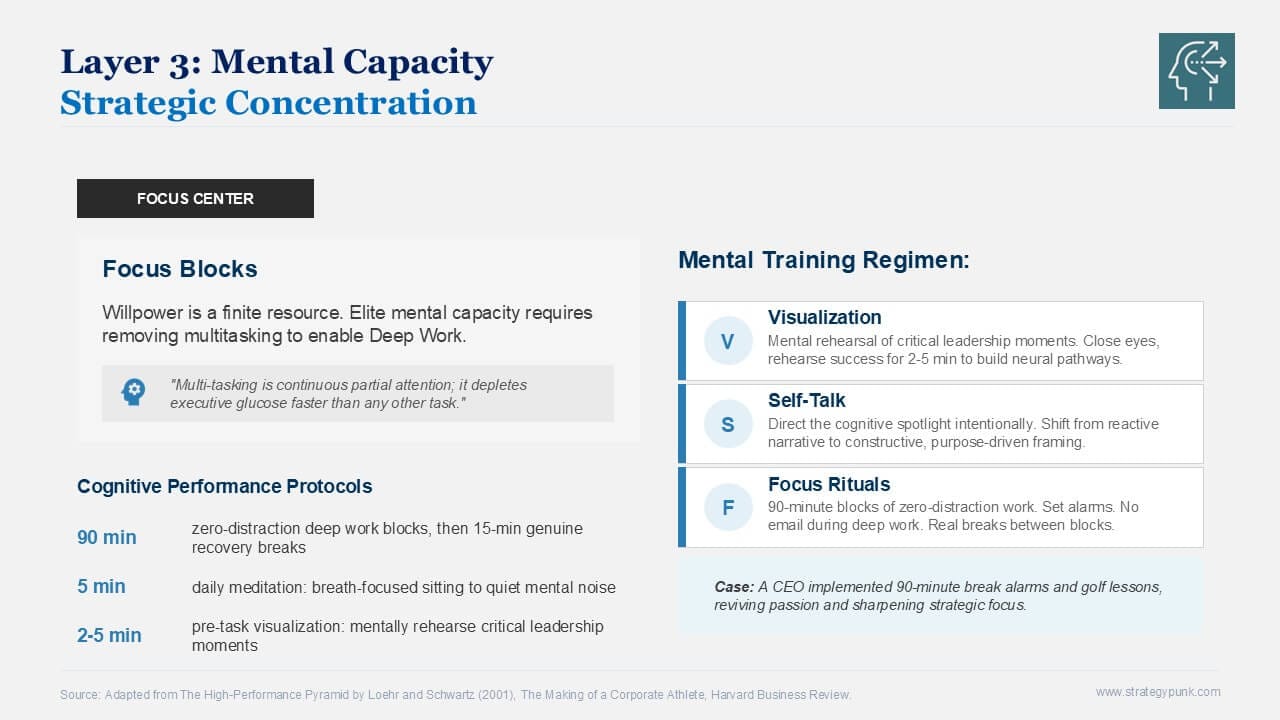
Willpower is a finite resource. The framework's mental layer is built on this premise, and its implications are significant: multitasking isn't a productivity strategy; it's a performance destroyer. It depletes executive glucose faster than almost any other cognitive activity.
Elite mental capacity requires removing distractions to enable deep work. The protocols are based directly on how elite athletes train their concentration.
Work in 90 to 120-minute cycles, then take genuine 15-minute breaks. Not email breaks. Real breaks: deep breathing in a quiet space, a short walk outdoors, or brief meditation. Use visualization before key moments. Close your eyes and mentally rehearse success for two to five minutes. This builds neural pathways, just as athletes visualize race performance.
Meditate daily, even if it's just five minutes of breath-focused sitting. Break large projects into smaller tasks and time-block 90 minutes for your most important work. Establish no-work zones: commit to weekends off, or restructure schedules to reclaim discretionary time.
A CEO in the case studies implemented 90-minute break alarms and took up golf lessons. The result was no less output. It was a sharper focus on strategic issues and a revived sense of passion for the work.
5. Spiritual Capacity: Purpose Is the Ultimate Energy Multiplier
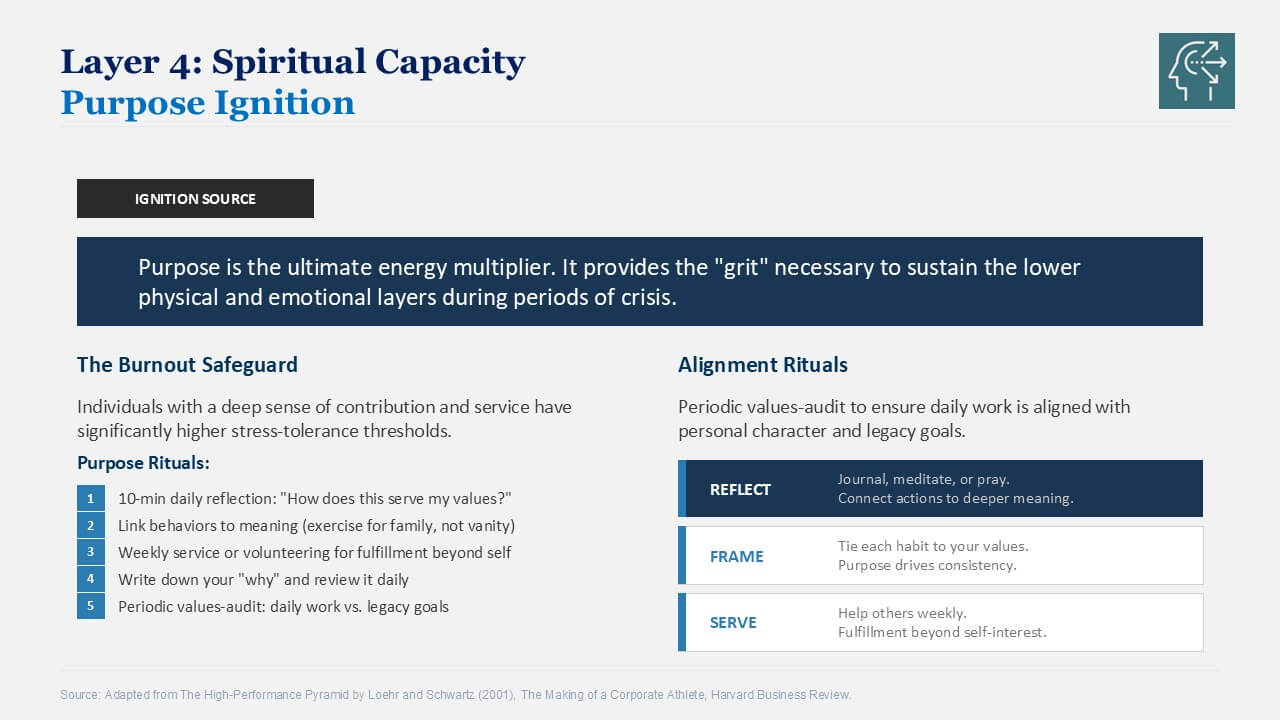
The apex of the pyramid is spiritual capacity, and it is unrelated to religion. It's about purpose. The framework positions it as the "ignition source," the ultimate "why" that sustains every other layer.
This is the layer most executive development programs skip entirely. But the research is compelling: individuals with a deep sense of contribution and service have significantly higher stress-tolerance thresholds. Purpose provides the grit necessary to sustain the physical and emotional layers during periods of crisis.
The rituals here are reflective. Spend 10 minutes daily journaling, meditating, or simply asking: "How does today's work serve my values?" Link behaviors to meaning. Frame exercise not as vanity, but as energy to support loved ones. Incorporate service, volunteering, or helping others weekly to tap into fulfillment beyond self-interest.
Create a purpose reminder. Write down your core values and how your work connects to them. Review it daily. Run periodic "values audits" to ensure your daily actions continue to align with your personal character and legacy goals.
One stockbroker in the original studies began pausing in a park during his commute to affirm his family priorities. He reduced his work hours while simultaneously boosting his productivity. That's not a paradox. That's alignment.
6. Rituals Beat Willpower Every Time
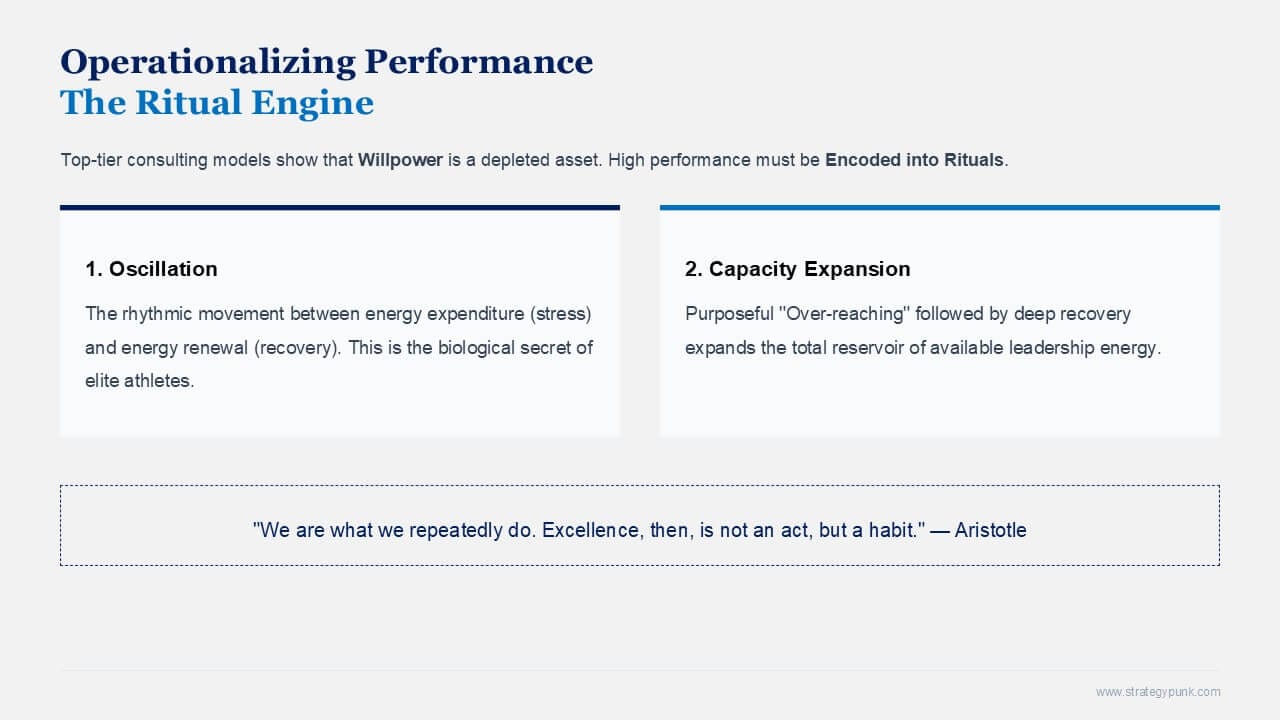
The mechanism that holds the entire framework together isn't motivation or discipline. It's rituals: precise, consciously designed behaviors that become automatic over time.
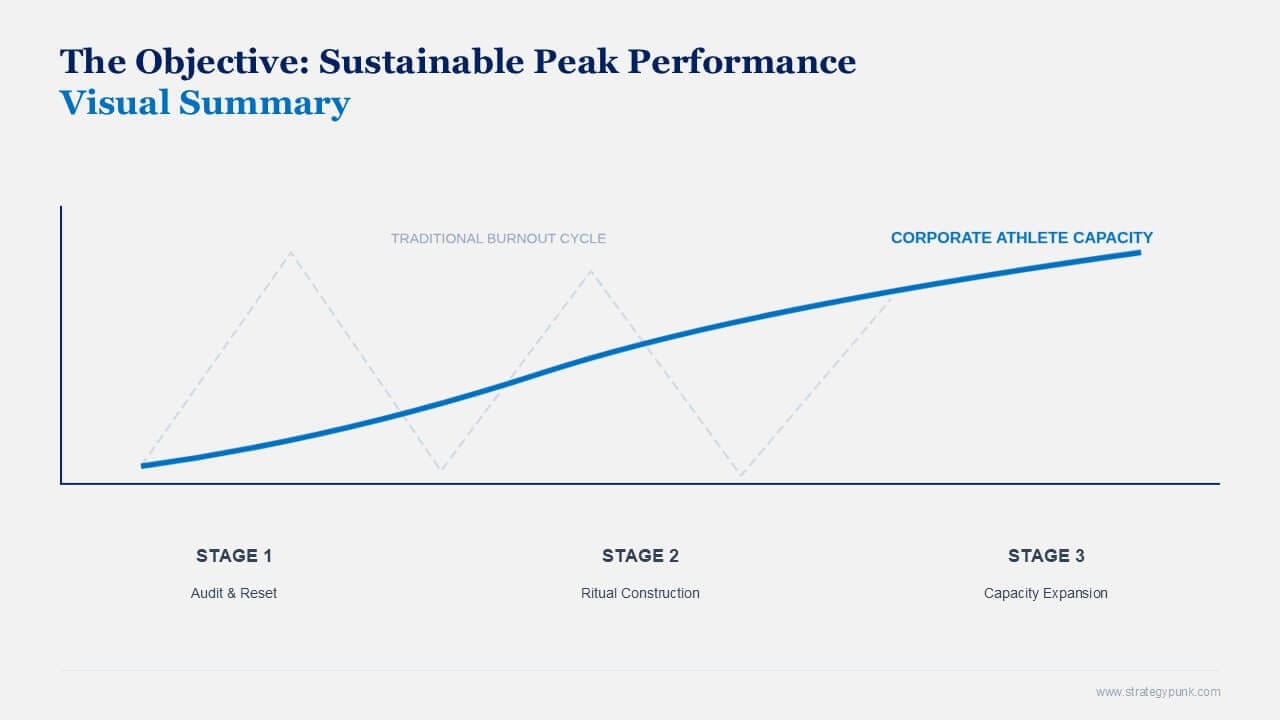
The framework's implementation follows three stages. First, an audit and reset to identify your biggest energy leaks across the four layers. Second, ritual construction, where you design specific, time-bound behaviors to address those leaks. Third, capacity expansion, where you purposefully "over-reach" followed by deep recovery to grow your total energy reservoir over time.
The principle of oscillation, alternating between stress and recovery, is the biological secret borrowed from elite sport. Traditional corporate life is a flat line of sustained stress. The Corporate Athlete approach replaces that with rhythmic cycles that build capacity rather than deplete it.
"I'll exercise more" fails. "I walk for 20 minutes at 12:15 PM every weekday" succeeds. Specificity is everything.
Action audit: Ready to optimize?
The Corporate Athlete Framework isn't a wellness program dressed up in business language. It's a performance architecture. And its core premise remains as relevant today as when it was first published: the human being is the ultimate instrument of performance, and that instrument needs systematic training and recovery to operate at its best.
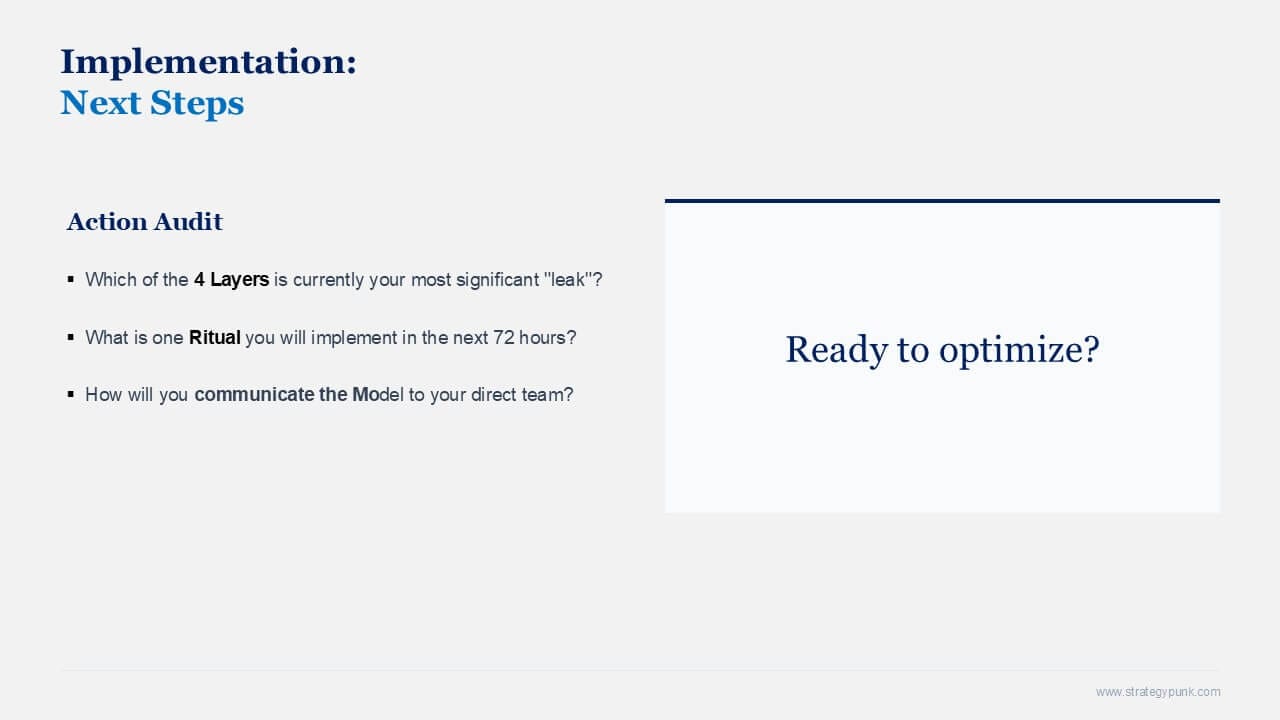
Here's the question worth considering: which of the four layers is currently your most significant leak, and what is one ritual you will implement in the next 72 hours?
Relevant Resources
Here are key resources for exploring the concept further, including foundational articles, books, and posts:
- Articles and Summaries:
- "The Making of a Corporate Athlete" by Jim Loehr and Tony Schwartz (Harvard Business Review, 2001): The seminal piece outlining the framework, with practical examples.
- Books:
- The Corporate Athlete by Jack Groppel: Provides fitness and nutrition tips for professionals, with principles like patience, persistence, and perfect practice.
- The Power of Full Engagement by Jim Loehr and Tony Schwartz (related work expanding on the framework's energy management ideas).
- Additional Discussions:
- Podcast on strategies for excelling as a corporate athlete.
Download the Corporate Athlete Framework PDF Guide
We've distilled the complete Corporate Athlete Framework into a practical, presentation-ready PDF guide you can use with your team or keep as a personal reference.
What's inside the guide:
- The full Performance Pyramid with all four layers explained
- Specific rituals and protocols for physical, emotional, mental, and spiritual capacity
- Key data points (cognitive impact of dehydration, optimal focus cycles, macro ratios)
- The 3-stage implementation methodology (Audit, Ritual Construction, Capacity Expansion)
- Ready-to-use slides you can drop into your next leadership offsite or team workshop