Does Your Strategy Contradict Itself? The Strategic Coherence Matrix Worksheet
Most strategy documents fail not because the individual choices are wrong, but because the choices contradict each other. The Strategic Coherence Matrix is a one-page cross-check that tests whether your strategic decisions reinforce or undermine each other. Free PPTX worksheet included.

Your Strategy Has a Hidden Contradiction. Here Is How to Find It.
Most leadership teams walk out of a strategy offseason with five or six decisions they feel good about. Each one makes sense on its own. Each one passed the smell test. And yet, six months later, the organization is pulling in three directions at once.
The problem is rarely the individual choices. The problem is that nobody checked whether those choices actually work together.
That is what the Strategic Coherence Matrix does. It is a simple cross-check tool that forces you to evaluate every pair of strategic choices for reinforcement, neutrality, or conflict. It takes 30 minutes. It will save you a year of organizational friction.
What Makes a Strategic Choice Real
Before you can test coherence, you need real strategic choices to test.
A real strategic choice is not "we value quality" or "customer first." Those are platitudes. Nobody wakes up and chooses the opposite. A real strategic choice picks one smart option over another smart option, and accepts the consequences of that pick.
"Cohesive all-in-one UX over extensible ecosystem" is a real choice. Apple Notes chose one side. Obsidian chose the other. Both are successful. Both are loved. The choice forces trade-offs that ripple through product, support, hiring, and pricing.
If both sides of your choice are not viable strategies for successful companies, you have not made a decision. You have written a motivational poster.
The Hidden Failure Mode: Locally Smart, Globally Broken
Here is where most strategy work stops. The team picks five choices that each pass the test individually and calls it done.
But strategy is not a list. It is a system.
"Small team" is smart. "Feature-rich product" is smart. Put them together, and you have a conflict. A small team cannot build, maintain, support, and evolve a feature-rich product. Not sustainably. Not without burning people out or letting quality collapse.
A strategic choice is a package deal: you don't get advantages without weaknesses.
The failure hides in the second-order effects. "Small team" implies limited build capacity. "Feature-rich" demands broad build capacity. The first-order logic checks out. The second-order consequences collide. And nobody notices until engineering is drowning and the product is frustrated.
How the Strategic Coherence Matrix Works
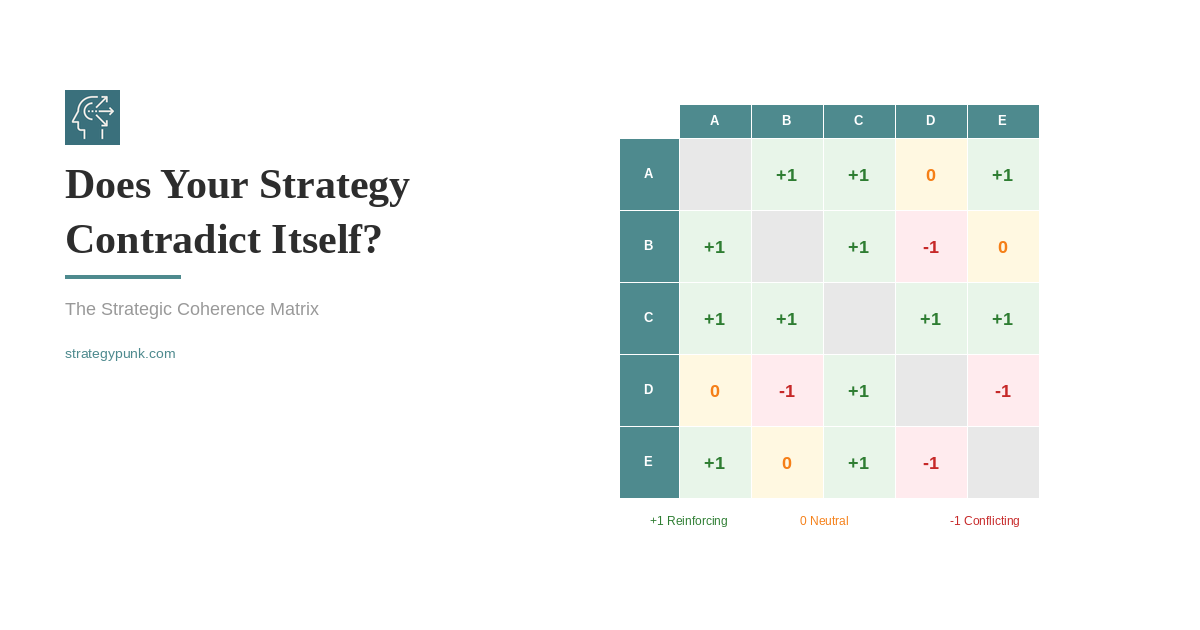
The matrix is simple. List your strategic choices on both axes. Then score every pair with one of three values.
+1 Reinforcing. These choices make each other stronger. "Cohesive all-in-one UX" reinforces "fewer, better features." Each decision constrains the scope, freeing the team to polish what remains — the choices compound.
0 Neutral. No meaningful interaction. Neither helps nor hurts. This is fine, but it is also a missed opportunity. The best strategies have very few neutral pairs.
-1 Conflicting. These choices create tension. "Minimal support" and "enterprise complexity" are classic conflicts. Enterprise buyers expect phone numbers, SLAs, and dedicated account managers. A minimal support model cannot deliver that.
Once you score every pair, the matrix gives you a coherence score. Positive means your strategy interlocks. Zero means your choices are independent but not compounding. Negative means you have structural contradictions embedded in your strategy.
What to Do With the Results
A conflict in the matrix does not automatically mean one choice is wrong. It means you need to do one of three things.
First, you can resolve the conflict by introducing a third choice that bridges the gap. "Small team" conflicts with "feature-rich." But add "extensible ecosystem" and the conflict dissolves. A small team builds a small core. Third-party plugins deliver the breadth. The three choices now reinforce each other.
Second, you can remove one of the conflicting choices. If "minimal support" and "enterprise sales" both made the list, one of them probably does not belong. Pick the one that fits the rest of your bundle.
Third, you can accept the tension deliberately. Some strategies involve an internal conflict that the team actively manages. That is fine, as long as itis documented and we're aware of it, not discovered six months later when two VPs are at war over resource allocation.
The goal is not a perfect score. The goal is awareness. Conflicts you know about are manageable. Conflicts you do not know about are the ones that fracture execution.
Try It With Your Team
Take your current strategic choices. List them in the template. Score every pair. You will almost certainly find at least one conflict you had not articulated.
The best strategy is not the one with the smartest individual choices. It is the one where every choice makes the others stronger. That is coherence. And coherence is what turns a strategy document into an operating system for the entire company.
Download the free Strategic Coherence Matrix template and run the exercise with your leadership team.