The 3 Traits That Separate Resilient CEOs from the Rest
Most leadership advice focuses on what CEOs should do. But the leaders who last longest share something less visible. They think differently about discomfort, ego, and the breadth of their own experience. Three patterns emerged that most leadership content ignores entirely.

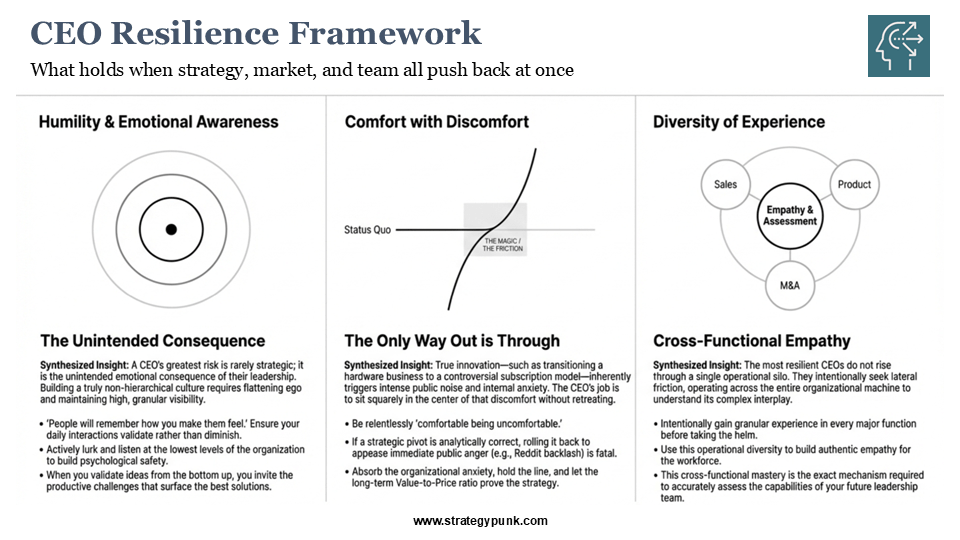
Most leadership advice focuses on what CEOs should do. Strategy frameworks. Decision trees. Prioritization matrices. But the leaders who survive the longest and build the most durable companies share something less visible. They think differently about discomfort, ego, and the breadth of their own experience.
After synthesizing research on CEO resilience, three patterns emerged that most leadership content ignores entirely. They form a psychological and experiential framework for navigating what I call the messy middle of leadership: the stretch between having a bold vision and seeing it materialize.
1. Your Greatest Risk Is Not Strategic. It Is Emotional.
CEOs obsess over competitive threats, market shifts, and margin erosion. Fair enough. But the risk that actually derails most leaders is quieter. It is the unintended emotional consequence of their own behavior.
Every interaction a CEO has carries disproportionate weight. A dismissive comment in a hallway. A skipped town hall. A question that feels like interrogation instead of curiosity. These micro signals compound. They shape culture faster than any strategy deck.
"People will remember how you make them feel." Ensure your daily interactions validate rather than diminish.
Building a non hierarchical culture requires two things most executives resist: flattening ego and maintaining high, granular visibility. That means actively lurking at the lowest levels of the organization. Listening without an agenda. Validating ideas from the bottom up invites productive challenges that surface the best solutions.
2. The Only Way Out of a Strategic Pivot Is Through It
True innovation triggers anxiety. Not just in the market. Inside the building. Inside the CEO.
Think about any major business model transition. Moving from hardware to subscription. Shifting from on-premises to cloud. Killing a legacy cash cow. These moves generate intense public noise and deep internal resistance.
The CEO's job in those moments is deceptively simple: sit squarely in the center of that discomfort without retreating.
Be relentlessly "comfortable being uncomfortable."
If a strategic pivot is analytically correct, rolling it back to appease immediate public anger is fatal. Reddit backlash, media cycles, investor skepticism: these are symptoms of friction, not evidence of a wrong decision. The CEO must address the organizational anxiety, stay the course, and let the long-term value-to-price ratio validate the strategy.
This is where most leaders break. Not because the strategy was wrong. Because the discomfort was too loud.
3. Cross-Functional Empathy Is a Leadership Superpower
The most resilient CEOs do not rise through a single operational silo. They intentionally seek lateral friction, operating across the entire organizational machine to understand its complex interplay.
This is not a nice-to-have. It is the exact mechanism needed to accurately assess the capabilities of your future leadership team.
A CEO who spent a decade in finance but never worked closely with product development, sales execution, or supply chain operations will misjudge talent, misallocate resources, and misread organizational bottlenecks. The pattern among durable leaders is consistent: they gain granular experience in every major function before taking the helm.
That diversity of experience builds something no MBA program teaches. Authentic empathy for the workforce. Not performative empathy. The kind that comes from knowing what it actually feels like to miss a quarterly sales target, to ship a product with a known compromise, or to restructure a team you built.
The Takeaway
Resilience is not about grit or toughness. Those are table stakes. CEO resilience is a compound skill built from emotional awareness, a tolerance for sustained discomfort, and the breadth of experience needed to lead with genuine understanding.
The question worth sitting with: which of these three dimensions is your weakest, and what are you doing about it this quarter?
Download the CEO Resilience Framework
A one page visual breakdown of the three dimensions that separate CEOs who endure from those who flame out. Use it as a self assessment, a coaching tool, or a reference point for your next leadership offsite.
The framework maps three core traits: emotional awareness, comfort with discomfort, and cross functional empathy. Each includes synthesized insights and actionable principles you can apply immediately.
📥 Download the free PDF below.