The Minto Pyramid Principle: How to Communicate Like a McKinsey Consultant (PDF)
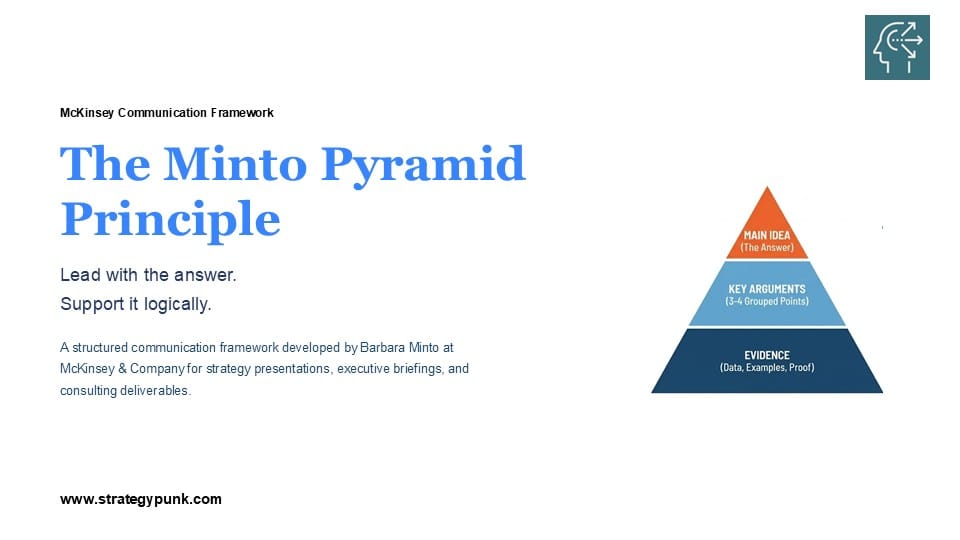
The Minto Pyramid Principle is the communication framework behind every McKinsey presentation. Lead with the answer. Support it with logic. Back it with evidence. This post breaks down the three tier structure, SCQA, MECE, and deductive vs inductive reasoning. Free PDF guide included.

Intoduction
Most business communication fails for one reason: it buries the point.
You write a long email. You build a 30-slide deck. You present for 20 minutes before anyone hears your recommendation. Your audience checks out before you get there.
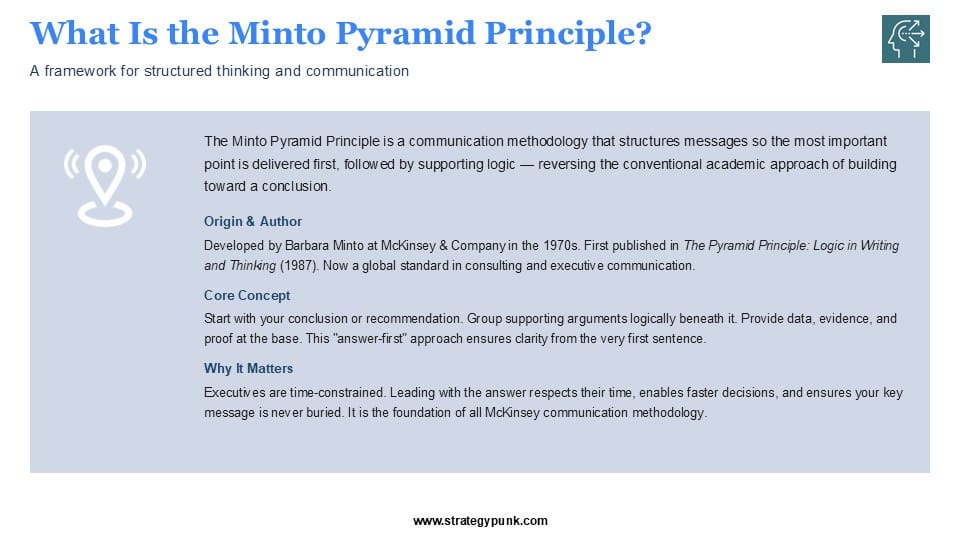
Barbara Minto solved this problem over 50 years ago. Her framework, the Minto Pyramid Principle, remains the gold standard for structured communication in consulting, boardrooms, and executive leadership.
Here is how it works. And why you should start using it today.
Who Is Barbara Minto?
Minto joined McKinsey in 1963 as the firm's first female consultant. She quickly stood out for her writing. While editing reports across offices in the US, London, Paris, and Düsseldorf, she noticed the same problem everywhere: people presented information in a way that mixed findings and conclusions, with neither leading clearly to recommendations.
Her diagnosis was sharp. The problem was not language. It was thinking. People started writing without working out their thinking in advance.
She spent years studying the structure of thought, drawing on Aristotle, Piaget, and the Bourbaki mathematicians. The result was a framework she first taught internally at McKinsey, then to every major consulting firm, and eventually to organizations worldwide. Her book, The Pyramid Principle, has sold millions of copies and is still taught at McKinsey today.
The Three-Tier Pyramid Structure
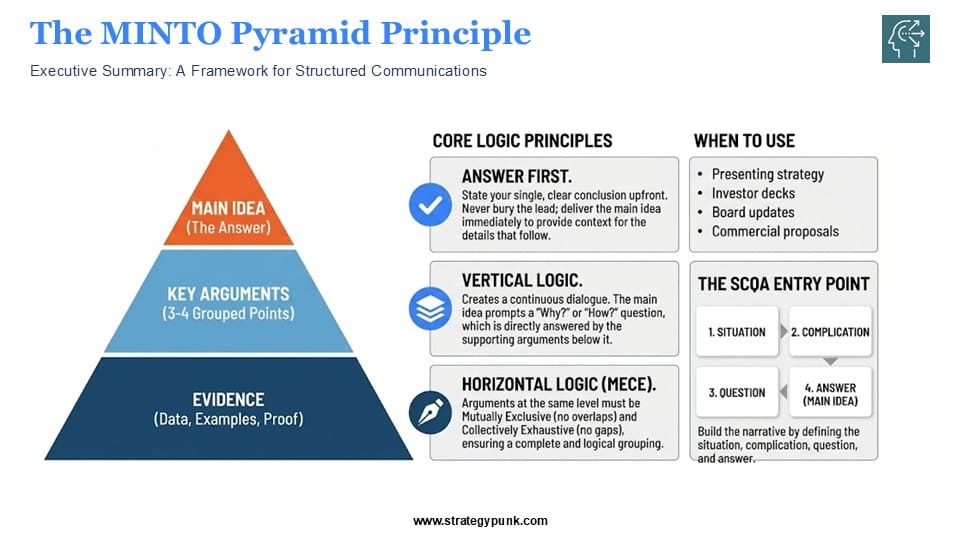
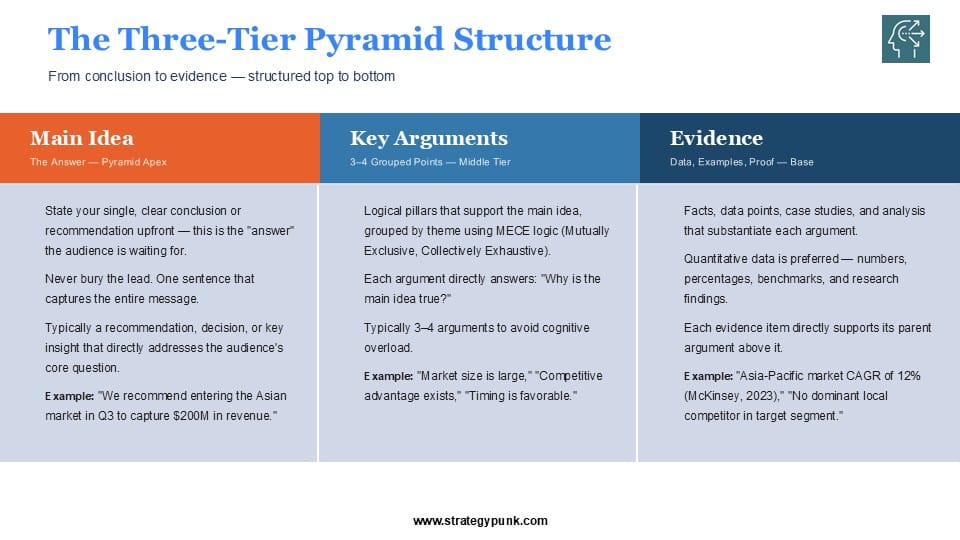
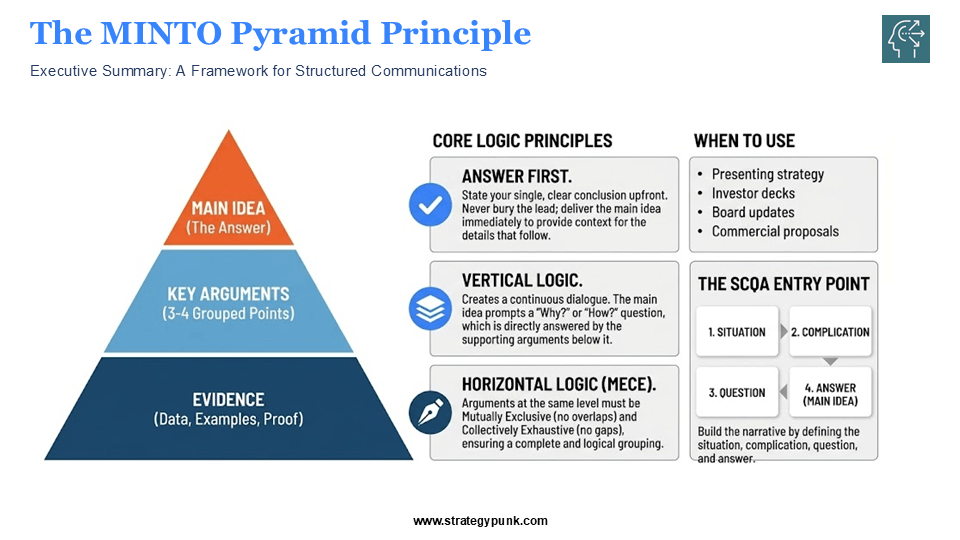
The Minto Pyramid inverts the way most people communicate. Instead of building up to your conclusion, you start with it. Then you support it with key arguments. Then you back those arguments with data.
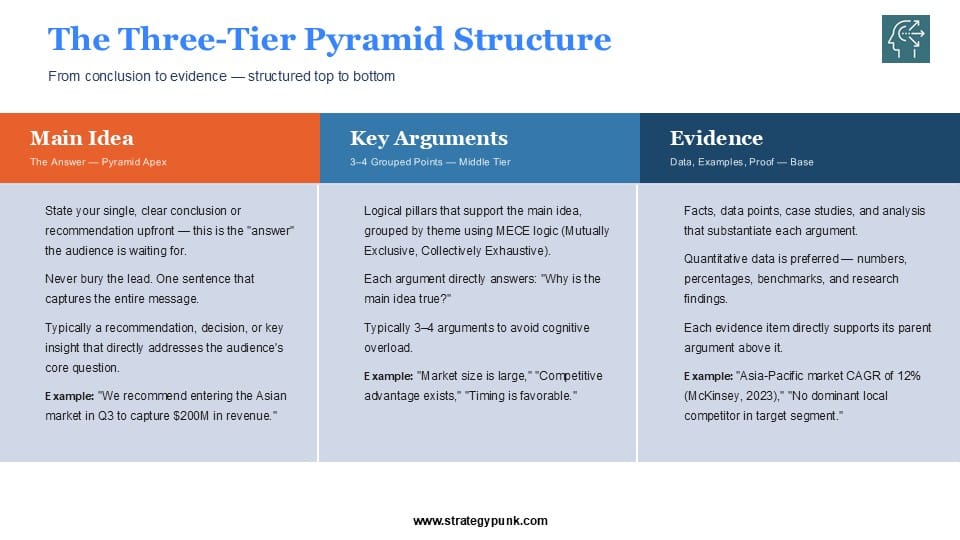
Main Idea. Your single, clear conclusion or recommendation. State it upfront. Never bury the lead. One sentence that captures the entire message and directly addresses the audience's core question.
Key Arguments. The logical pillars that support the main idea are grouped by theme. Each argument directly answers: "Why is the main idea true?" Aim for three to four arguments to avoid cognitive overload.
Evidence. Facts, data points, case studies, and analysis that substantiate each argument. Quantitative data is preferred: numbers, percentages, benchmarks, research findings. Each piece of evidence directly supports its parent argument above it.
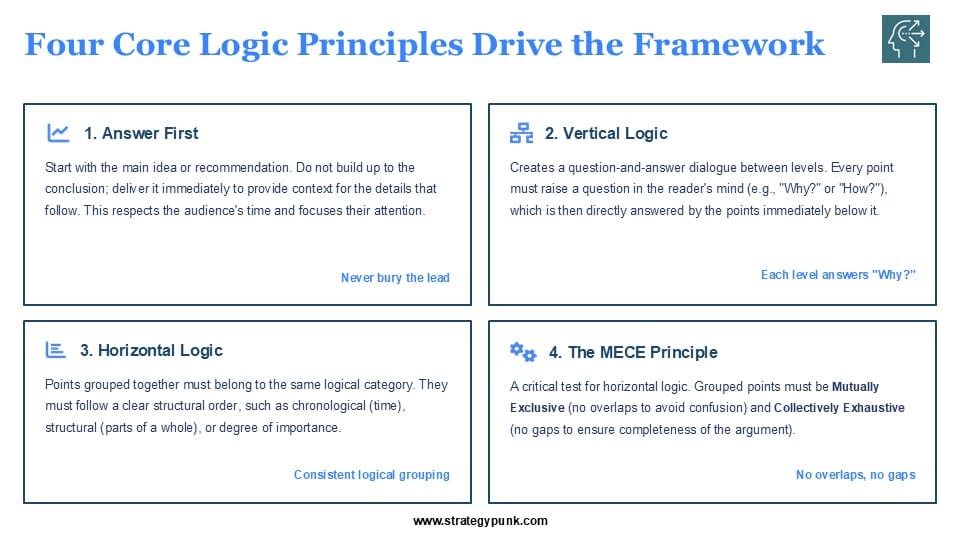
Four Core Logic Principles
The pyramid is governed by four principles that keep the structure airtight.
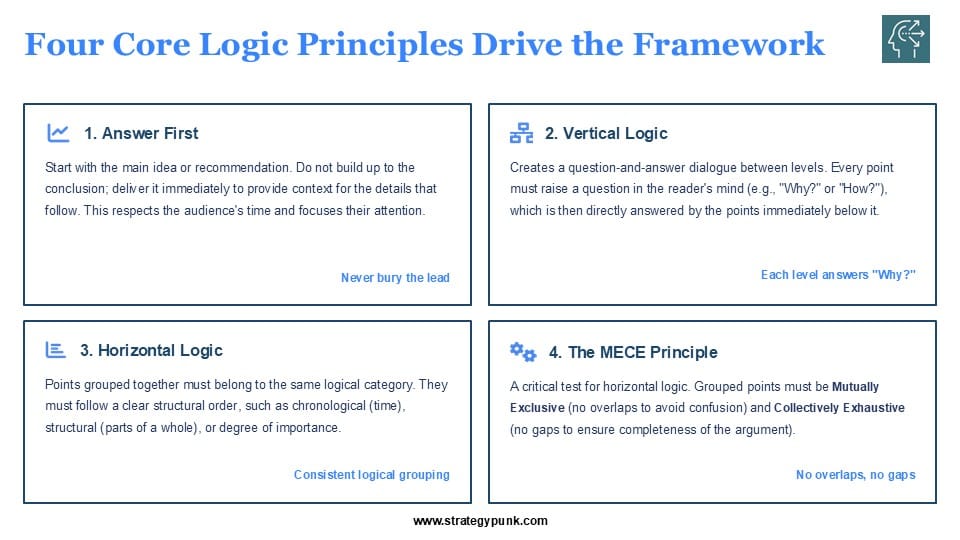
Answer First. Start with the main idea or recommendation. Do not build up to the conclusion. Deliver it immediately to provide context for the details that follow. This respects the audience's time and focuses their attention.
Vertical Logic. Every point must raise a question in the reader's mind ("Why?" or "How?"), which is then directly answered by the points immediately below it. This creates a question-and-answer dialogue between levels.
Horizontal Logic. Points grouped must belong to the same logical category. They must follow a clear structural order: chronological (time), structural (parts of a whole), or degree of importance.
The MECE Principle. A critical test for horizontal logic. Grouped points must be Mutually Exclusive (no overlaps) and Collectively Exhaustive (no gaps). MECE prevents redundancy and ensures completeness of the argument.
Think Bottom Up. Communicate Top Down.
When you research and analyze, you work from the ground up. You collect data, identify patterns, form hypotheses, and arrive at conclusions. That is bottom-up thinking.
When you communicate, you reverse the order. You share the conclusion first. Then you walk the audience through the logic that supports it.
Most people make the mistake of presenting in the same order they thought. They take the audience on their research journey. That journey is not what the audience needs. The audience needs the destination.
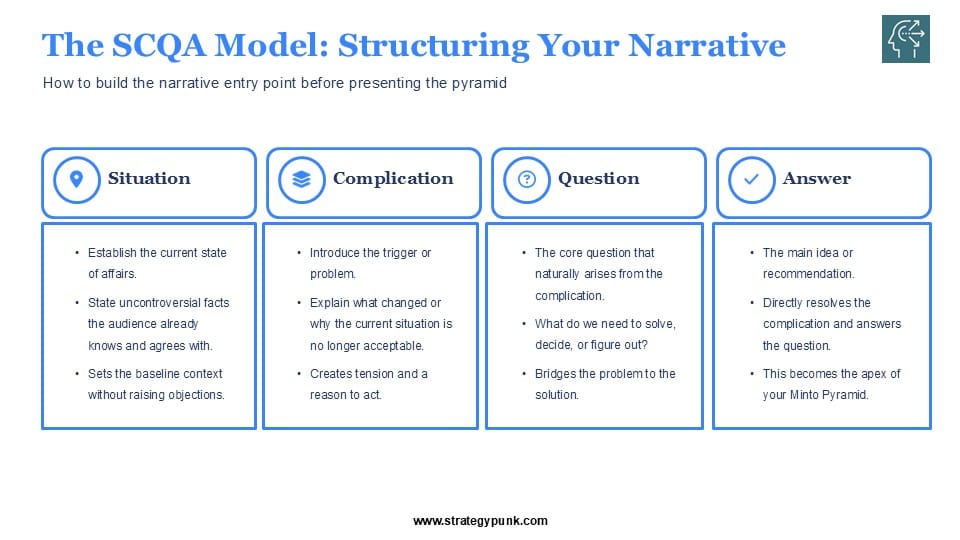
The SCQA Model: Structuring Your Narrative
Minto pairs the pyramid with a narrative entry point called SCQA.
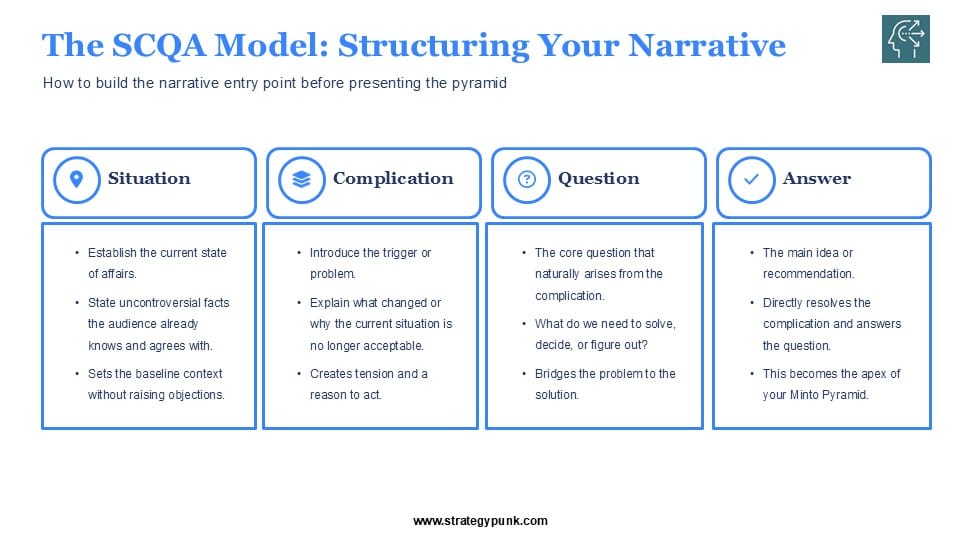
Situation. Establish the current state of affairs. State uncontroversial facts that the audience already knows and agrees with. This sets the baseline context without raising objections.
Complication. Introduce the trigger or problem. Explain what changed or why the current situation is no longer acceptable. This creates tension and a reason to act.
Question. Surface the core question that naturally arises from the complication. What do we need to solve, decide, or figure out?
Answer. Deliver your main idea or recommendation. This directly resolves the complication and becomes the apex of the pyramid.
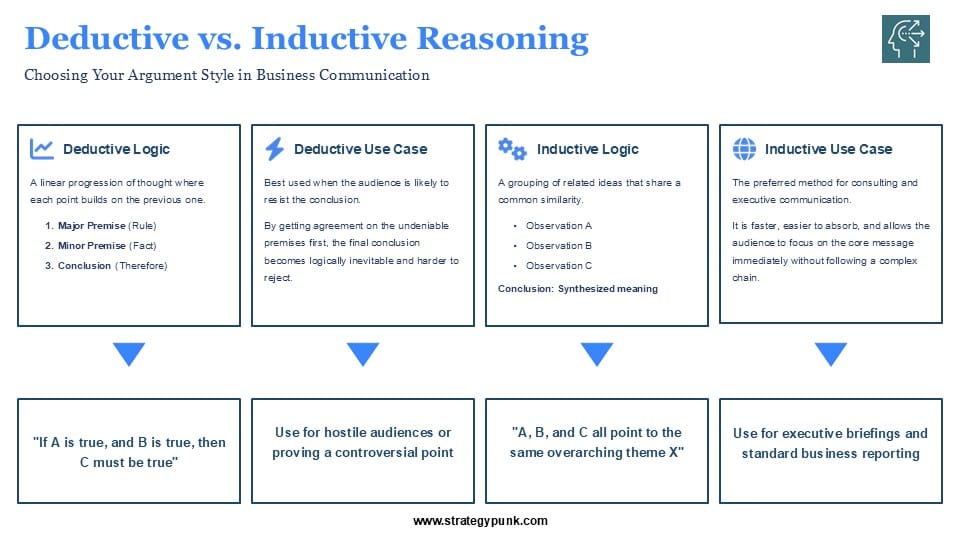
Deductive vs. Inductive Reasoning
The pyramid supports two argument styles. Choose based on your audience.
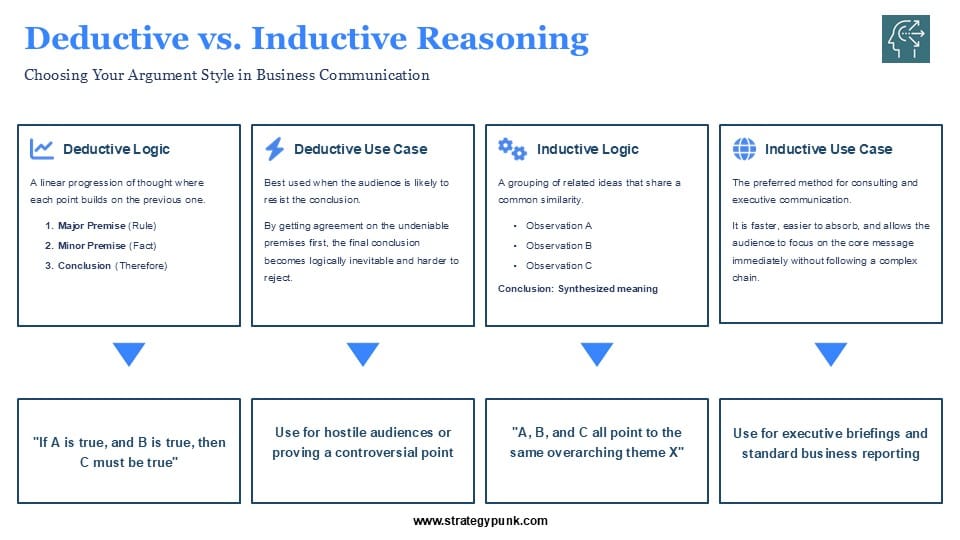
Deductive logic follows a linear chain: major premise, minor premise, conclusion. Each point builds on the previous one. Best used when the audience is likely to resist the conclusion. By first reaching agreement on undeniable premises, the conclusion becomes logically inevitable.
Inductive logic groups related observations that all point to the same overarching theme. This is the preferred method for consulting and executive communication. It is faster, easier to absorb, and allows the audience to focus on the core message immediately. If someone challenges one supporting point, the overall argument still holds.
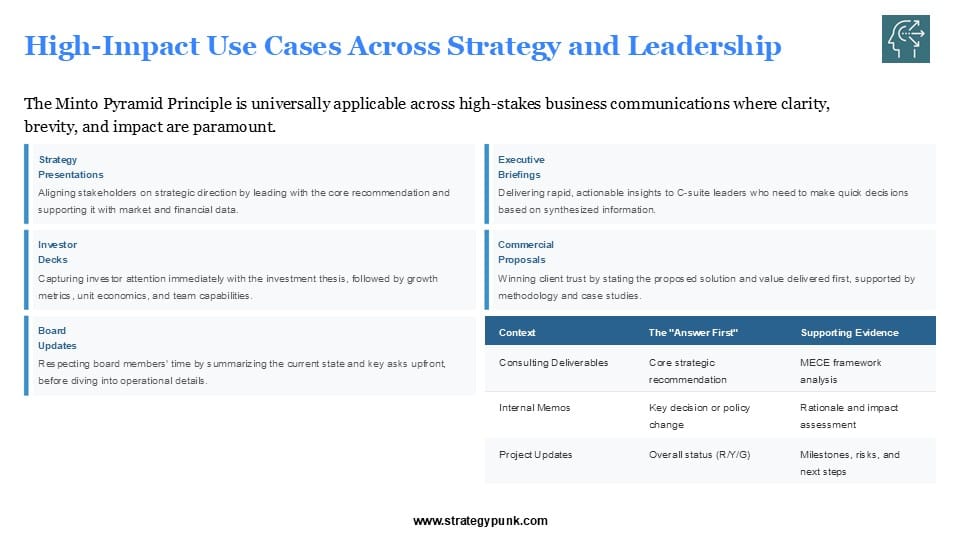
High Impact Use Cases
The Minto Pyramid applies across every format where clarity, brevity, and impact matter. Strategy presentations that align stakeholders on direction. Investor decks that lead with the thesis and follow with metrics. Board updates that summarize the current state and key asks upfront. Executive briefings that deliver rapid, actionable insights. Commercial proposals that state the solution and value delivered first.
It works in emails, Slack messages, internal memos, and two-minute hallway conversations. When someone asks you a question, respond with the answer first. Then give the reasons. Then offer the evidence if needed.
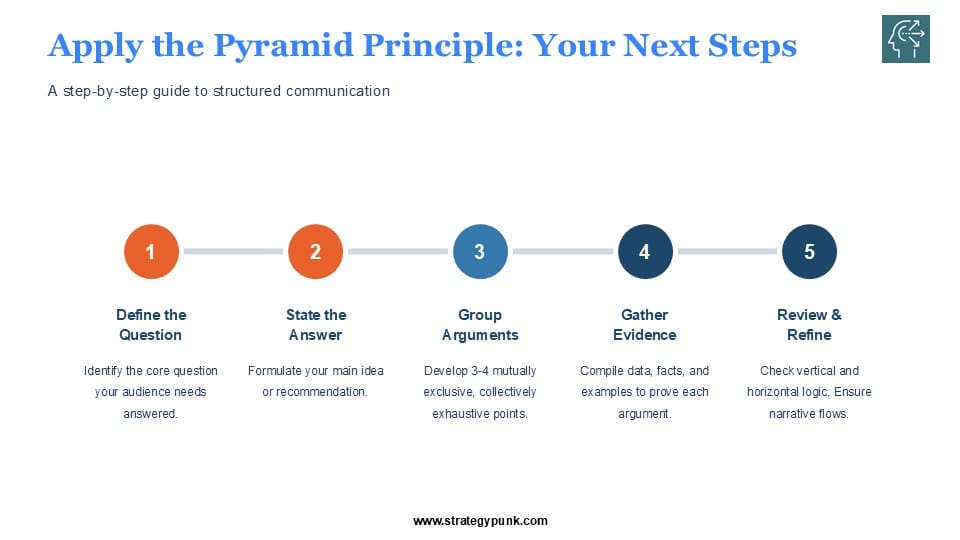
Apply the Pyramid: Five Steps
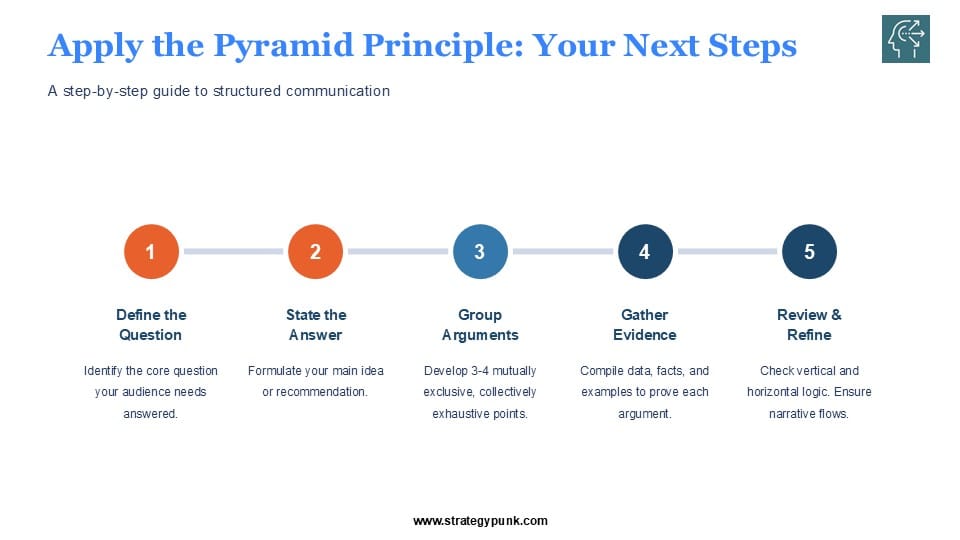
- Define the question. Identify the core question your audience needs answered.
- State the answer. Formulate your main idea or recommendation.
- Group arguments. Develop three to four mutually exclusive, collectively exhaustive points.
- Gather evidence. Compile data, facts, and examples to prove each argument.
- Review and refine. Check vertical and horizontal logic. Ensure the narrative flows.
The Bottom Line
The Minto Pyramid Principle is one of the most practical communication frameworks ever developed. It forces clarity of thought before clarity of expression. It respects the audience's time. And it works in any format, from a one-line message to a full strategy presentation.
Start with the answer. Support it with logic. Back it with evidence.
That is the pyramid. Use it.
Download Our Minto Pyramid Principle PDF Guide
To help you get started, we’re providing a free Minto Pyramid Principle PDF Guide.