The Partnership Priority Framework (Free PDF Guide)
Evaluate partnership opportunities like a strategy consultant. Free Partnership Priority Framework guide + editable assessment worksheet. Download now.

A Systematic Approach to Evaluating Strategic Alliances
Strategic partnerships can be transformative - or catastrophic. The difference often comes down to one thing: how rigorously you evaluate opportunities before committing.
Too many organizations approach partnerships opportunistically. A promising company crosses their radar, excitement builds, and suddenly they're deep in negotiations without ever asking the fundamental question: Is this the correct type of partnership for what we're trying to achieve?
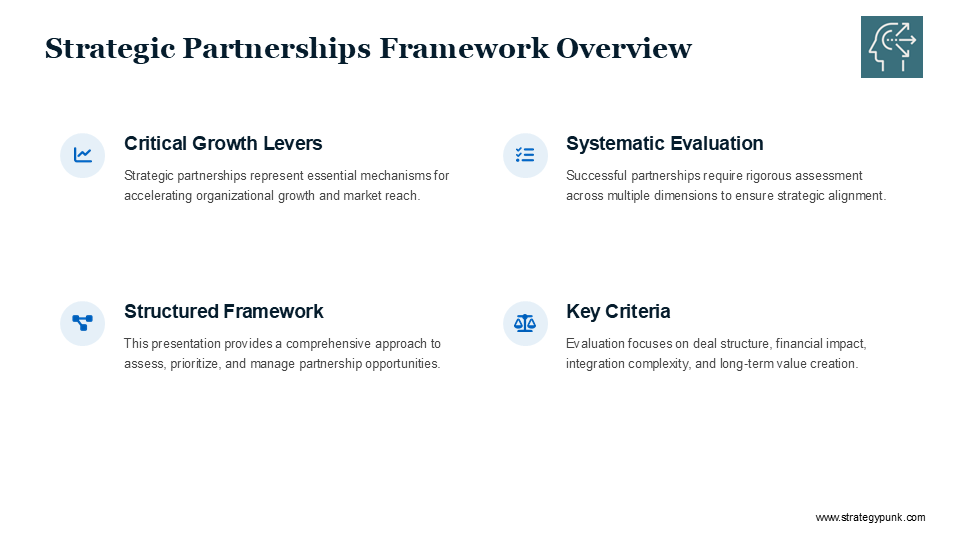
The Partnership Priority Framework changes that. It provides a structured methodology for assessing, prioritizing, and selecting partnership opportunities based on strategic fit, financial impact, and execution feasibility.
Why Most Partnership Decisions Go Wrong
The failure rate for strategic partnerships hovers around 60-70%.
That's not because companies choose bad partners; it's because they choose the wrong partnership model for their situation.
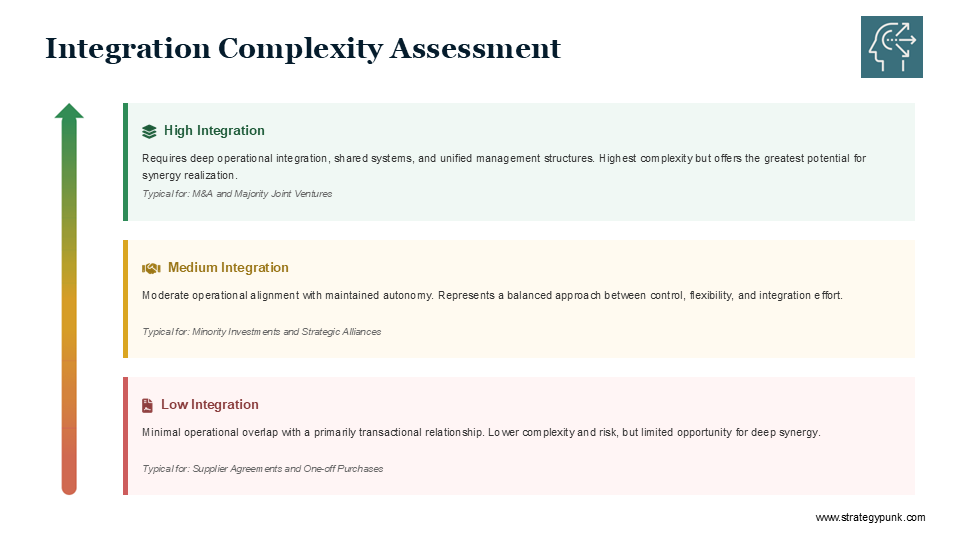
Consider a technology company seeking to enter a new market. They could pursue a full acquisition, form a joint venture, take a minority stake, establish an R&D alliance, or simply negotiate a supplier agreement. Each option carries different implications for control, capital requirements, integration complexity, and risk exposure.
Without a systematic evaluation process, organizations default to whatever model feels familiar or whatever their advisors recommend. The result? Misaligned expectations, integration nightmares, and value destruction instead of value creation.
The Five Core Partnership Models
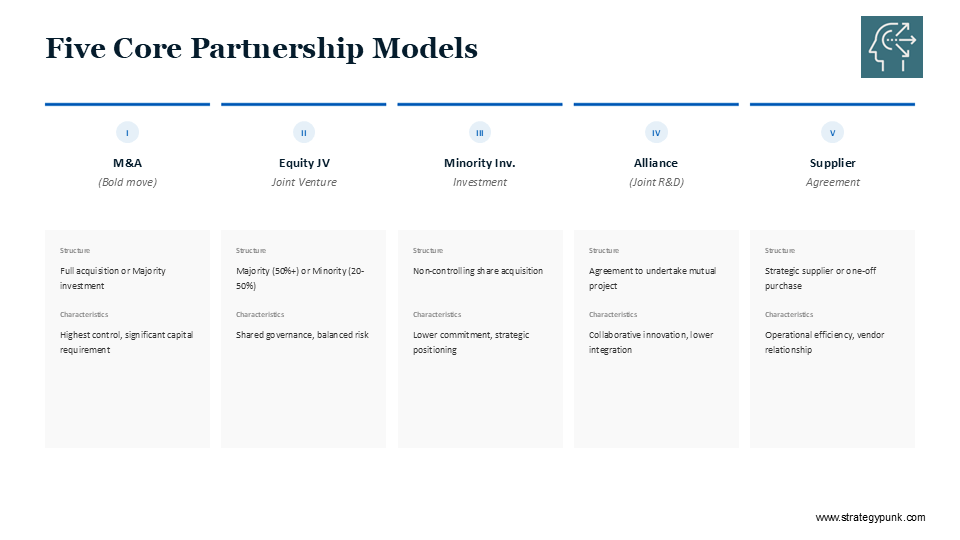
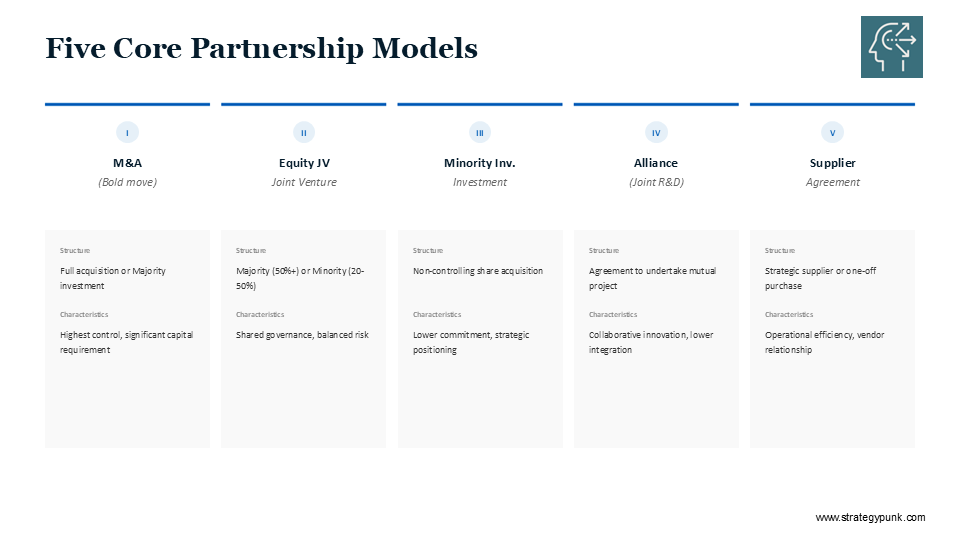
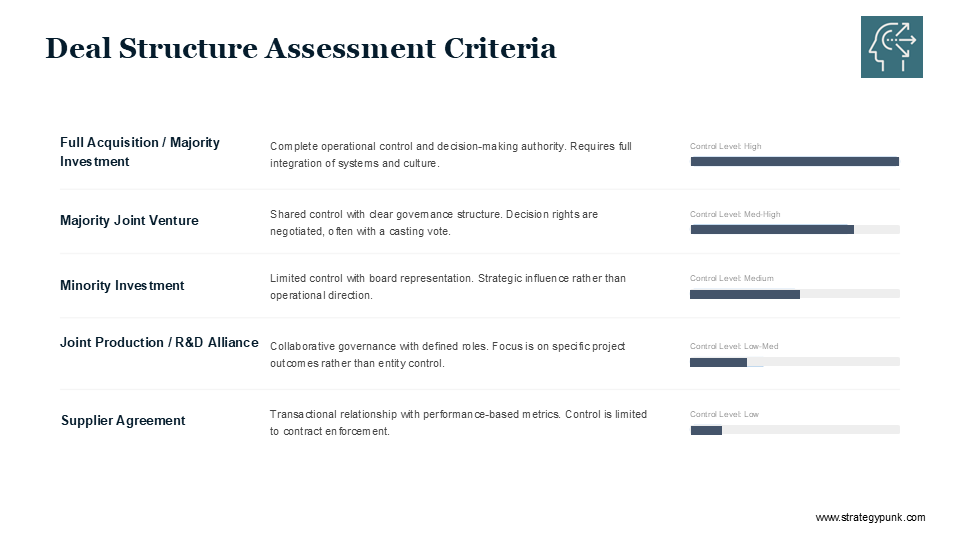
The framework identifies five distinct partnership structures, each suited to different strategic objectives:
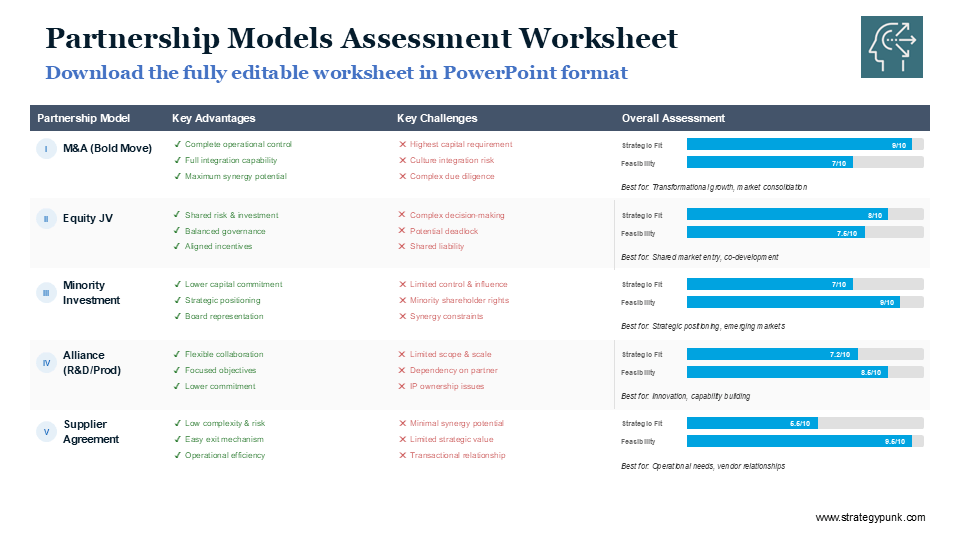
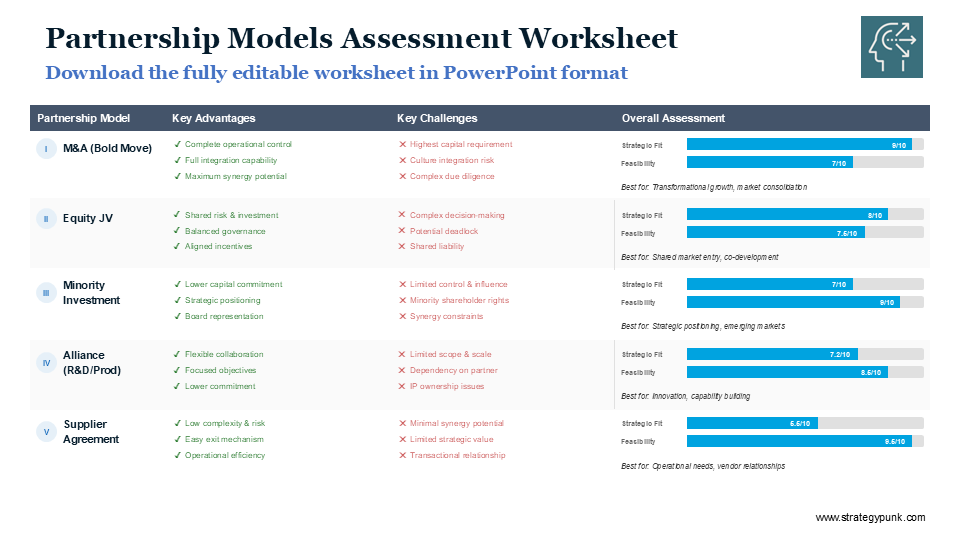
M&A (Bold Move) offers maximum control and synergy potential but demands significant capital and carries the highest integration risk. It's best suited for transformational growth or market consolidation plays.
Equity Joint Ventures balance shared investment with shared governance. They work well for market entry or co-development initiatives where both parties bring essential capabilities to the table.
Minority Investments provide strategic positioning with limited capital commitment. You gain board representation and influence without operational control—ideal for exposure to emerging markets or keeping options open.
Strategic Alliances enable focused collaboration on specific projects, such as R&D or production. Lower commitment means lower risk, but also more limited scope for value creation.
Supplier Agreements represent the simplest structure: transactional relationships with minimal strategic upside but easy exit mechanisms and operational efficiency.
Evaluating Each Opportunity
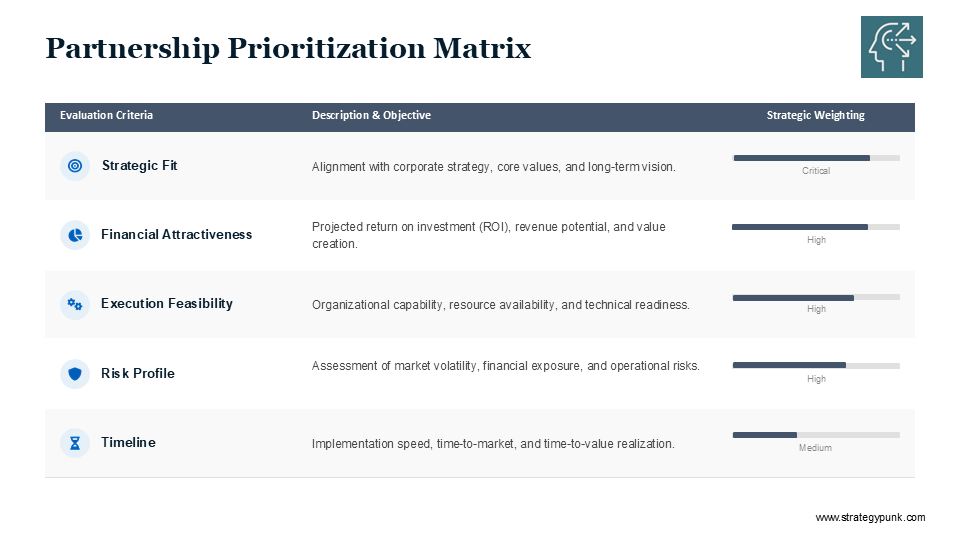
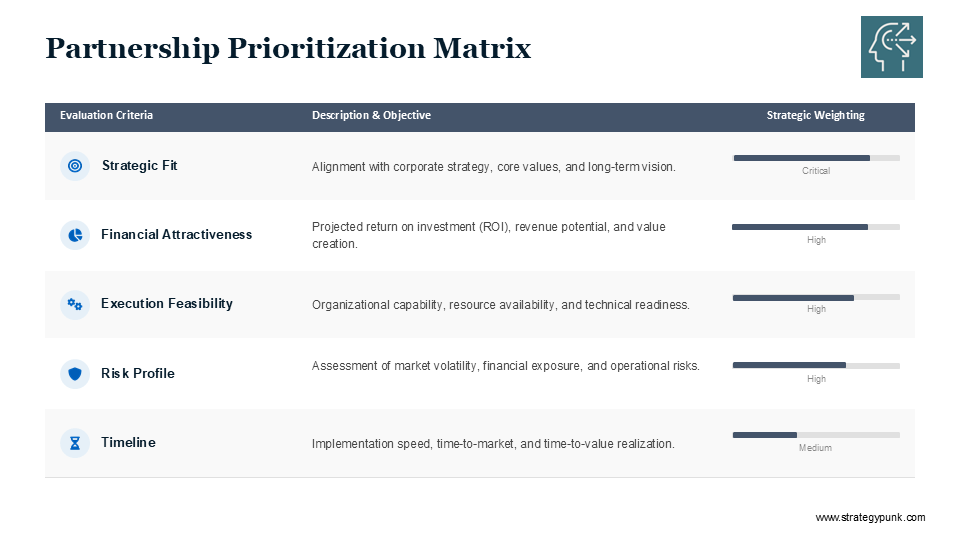
Once you understand the available models, the framework guides you through a weighted assessment across five dimensions:
Strategic Fit (Critical): Does this partnership align with your corporate strategy, core values, and long-term vision? A financially attractive deal that pulls you away from your strategic direction will destroy more value than it creates.
Financial Attractiveness (High): What's the projected ROI? Revenue potential? Total value creation opportunity? Run the numbers rigorously.
Execution Feasibility (High): Do you have the organizational capability, resources, and technical readiness to make this partnership work? Ambition without execution capacity leads to expensive failures.
Risk Profile (High): What's your exposure to market volatility, financial risk, and operational disruption? Match the partnership model to your organization's risk appetite.
Timeline (Medium): How quickly can you implement and realize value? Speed matters, but not at the expense of the other criteria.
From Evaluation to Execution
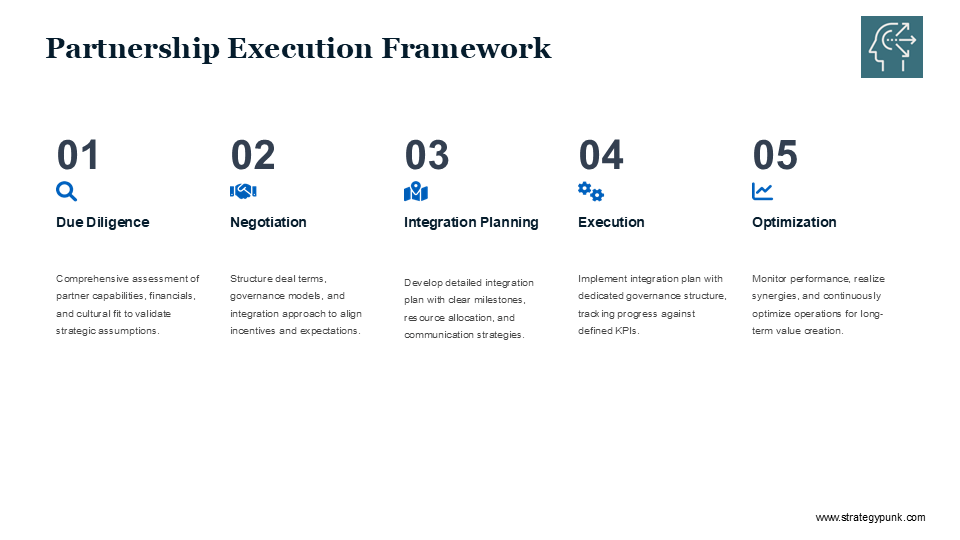
Assessment is only the beginning. The framework outlines a five-stage execution process: due diligence, negotiation, integration planning, execution, and optimization.
The critical insight here is that governance structures must be established early. Define decision rights, conflict resolution mechanisms, and performance metrics before you sign the deal—not after problems emerge.
Equally important: build in continuous monitoring from day one. Track performance metrics rigorously and be prepared to pivot or restructure if strategic objectives aren't being met. The sunk cost fallacy has killed more partnerships than bad initial decisions.
Putting the Framework Into Practice
Start by screening your current pipeline against these evaluation criteria. Identify your top three opportunities and launch detailed due diligence. As you gain experience with the framework, develop a standardized integration playbook that can accelerate future partnerships.
The goal isn't to eliminate risk—partnerships inherently carry uncertainty. The goal is to make risk-adjusted decisions based on systematic analysis rather than intuition or opportunism.
In a business environment where the right partnership can leapfrog you past competitors and the wrong one can set you back years, that systematic approach isn't just helpful. It's essential.
Download the Complete Framework
Ready to transform how your organization evaluates strategic partnerships? Get the full toolkit to start making smarter, more systematic partnership decisions today.
What's Included
The Partnership Priority Framework (PDF Guide) A comprehensive 12-page guide covering everything you need to assess, prioritize, and execute strategic partnerships—from the five core partnership models to the complete execution framework.
Partnership Models Assessment Worksheet (Editable PowerPoint) A ready-to-use worksheet for evaluating partnership opportunities across all five models. Includes pre-built scoring criteria for strategic fit, feasibility, key advantages, and key challenges. Fully editable so you can customize it for your organization's specific needs.
Get Instant Access
Sign in to download both resources and add them to your strategy toolkit.
Download Now → Already have an account? [Just Log in]