Simon Sinek's Golden Circle: Complete Guide with Free PowerPoint Template
Simon Sinek's Golden Circle explains why some leaders inspire and others do not. This guide breaks down the WHY, HOW, and WHAT framework with real examples, honest limitations, and a free editable PowerPoint template.

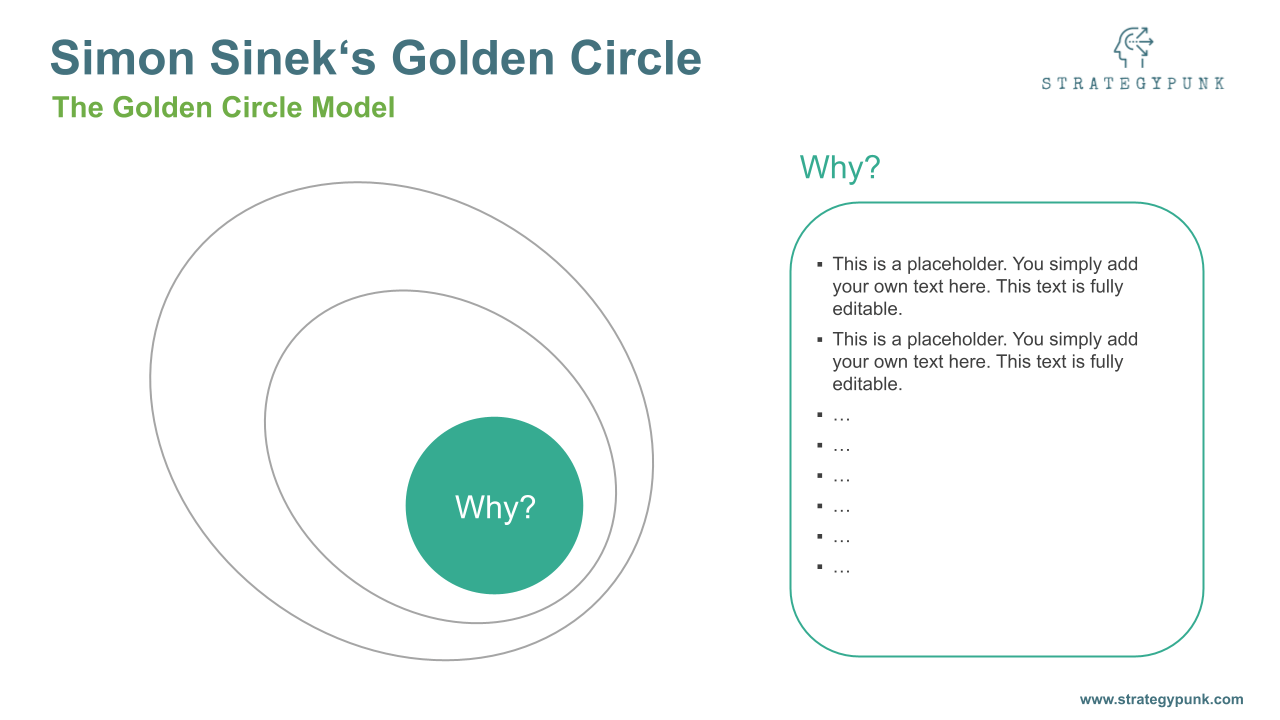
The Golden Circle Model was developed by Simon Sinek, who famously says, "People don't buy what you do; they buy why you do it."
Simon Sinek introduced the Golden Circle in his 2009 TED Talk, which has since crossed 65 million views. The core idea is deceptively simple. Most organizations communicate from the outside in. They start with what they sell, then explain how they do it, and rarely articulate why they exist. The leaders and companies that genuinely inspire people reverse that sequence. They start with WHY.
This post breaks down the Golden Circle model, walks through real company examples, addresses the framework's known limitations, and provides a free editable PowerPoint template you can use in your next strategy session.
What is the Golden Circle?
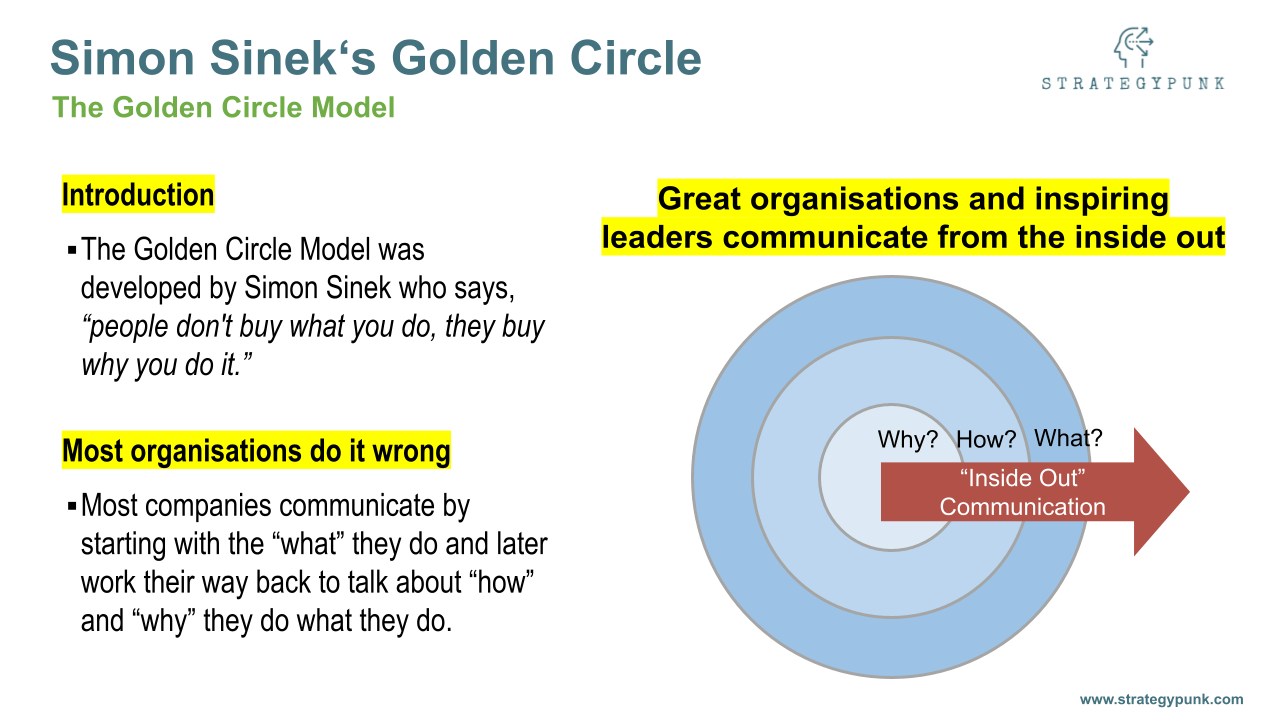
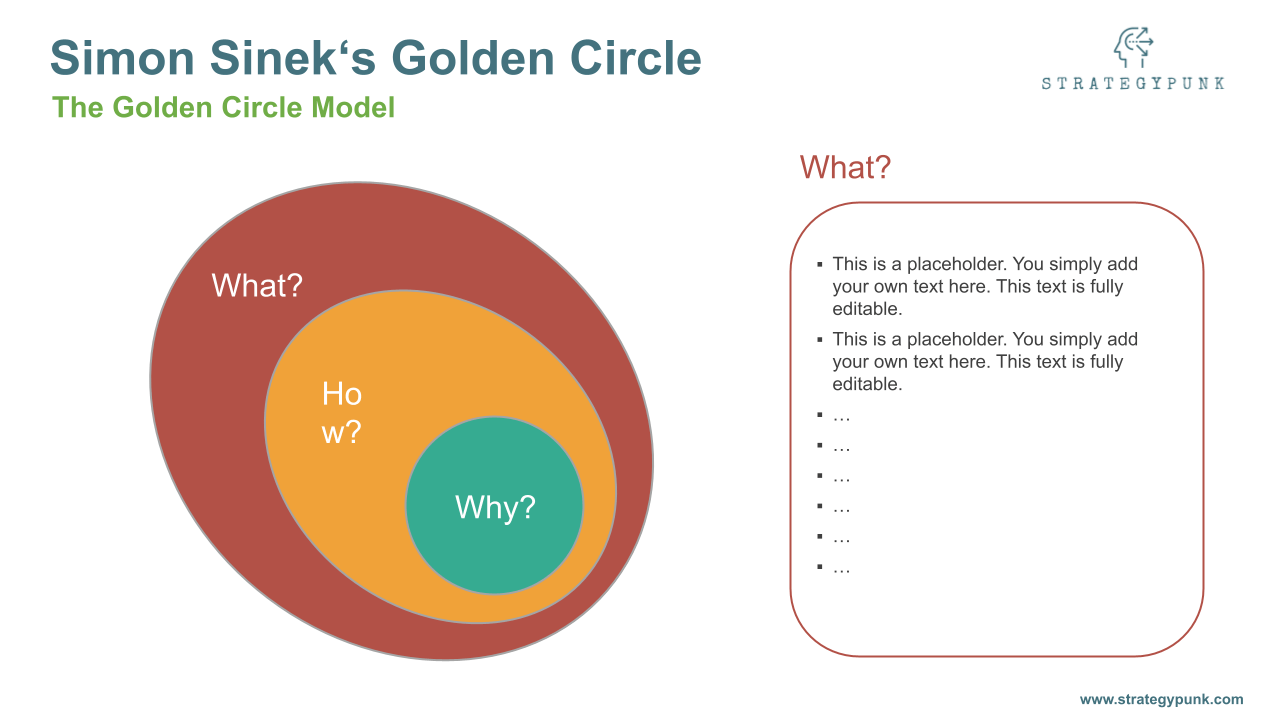
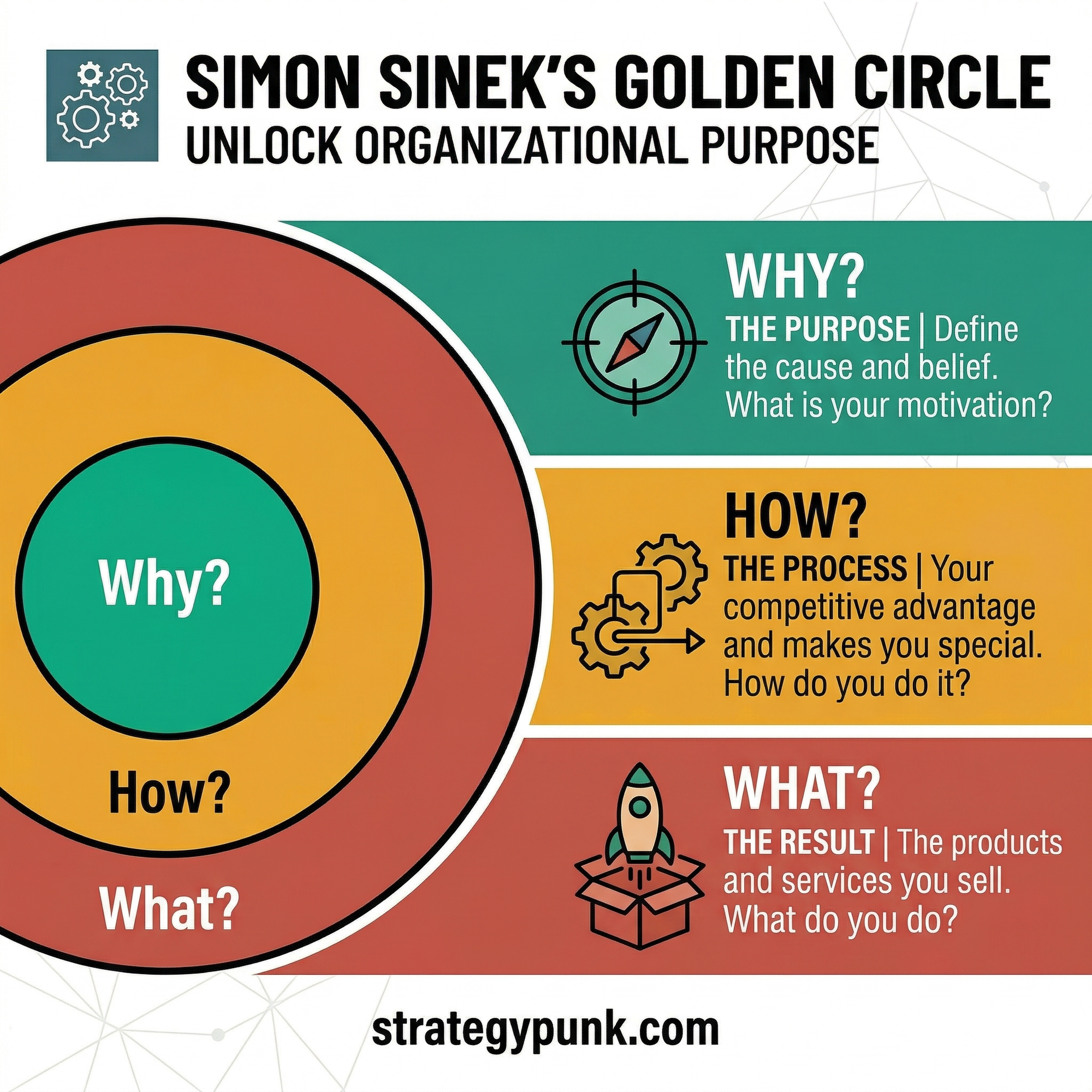
The Golden Circle is a three-ring concentric model. The innermost ring is WHY, surrounded by HOW, and then WHAT on the outside.
Sinek's argument: the sequence in which you communicate these three layers determines whether you inform people or inspire them.
WHY: The purpose. Why does your organization exist beyond making money? What is the cause or belief that drives every decision? This is not a mission statement written by committee. It is the genuine reason you get out of bed.
HOW: The process. How do you bring your WHY to life? These are the values, differentiating actions, or proprietary processes that make your organization distinct. Sinek describes the combination of WHY and HOW as an organizational fingerprint.
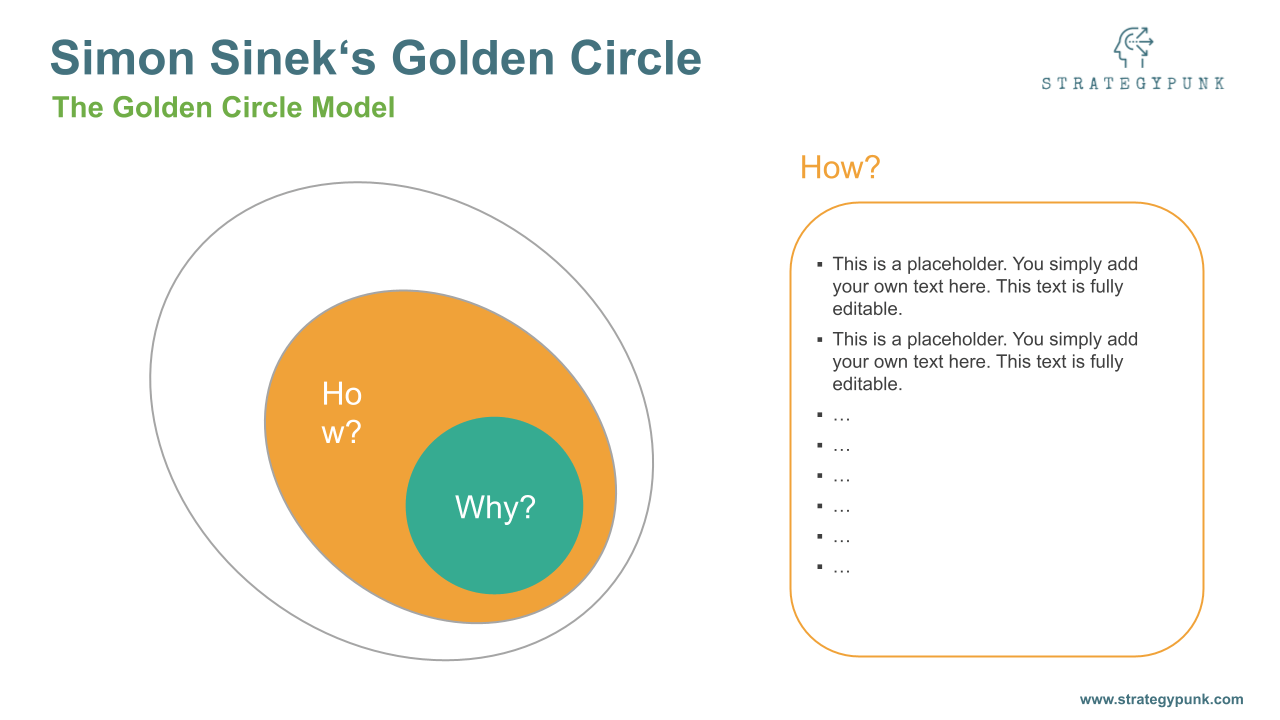
WHAT: The result. What do you sell? What products or services do you offer? Every company knows its WHAT. It is the easiest layer to articulate and the least powerful for inspiring loyalty.
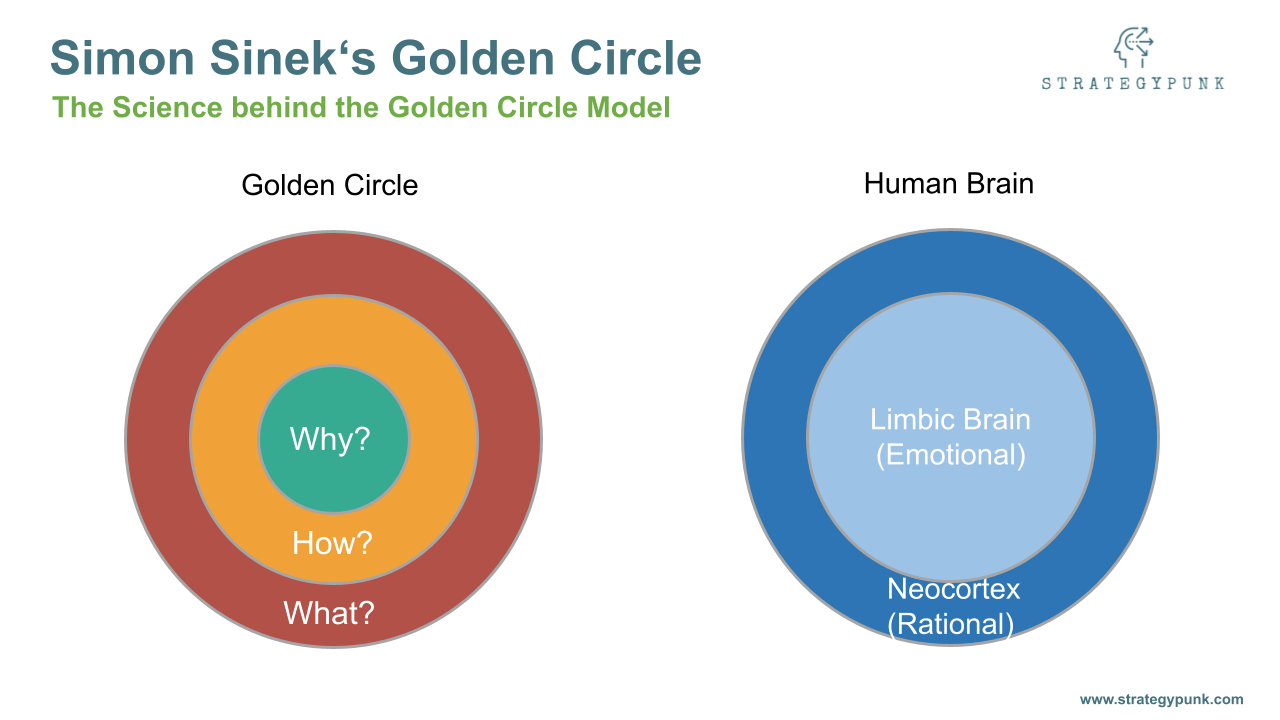
The framework maps to biology. The neocortex (the outer layer of the brain) processes rational, analytical information. It corresponds to WHAT. The limbic system (the inner brain) governs emotions, trust, and decision-making.
It has no capacity for language, but it drives behavior. WHY and HOW speak to the limbic system. This is why a decision can "feel right" even when you cannot fully articulate the reasons.
What are the three layers of Simon Sinek's Golden Circle concept?
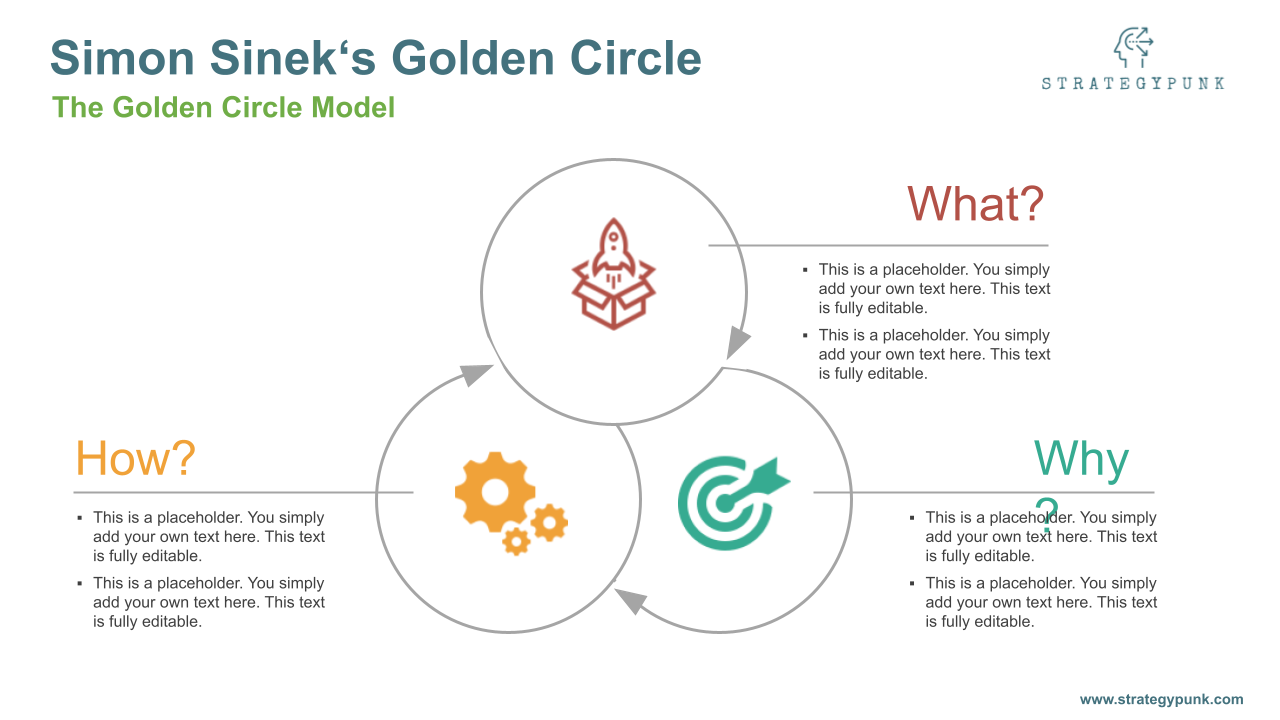
Why? = The purpose (The core question)
- What is your cause? What is your motivation and belief?
How? = The process
- How do you do it? What is your competitive advantage, and what makes you special
What? = The result
- What do you do? The What-Ring represents the products or services a company sells
What Is the Science Behind the Golden Circle?
Sinek argues that the Golden Circle maps directly onto the structure of the human brain. The neocortex, responsible for rational thought and language, corresponds to the WHAT ring. The limbic system, which governs feelings, trust, and decision making, corresponds to the WHY and HOW rings.
This mapping explains a common experience: you evaluate all the facts and data, yet your decision ultimately comes down to a gut feeling. That gut feeling is the limbic system at work. It has no capacity for language, which is why articulating the reasons behind an emotional decision is difficult.
However, this neuroscience claim deserves scrutiny. See the limitations section below.
How to Find Your WHY: A Practical Process
Sinek expanded the process in his follow-up book, Find Your Why (2017). The core method works for both individuals and teams.
Step 1: Gather stories. Collect specific stories from your life or your organization's history that had a deep impact. Focus on moments of pride, fulfillment, or meaning.
Step 2: Identify themes. Look for recurring patterns across the stories. What values or motivations keep appearing?
Step 3: Draft a WHY statement. Use the format: "To [contribution] so that [impact]." Example: "To challenge conventional thinking so that people can see new possibilities."
Step 4: Validate with HOW. Your HOWs are the actions you take when you are at your best. They should feel like natural expressions of your WHY, not aspirational slogans.
Step 5: Stress test. Share the statement with people who know you or your organization well. If it does not resonate immediately, it is not sharp enough.
The most common mistake: confusing WHAT you produce with WHY you exist. Revenue, growth, and market share are results. They are never the WHY.
The Golden Circle in Practice: Three Company Examples
Apple
This is Sinek's most referenced example. If Apple communicated like most technology companies, it would say: "We make great computers. They are beautifully designed and simple to use. Want to buy one?"
Instead, Apple leads with WHY: "Everything we do, we believe in challenging the status quo. We believe in thinking differently." The HOW: "We make our products beautifully designed and simple to use." The WHAT: "We happen to make computers."
The sequence matters. Apple sells laptops, phones, tablets, watches, and headphones. If customers only bought WHAT a company makes, buying a phone from a computer company would feel strange. But because customers buy WHY Apple does what it does, every new product category feels like a natural extension.
Patagonia
WHY: "We are in business to save our home planet." This is not a tagline bolted onto a marketing campaign. Patagonia has run ads telling customers not to buy their jackets. They donate 1% of sales to environmental causes. They sued the U.S. government over public lands.
HOW: Radical transparency in supply chains, lifetime repair guarantees, used gear resale through Worn Wear.
WHAT: Outdoor clothing and gear.
Patagonia's WHY is so clearly articulated that it attracts employees, customers, and investors who share the same belief. The result is a brand valued at over $3 billion, built almost entirely without traditional advertising.
Tesla (early era)
WHY: "Accelerate the world's transition to sustainable energy."
HOW: Build desirable electric vehicles that outperform combustion alternatives, then open-source patents to accelerate industry adoption.
WHAT: Electric cars, solar panels, battery storage.
Tesla's early dominance came from leading with a mission that transcended the product. First adopters were not buying a car. They were buying into a future.
Limitations and Criticism of the Golden Circle
No framework is without flaws. The Golden Circle has attracted legitimate criticism on three fronts.
1. The neuroscience is oversimplified. Sinek states that his model is "firmly grounded in the tenets of biology." Neuroscientists have pushed back. Brain functioning is complex and not fully understood. The idea that rational and emotional decisions map neatly to distinct brain regions is a significant oversimplification. Neuroscientist Paul Middlebrooks has noted that neuroscience does not yet understand brain systems well enough to validate claims like Sinek's. The Golden Circle works as a communication framework. Treating it as settled neuroscience is a stretch.
2. Evidence is anecdotal, not empirical. The supporting examples (Apple, Wright Brothers, Martin Luther King Jr., TiVo) are compelling stories, but they are cherry-picked. There is no controlled study demonstrating that starting with WHY causes superior business outcomes. Correlation is not causation. Many successful companies (Amazon, Berkshire Hathaway) rarely lead with WHY in their communications, yet dominate their markets.
3. The model ignores WHO. Several strategists have noted the Golden Circle omits the most critical element of any business: the customer. A WHY that is not grounded in a deep understanding of who you serve and what problems they face becomes a philosophical abstraction. Lex Sisney of Organizational Physics argues that great organizations start with WHO they serve before articulating WHY they exist. Similarly, GLYPH Marketing has proposed a revised model (Who, How, Why) that places the audience at the center.
4. Purpose washing risk. In 2026, the gap between stated purpose and actual behavior is under more scrutiny than ever. Consumers, employees, and investors now demand proof. A beautifully crafted WHY that is contradicted by supply chain practices, compensation structures, or environmental impact does more damage than having no stated purpose at all.
Academic research supports this gap. A 2019 study by Straker and Nusem analyzed the value propositions of 100 organizations using the Golden Circle framework. Only 24% articulated their WHY explicitly. The majority defaulted to communicating WHAT and HOW.
The Golden Circle in 2026: Why It Still Matters (and What Has Changed)
The Golden Circle is 17 years old. Some things have shifted.
AI makes WHAT and HOW commodities faster than ever. When generative AI can replicate your product descriptions, design patterns, and operational processes, the only thing left difficult to copy is your WHY. In a market flooded with AI-generated content and AI-assisted products, genuine purpose becomes a scarce and therefore more valuable differentiator.
Trust is the new currency. Lippincott's 2026 trend report and Admind's branding forecast both identify accountability as the defining brand requirement. Consumers no longer accept vision statements at face value. They want measurable progress. The Golden Circle still works, but in 2026, the WHY ring must be backed by evidence, not just emotion.
"Human-made" carries a premium. As AI ostracization grows, brands that can demonstrate authentic human conviction behind their purpose will stand out. The Golden Circle provides the structure for that story, but the story itself must be genuine.
Micro storytelling replaces manifestos. The TED Talk era rewarded grand narratives. In 2026, short-form content (reels, clips, micro case studies) is the dominant format. Your WHY needs to be expressible in 15 seconds, not 18 minutes. This is not a weakness of the model. It is an evolution. The most powerful WHY statements are already short.
Complementary Frameworks
The Golden Circle works best when combined with other strategic tools.
Value Proposition Canvas (Osterwalder): Adds the customer perspective that the Golden Circle lacks. Map your WHY to specific customer jobs, pains, and gains.
Jobs To Be Done (Christensen): Grounds the WHY in functional, emotional, and social jobs your customers are trying to accomplish.
Brand Purpose Pyramid: Layers functional benefits, emotional benefits, and purpose into a hierarchy. The Golden Circle's WHY sits at the apex.
Strategy House: Your WHY becomes the roof (vision). HOW populates the pillars (strategic priorities). WHAT fills the foundation (capabilities and resources)?
Simon Sinek's Golden Circle Template
Free PowerPoint and Google Slides template
Get an accessible and fully editable Simon Sinek's Golden Circle Template today!
This template is a powerful tool for understanding and applying the principles of the Golden Circle to your organization or project.
Please sign up to access the template. I want to help you improve your understanding of the Golden Circle.
Sign up now and download your free template!