Discuss, Decide, Deliver: A Decision Making Framework for Leadership Teams (Free Template)
Discuss, Decide, Deliver: The Decision Framework That Stops Decisions Reopening

The Discuss, Decide, Deliver Framework: What HUGO BOSS CEO Daniel Grieder Gets Right About Decisions
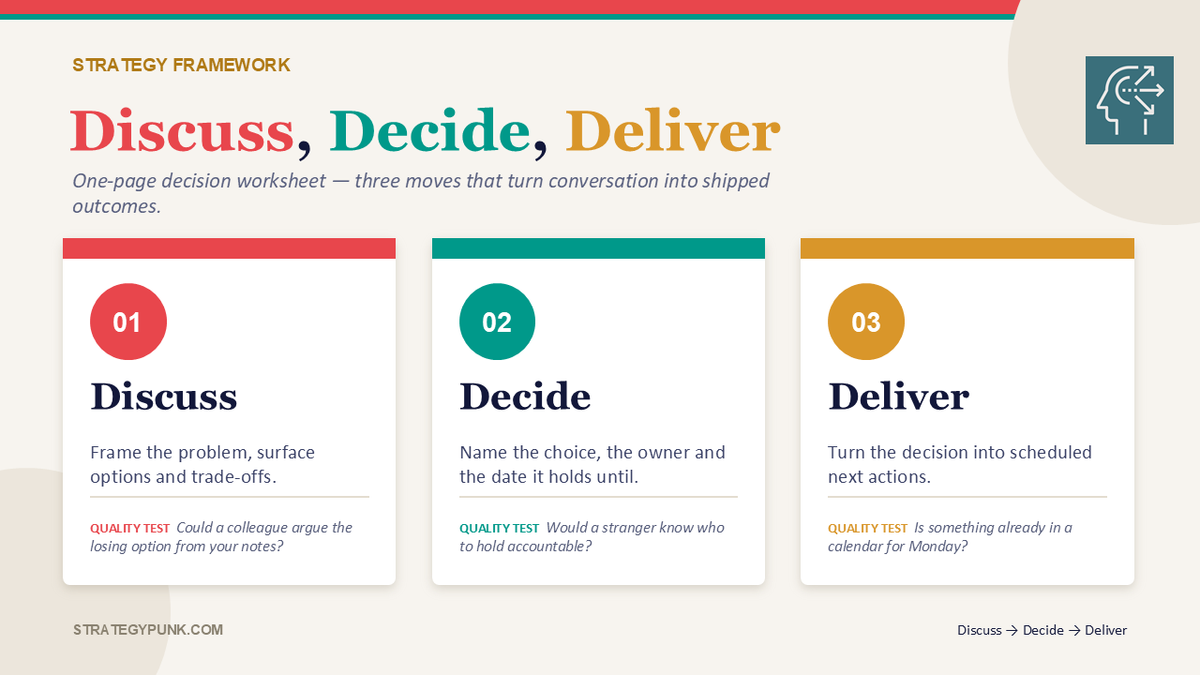
Daniel Grieder, CEO of HUGO BOSS, describes his leadership approach in three words. Discuss, decide, deliver. It sounds like a slogan. It reads more like an operating instruction, and most leadership teams break it on the first word.
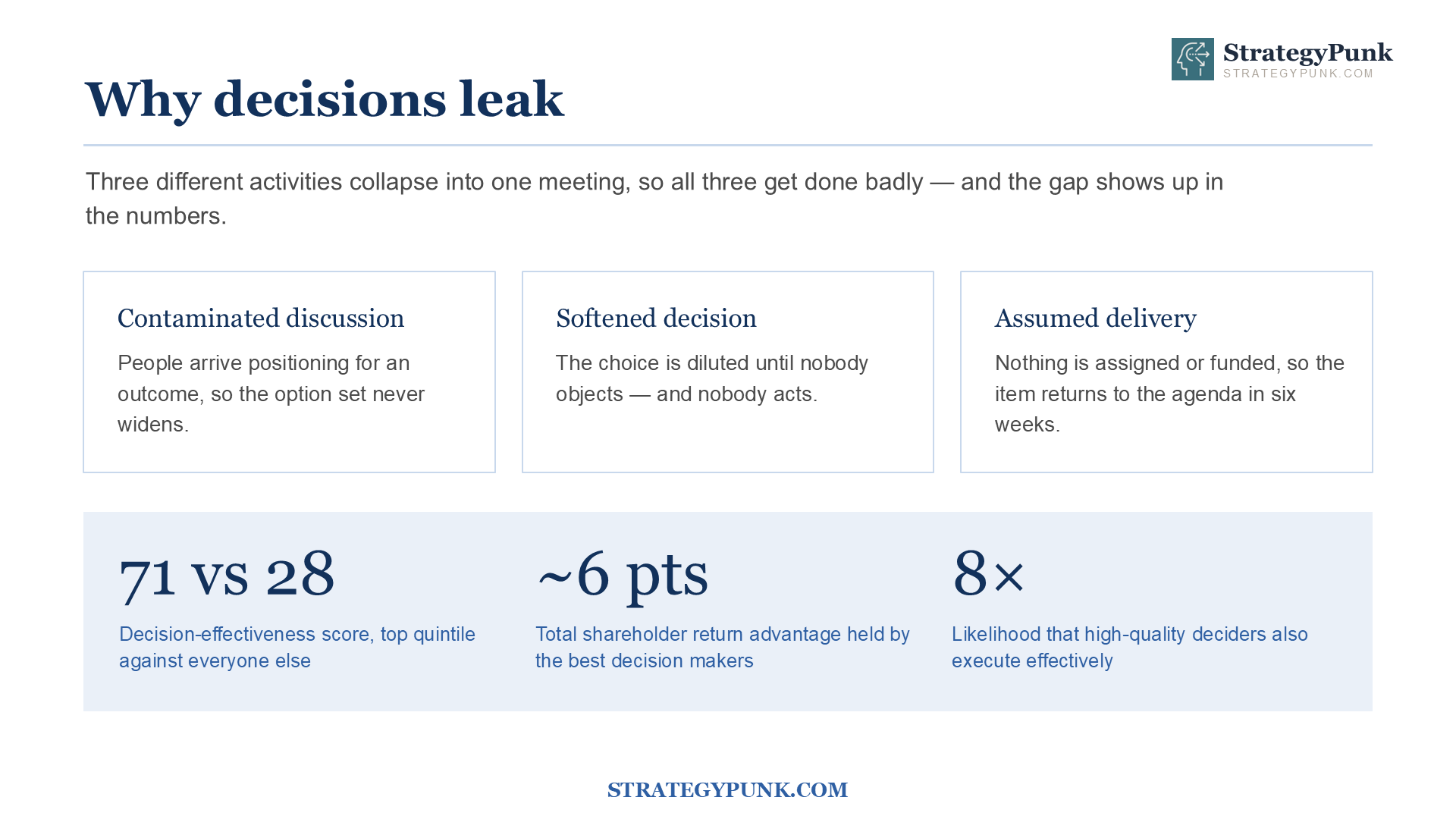
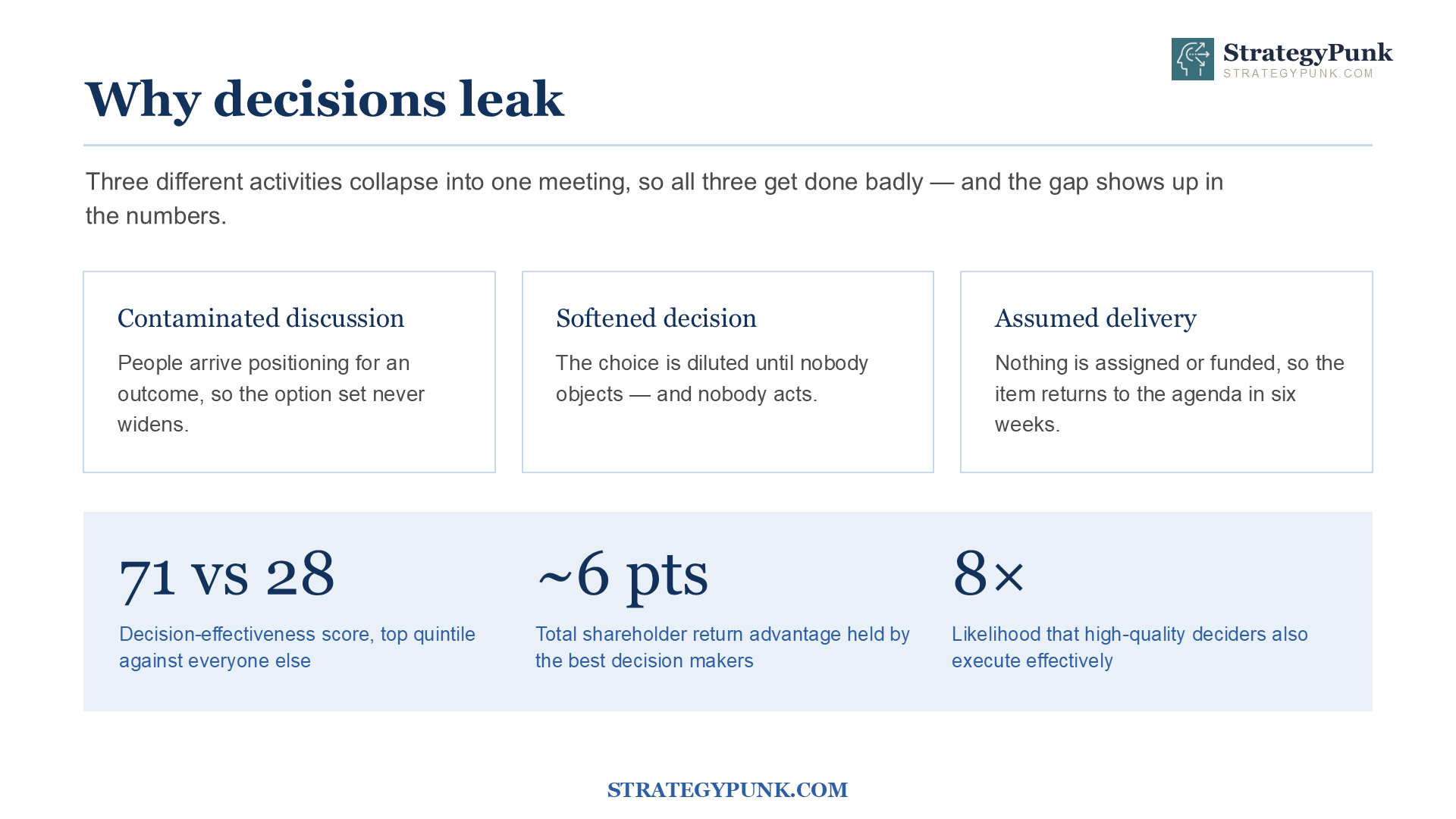
Here is the failure. Three different activities are collapsed into one meeting, so all three are done poorly. The discussion is being influenced by people who are already positioning for an outcome. The decision softens until nobody objects and nobody acts. Delivery is assumed rather than assigned, and six weeks later the item reappears on the agenda as if it were new.
Bain's research on decision effectiveness puts numbers behind the frustration. Across countries, industries, and company sizes, decision effectiveness correlates with financial results at the 95 percent confidence level. Top-quintile organizations score around 71 on a 0-100 decision-effectiveness scale. Everyone else averages 28. The gap shows up in returns, with the best decision makers delivering total shareholder returns nearly six percentage points above their peers.
The gap is not intelligence. It is mode discipline.
One decision. Three modes. Never two at once.
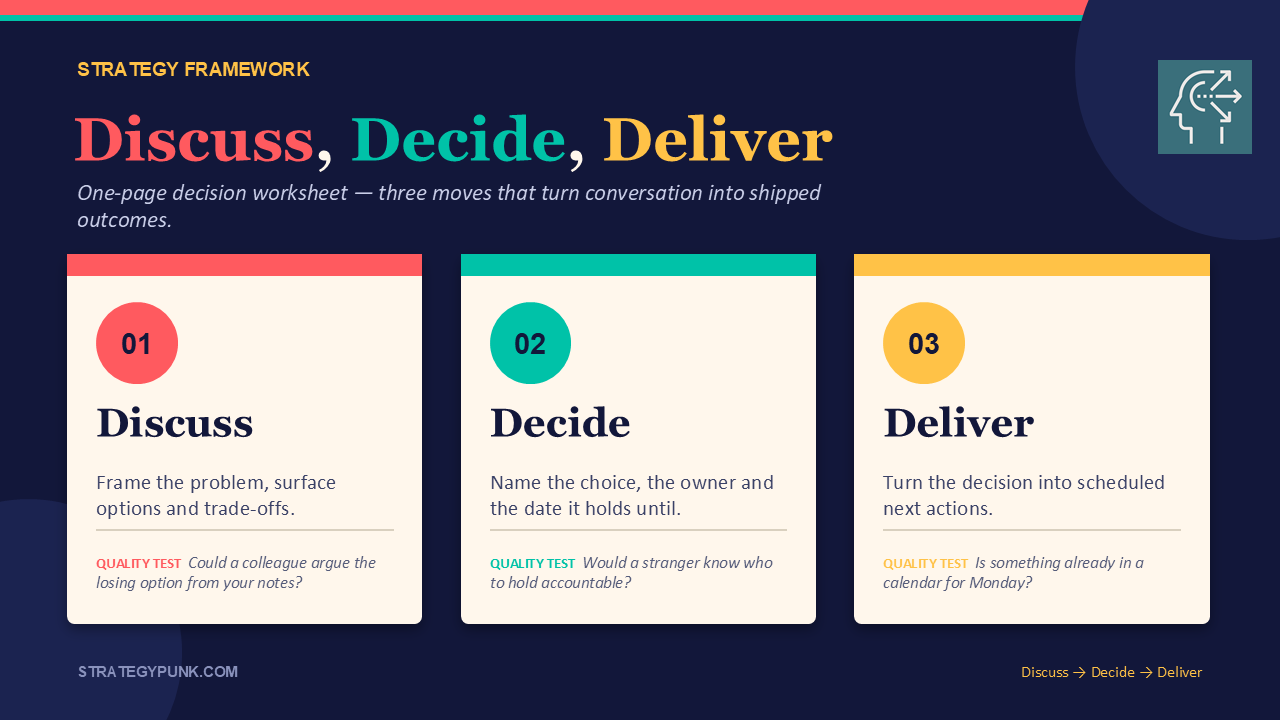
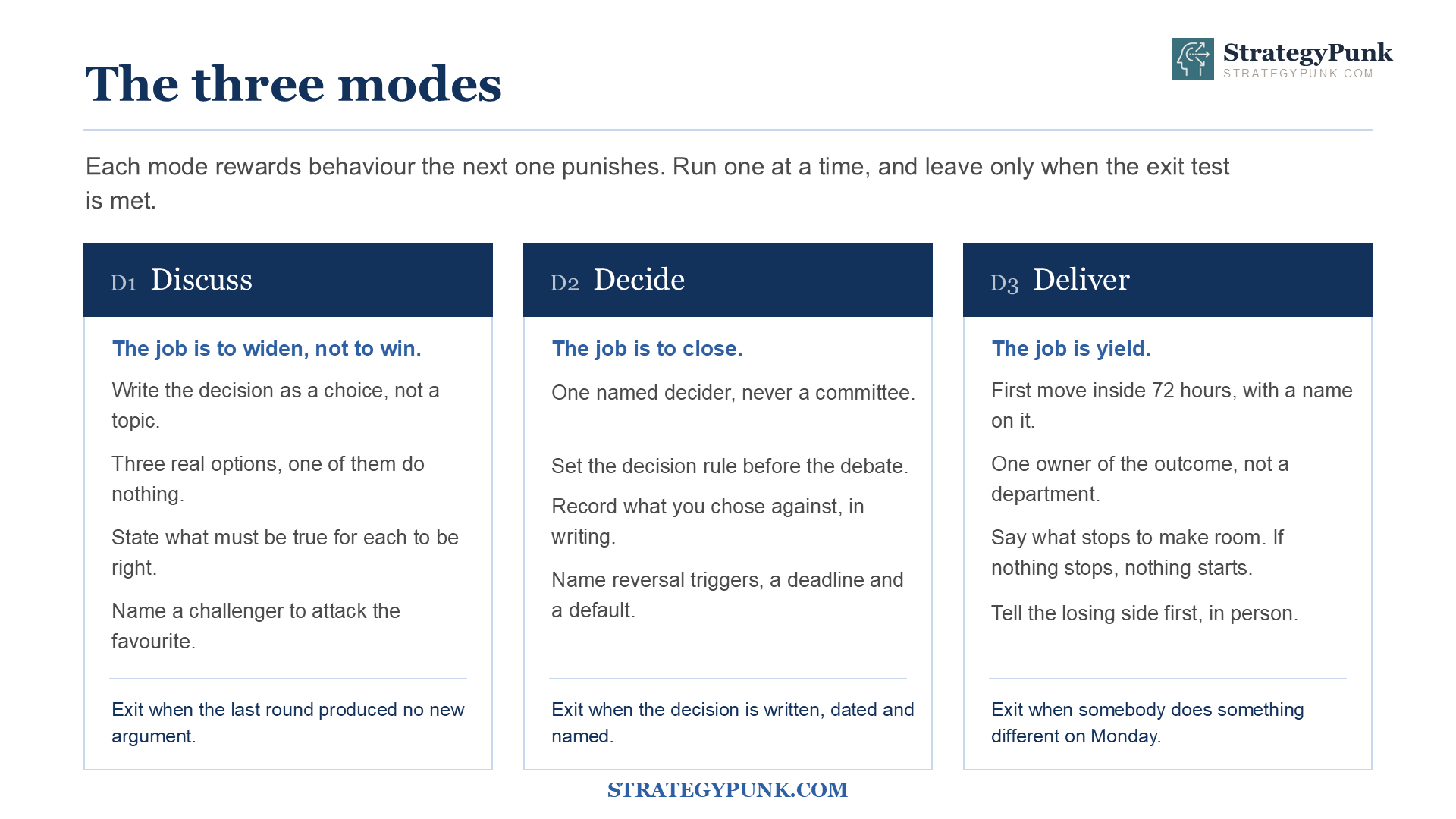
The framework is deliberately small. You take a single decision that matters, and you move it through three modes in sequence. Discuss widens. Decide closes. Deliver moves.
The governing rule is one sentence. You may not decide while still discussing, and you may not discuss once you have decided.
That rule does most of the work. It is also the rule that almost nobody enforces, because breaking it feels efficient in the moment and only costs you three months later.
Phase one: Discuss
The job is to widen, not to win.
Discussion rewards divergence, dissent and slow judgement. The output is not agreement. The output is a set of genuinely different options and the honest case against each one.
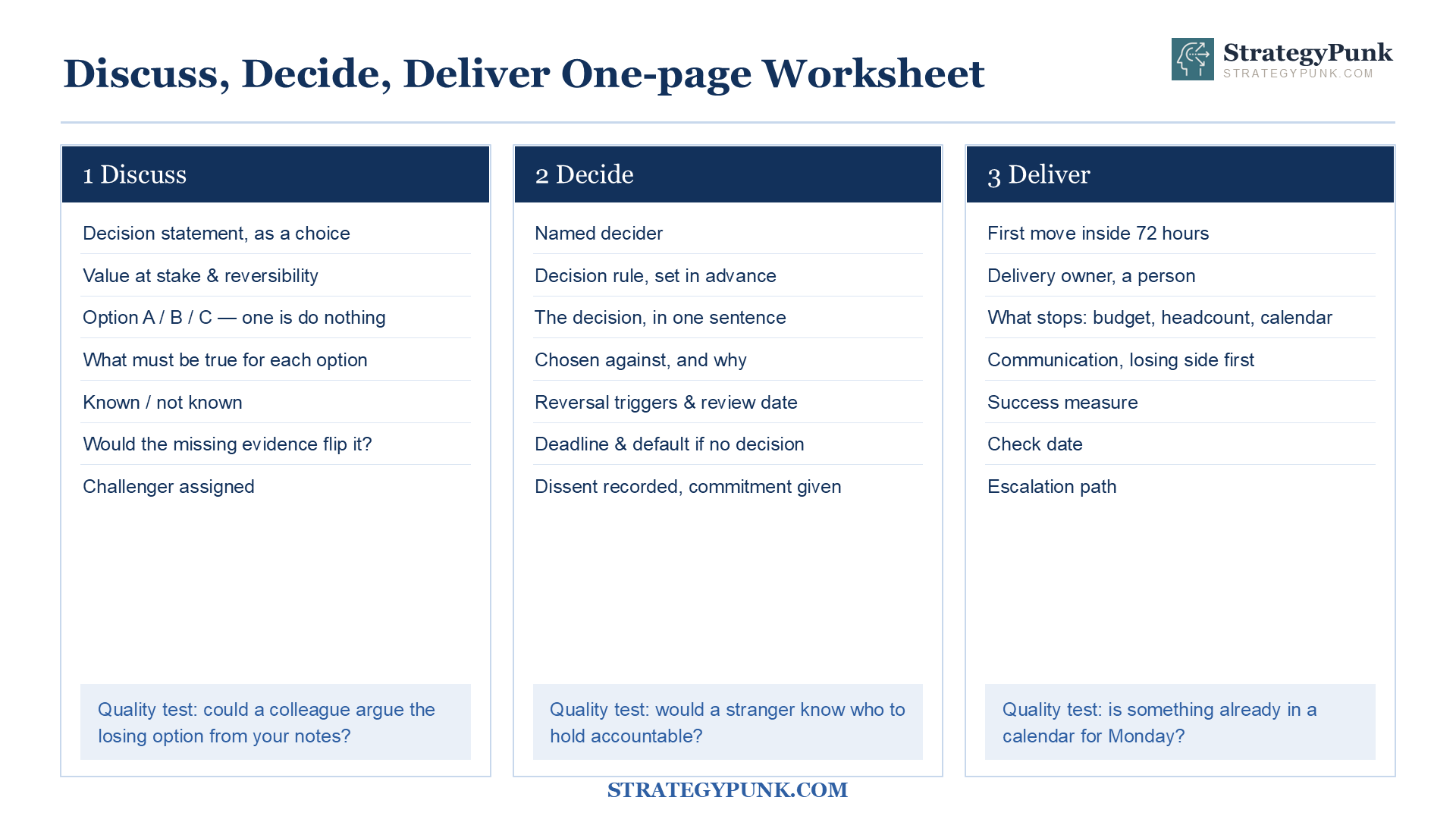
Start with the decision statement. Write the decision as a choice, not as a topic. "Our pricing strategy" is a topic that will take about 40 minutes and has little substance. "Whether to move Southern Europe to a distributor model by Q2" is a choice, and the room now has something to argue about.
Then check the stakes. What is the value at stake, and can you walk it back? High value plus low reversibility earns a full discussion. Low value plus high reversibility should never reach the leadership team at all. It should be delegated. Half of what clogs executive calendars fails this test.
List at least three options, and make one of them do nothing. Then add one that nobody in the room likes. Fake options are the most common form of discussion theatre, one real proposal flanked by two decoys built to lose.
For each option, write down what you would need to believe for it to be right. This converts opinion into a testable claim, and it is where most executive teams discover they are not actually disagreeing about the decision. They are disagreeing about a belief nobody had stated.
Then separate what you know from what you do not. Ask the question that saves months: would the missing evidence change the answer? If it wouldn't, please stop gathering it. Analysis that cannot flip the choice is procrastination in a spreadsheet.
Finally, name a challenger. One person is assigned to argue against the emerging favourite. Not because they believe it, but because an option set that nobody attacked was never tested.
You leave 'Discuss' when the last round of debate produced no new argument, and the remaining disagreement is about judgement rather than facts.
Phase two: Decide
The job is to close.
Decision rewards the opposite of everything Discuss rewards. Convergence, authority, a deadline. This is why running the two modes simultaneously produces poor versions of both.
Name one decider. One person, not a committee, not a function. If a stranger read the page, they should know who to hold accountable. Bain's RAPID model formalizes this across five roles: Recommend, Input, Agree, Decide, and Perform, and the underlying insight is simple. Ambiguous roles are not collaboration. They are a slow queue.
Set the decision rule before the debate, not during it. Single decider after input. Majority. Consensus minus one. Whichever you choose, choose it early, because a rule invented halfway through an uncomfortable conversation is always the rule that favours whoever is winning.
Write the decision in one sentence. Then write what you chose against. This second field matters more than it looks. Unrecorded rejections come back. Please keep the recorded ones closed so that the next time someone raises the distributor option, you can point to the line where it was closed and the reason for the closure.
Add reversal triggers. Name the specific evidence that would make you change course, and set a review date. This is what makes commitment psychologically survivable for the people who disagreed. They are not being asked to believe. They are being asked to commit until the trigger fires.
Set a deadline and a default. If no decision is made by the date, what happens automatically? A decision without a default can be avoided indefinitely, and avoidance is the most popular decision in corporate life.
Then record dissent. Who disagrees, and who has committed anyway. Public disagreement followed by public commitment beats private resentment followed by passive sabotage, every time.
You leave 'Decide' when the decision is written, dated, named, and the losing options are closed in writing.
Phase three: Deliver
The job is yield.
Bain uses the term "yield" to refer to the share of decisions that are actually executed as intended, and it sits alongside quality, speed, and effort in their definition of decision effectiveness. The interesting finding is that these are not independent. Organisations that score highest on decision quality are nearly eight times more likely to execute effectively. Good decisions and good delivery are the same muscle.
Start with the first move inside 72 hours. One concrete action, one named person, one date within three days. If nothing can start within three days, the decision remains abstract and will decay.
Name a delivery owner who owns the outcome rather than the activity. A person, never a department. "Sales will handle it" is how decisions die quietly.
Then the field that kills more fake decisions than any other. What stops you from making room? Budget, headcount, calendar. If nothing stops, nothing starts. A leadership team that decides five new priorities in a quarter without defunding anything has not made five decisions. It has made five announcements.
Plan the communication, including the people whose option lost. They hear it first, from the decider, in person. Losers who hear it secondhand relitigate. Losers who hear it first commit.
Set the success measure and the check date. Then name the escalation path before you need it, because the moment you need it is the moment nobody wants to own it.
You leave 'Deliver' when somebody can do something different on Monday morning, and it is already on their calendar.
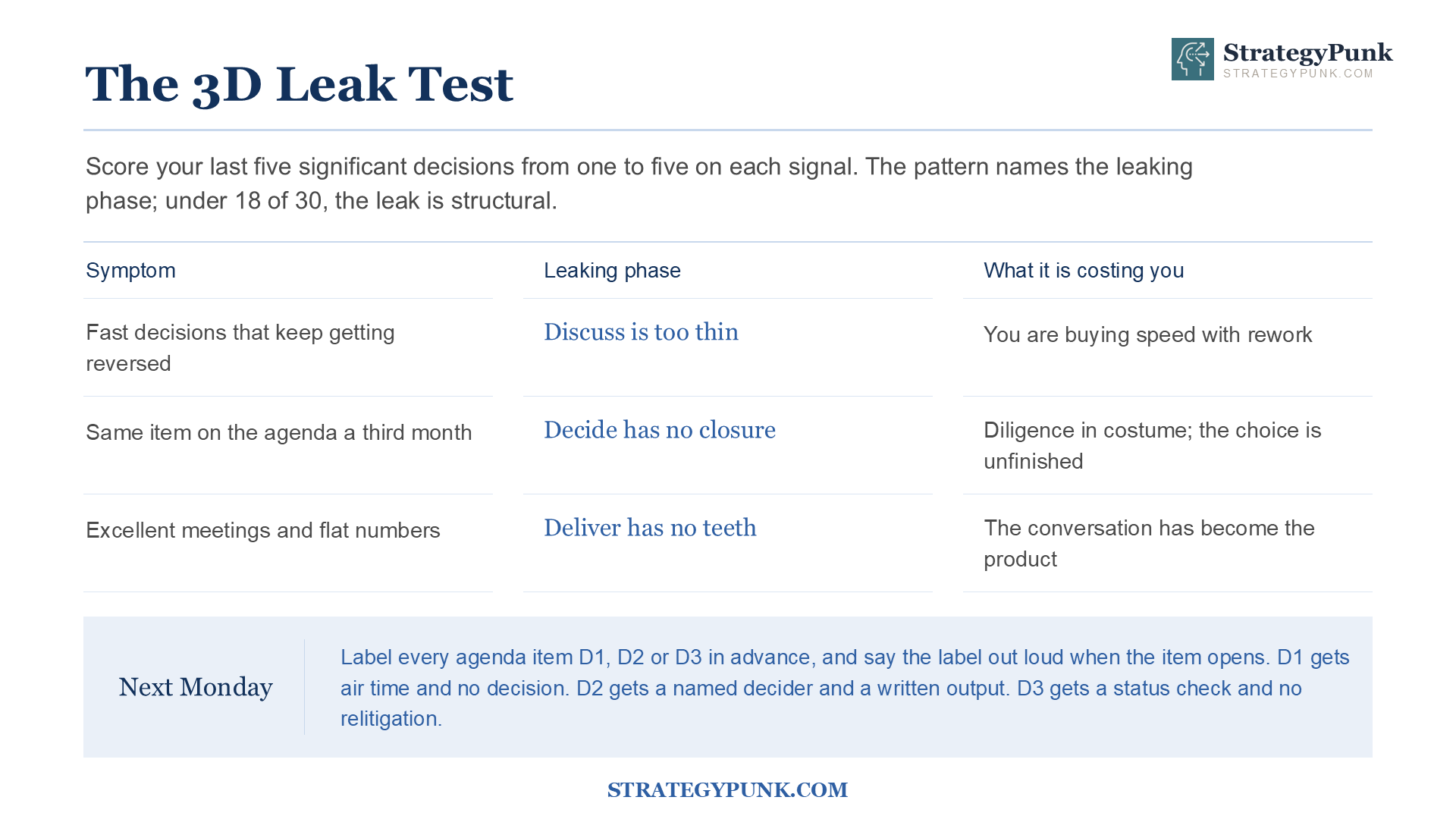
The 3D Leak Test
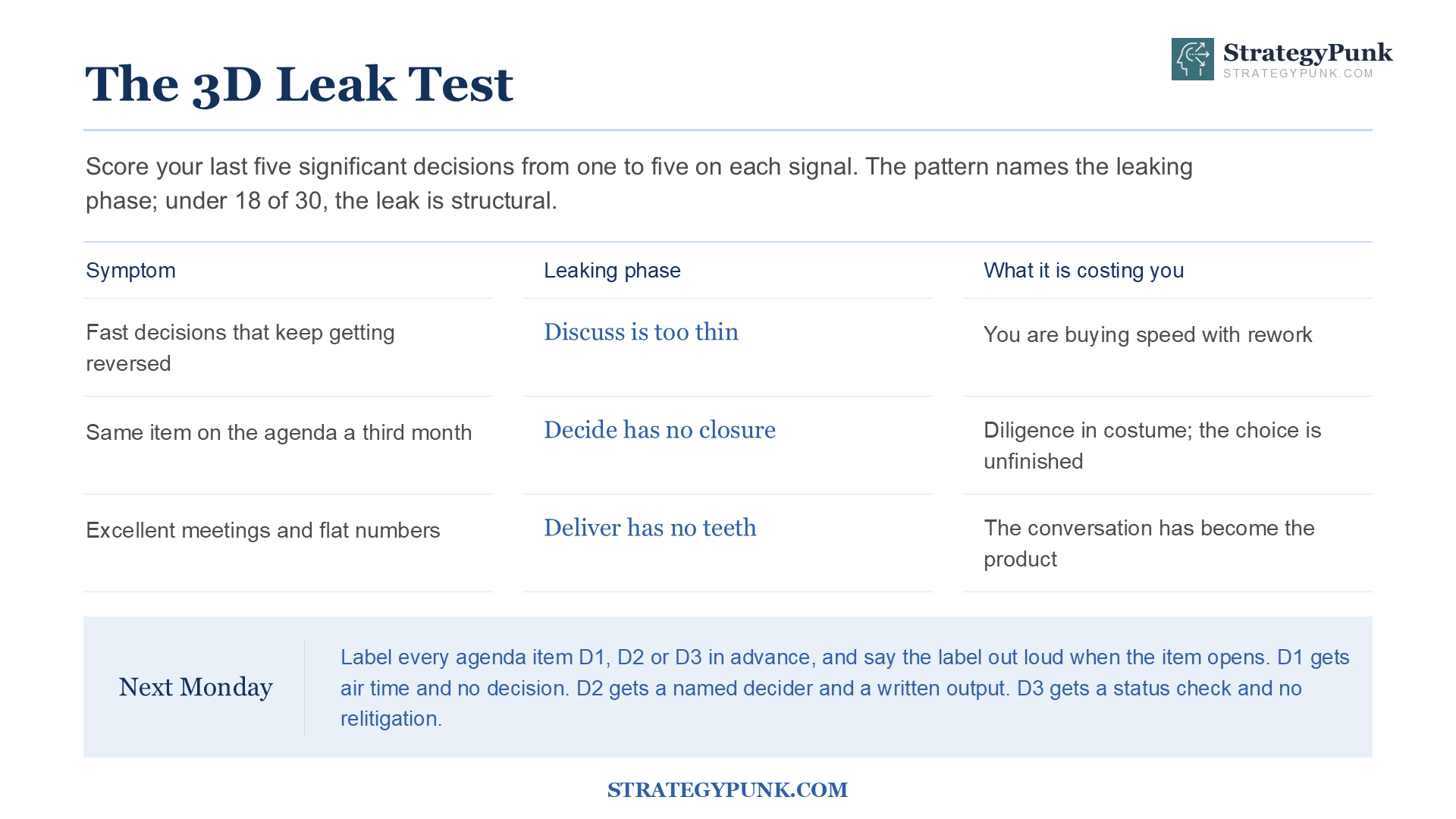
Take your last five significant decisions and score each signal from one to five.
Did we seriously consider a genuinely different path? Did anyone argue against the winning option before it won? Was there a named decider and a written decision? Has the item returned to the agenda without new information? Did behavior or budget change within two weeks? Do we know whether it worked?
The pattern tells you which phase leaks.
When decisions are made quickly and then reversed, with objections surfacing afterward, Discuss is too thin. You are buying speed with rework.
The same item on the agenda for three months running means we have no closure. This is not diligence. It is an unfinished decision wearing the costume of one.
Excellent meetings and flat numbers mean Deliver isn't having much impact. The conversation is the product, and the organization has learned that nothing follows it.
Score under 18 out of 30 and the leak is structural rather than situational. You do not have a bad quarter. You have a decision system that produces bad quarters.
Running it in your calendar
The framework earns its keep when it reaches the agenda. Label every item in advance as D1, D2, or D3, and say the label aloud when the item opens.
D1 items get long air time, an explicit challenger, and no decision. D2 items get short air time, a named decider, and a written output before the room empties. D3 items get a status check against milestones and nothing else. No relitigation.
Most leadership meetings improve immediately, simply by refusing to let a D1 item pretend to be a D2 item.
What this looks like in practice
A mid-sized European component manufacturer, with around 400 people, is deciding whether to replace its direct sales team in Southern Europe with distributors. Roughly 18 percent of group revenue is at stake, and the move is hard to reverse because the direct team would be gone.
In Discuss, three options are on the table. Keep direct. Full distributor. Hybrid, with distributors below one million euro and direct coverage for the top ten accounts. The belief required for full distributor is that a distributor can hold a technical specification conversation without losing the design win. Nobody knows whether the top ten accounts would accept it, and that answer would change the choice, so it gets gathered. The COO is assigned to argue for keeping direct.
In Decide, the CEO is the decider; the rule is a single decider after input; the deadline is three weeks; and the default is to keep direct for another year. The choice is hybrid. The full distributor is closed on the record because the specification influence is the actual product. The reversal trigger is two lost design wins in distributor-served accounts within twelve months. Two executives disagree and commit in writing.
In Deliver, the sales director drafts the account split within 72 hours. Two Iberian sales roles are not backfilled, and regional travel is cut by 40 percent, which funds the distributor margin. Affected staff hear it from the sales director before any customer announcement. The measures are contribution margin and 12-month design win count.
Notice what the worksheet forced. A real alternative. A named decider. A funded trade. None of that is sophisticated. It's written down, which is the part organizations often skip.
The reframe
Most leaders think their decision problem is a judgment problem. They want better analysis, sharper insight, more data before the call.
It usually is not. The judgment was fine. The discussion didn't expand, the decision wasn't finalized, and the delivery wasn't funded. Three modes, run as one, produce a company that is busy, articulate, and slow.
Please separate them and have the same people, with the same information, start shipping.
Sources
- Daniel Grieder on discuss, decide, deliver
- Decide & Deliver: 5 Steps to Breakthrough Performance in Your Organization, Bain & Company
- Bain & Company, Decision Insights: Score Your Organization
- Bain & Company, The Five Steps to Better Decisions
- Stanford GSB, Decide & Deliver
- Crews & Co, teams use the 3D framework to make better decisions
A note on naming. Crews & Co use 3D for a different sequence: Determine, Debate, and Decide. Both are useful. This piece uses the Grieder sequence, Discuss, Decide, Deliver, because it carries execution inside the framework rather than leaving it outside.
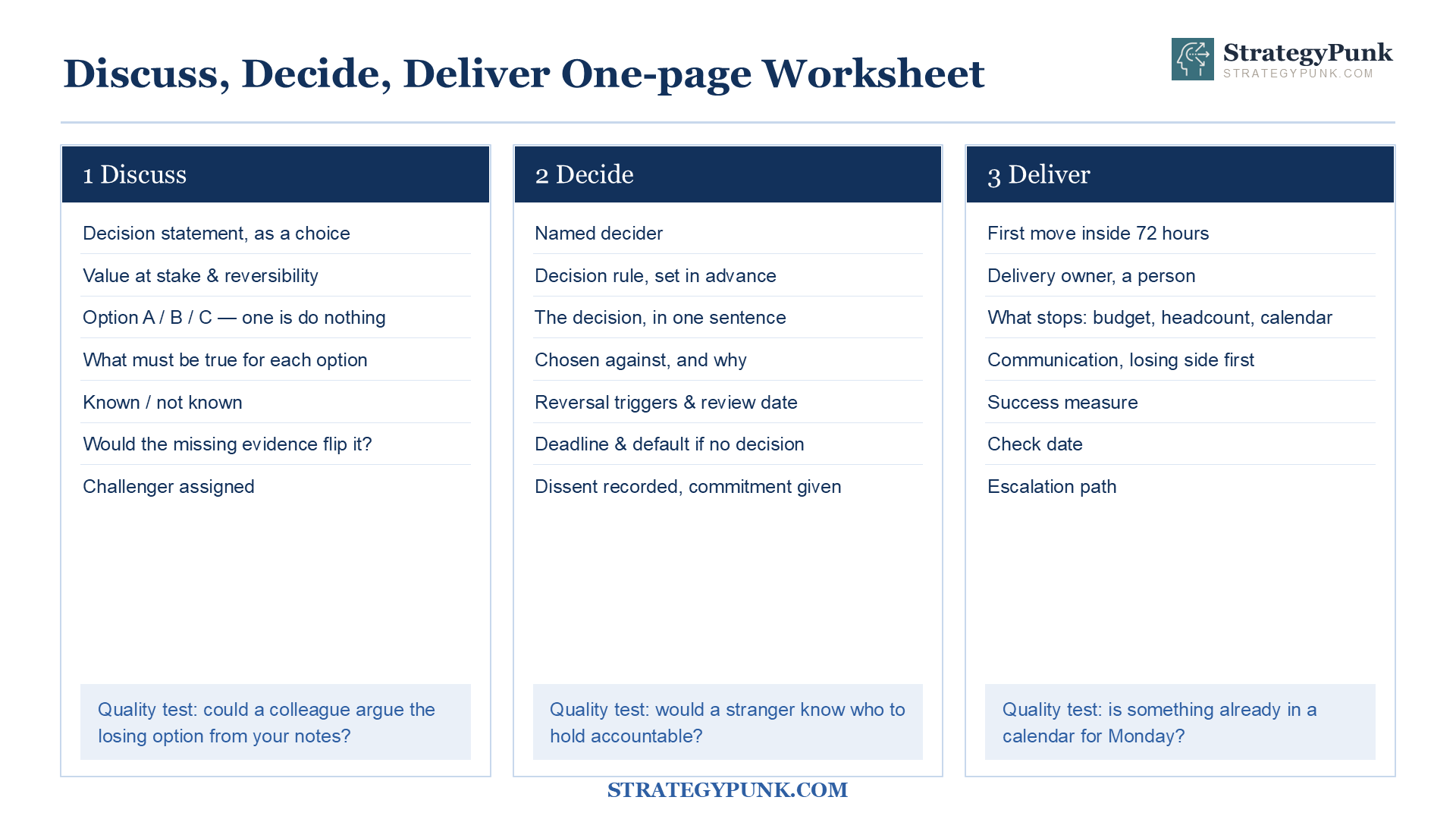
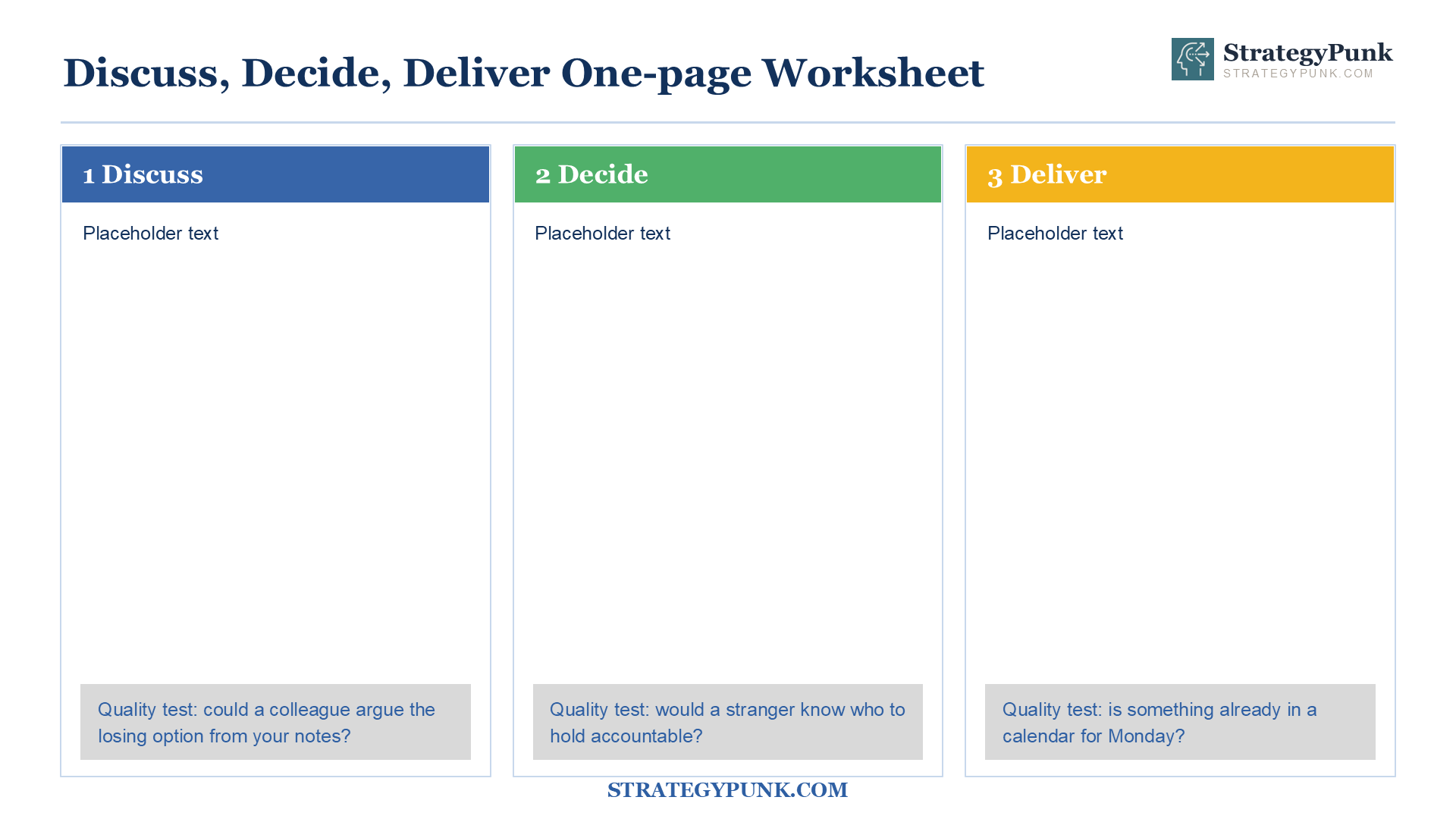
Download the Discuss, Decide, Deliver worksheet.
Download the Discuss, Decide, Deliver worksheet slide deck
Free for members. Create your free StrategyPunk account or log in to unlock both files on this page.
Discuss, Decide, Deliver Worksheet (PDF)
Print-ready. Three worksheet pages, the 3D Leak Test scoring grid, the failure mode diagnostic, and the completed worked example. Made for the table in a leadership offsite.
Slide deck
One-slider
Discuss, Decide, Deliver Worksheet (PowerPoint)
Fully editable .pptx. Same 21 fields, built as slides so you can rebrand it, cut it down, or drop single pages into your own board deck.
Sign up for free to download the PowerPoint
Already a member? Log in, and the download link appears below
No payment. One email. You also get new frameworks as they are published, and you can unsubscribe with one click.