The Tesco Turnaround: 4 Contrarian Lessons in Leading Change from Dave Lewis
How Dave Lewis turned Tesco around after its 2014 crisis: brutal objectivity, strategy by omission, followership and sustainable change. Four lessons for leaders. Free Slide Deck.

Introduction: Leading Change by Dave Lewis from the Tesco Turnaround
Most corporate change initiatives fail long before they reach their intended destination. When a business is in freefall, the atmosphere is rarely one of focused resolve; it is a landscape of frantic chaos, defining inertia, and a desperate scramble for quick fixes.
Source
How to lead change in business by Dave Lewis
In 2014, Tesco wasn’t just "in trouble"—it was a giant in crisis, reeling from a £263 million profit overstatement, plummeting market share, and a fundamental breakdown in public trust. This was the environment Dave Lewis inherited, and his success offers a masterclass in why traditional management theories often collapse under real-world pressure.
Leading a high-stakes turnaround requires more than a fresh set of KPIs or a revised mission statement; it requires a fundamental shift in how leadership perceives the problem. Lewis, acting as the outsider-architect of Tesco’s recovery, approached the task by stripping away the standard corporate jargon that often obscures reality. He argues that if a leader cannot ruthlessly diagnose a business's specific situation, the change agenda is doomed to fail from the start.
Drawing from the front lines of the Tesco recovery, Lewis identifies four principles for leading change that fly in the face of conventional "buzzword" wisdom. These insights go beyond surface-level impressions and focus on the often uncomfortable realities of organizational transformation.
1. The Power of Brutal Objectivity
The first step in any turnaround is the most difficult to execute because it requires an ego-less assessment of failure. Lewis identifies "brutal objectivity" as the most important requirement for change, yet notes it is "the easiest to say and the hardest to do." When a business is in decline, internal teams often develop a defensive myopia, crafting narratives that blame the market, the economy, or "external factors" rather than facing their own obsolescence.
At Tesco, this objectivity wasn't about inventing a radical new identity; it was about the painful process of stripping away the distractions that had obscured the company’s original core strength. Lewis’s "abiding mantra" was to put the customer back at the heart of decision-making—a move that was actually a return to what Tesco had historically done better than anyone else. Objectivity, in this sense, is the courage to admit that you have drifted from your own excellence.
"It's always the case that a business that finds itself in trouble finds it very difficult to objectively face the fact of why it's in that position."
2. The Strategy Trap: Omission Over Addition
In many corporate boardrooms, "strategy" is mistakenly equated with "capability building." Consultants often sell the idea that a turnaround requires a massive influx of new skills—more digital expertise, more logistics layers, more data scientists. Lewis, however, dismisses this approach. While adding skills is important, it is not a competitive strategy; it is merely paying the "table stakes" to stay in the game.
The "Capability Trap" suggests that if we get better at everything, we will win. Lewis offers a contrarian alternative: strategy is about what you leave out. It is the discipline of identifying one to three "differentiating competencies" and deciding to be better at those specific things than anyone else in the world. Being "good at many things" is a recipe for mediocrity. True strategy lies in a narrow focus on the levers that actually drive the turnaround.
Strategy is about being better than anyone else at a specific thing, not just adding skills.
3. The Leadership Myth: Why Followership Matters More
Leadership literature is an exhausted genre, yet Lewis pivots to a concept that is far more critical in a crisis: Followership. He references the intellectual challenge posed by Rob Goffee and Gareth Jones (often associated with the question raised in their seminal work): Why should you lead anyone?
This question is particularly pointed for an outsider CEO. When Lewis arrived at Tesco, he was leading a legacy culture of people who had been with the business for decades—people who, in his words, "didn't know where we came from." In this environment, a leader cannot simply command progress through hierarchy. You have to "recruit" the workforce to the cause. You are not a general; you are a recruiter, constantly earning the right to lead people into an uncertain future. Without active followership, cultural change is just a memo that everyone ignores.
4. Avoiding the Short-Term Improvement Trap
A dangerous phenomenon in business is the "flash"—a temporary spike in performance driven by sheer force of will or short-term cost-cutting. Lewis warns that "anyone" can improve a business for a short time. You can squeeze margins or slash budgets to make the next quarter look stellar, but that isn't a turnaround; it's a stay of execution.
The true measure of leadership is whether the success is sustainable. Real sustainability means that the structural and cultural changes are so deeply embedded that the business stays successful long after the initial push—and long after the leader has departed. If the performance of the organization depends entirely on the constant "push" of the current CEO, the change hasn't actually happened.
Conclusion: The Question Every Leader Must Answer
The path to transforming a business is paved with clear, objective thinking, a focused strategy of omission, the active recruitment of followers, and a relentless focus on sustainability over short-term gains. To move from managing chaos to driving long-term success, a leader must stop hiding behind corporate jargon and face the difficult reality of their team’s perception.
Ultimately, you cannot mandate a turnaround; you must invite your people to build it with you. You must provide a compelling answer to the most fundamental question of followership.
If you were to ask your team today, "Why should you follow me?"—would you be prepared for the answer?
Key Takeaways: What are the four core lessons for leading business change?
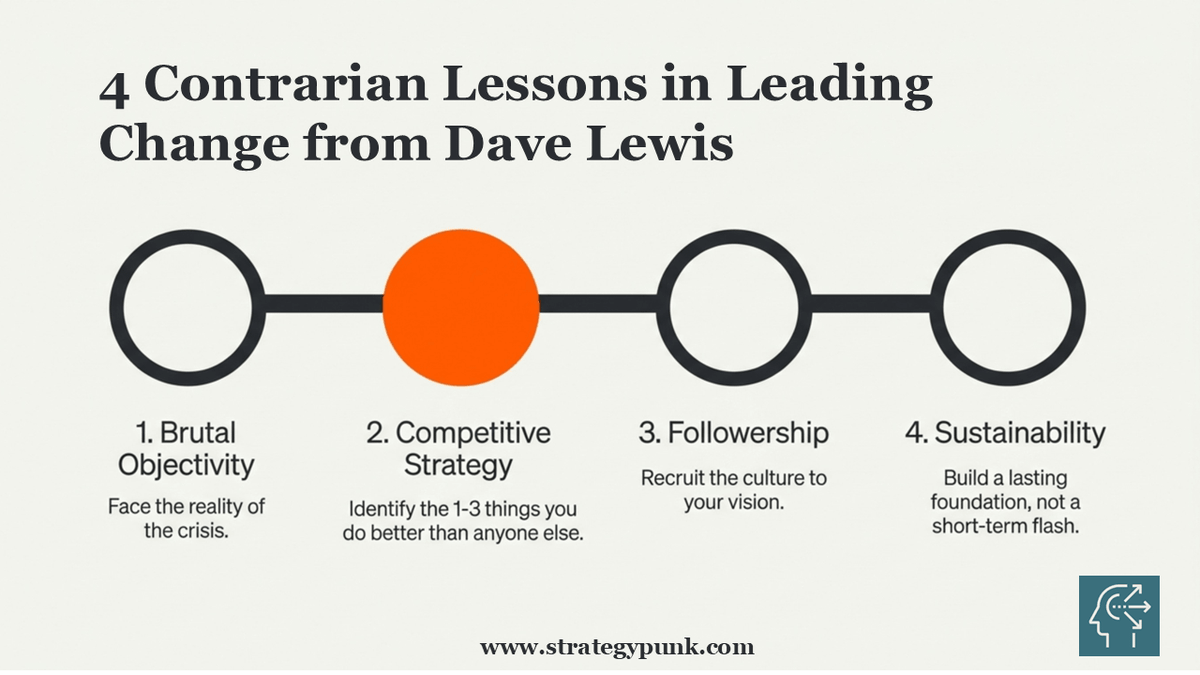
Dave Lewis outlines four core lessons for leading business change and turnaround, preconditioned on first thoroughly understanding the business's current situation:
- Brutal Objectivity: Troubled businesses must objectively face the hard facts of why they are struggling rather than falling into denial. In Tesco's case, this meant placing the customer back at the heart of every decision.
- Differentiating Competencies: A competitive strategy requires more than just general capability building. Leaders must identify the one to three unique competencies that the business can perform better than anyone else to drive a true competitive advantage.
- Followership: True change depends on inspiring others to join you. Leaders must continuously answer the question, "Why should anybody follow you?" and focus on actively recruiting people into the change process.
- Long-Term Sustainability: A short-term improvement is possible for almost any business, but a successful turnaround requires embedding long-term sustainability so the business remains successful over time.