
10 Strategy Frameworks Every CEO Needs to Know (Free PPTs)
Ten strategy frameworks every CEO actually needs. Not a library. A working set for real decisions, from board questions to Monday mornings.
Most CEOs do not lack frameworks. They lack the right ten.
The shelf groans with two-by-twos, canvases, and cascades. Few survive a Monday morning. The frameworks that earn their place do three things. They force a choice. They reveal a contradiction. They translate intent into a decision that the company can act on this quarter.
This is the working set. Ten frameworks worth keeping within reach. Each one answers a question a CEO actually faces. Where do we play? Where do we win? What do we protect? What do we kill? Who do I have to become to lead through it?
1. The Strategy House
 StrategyPunk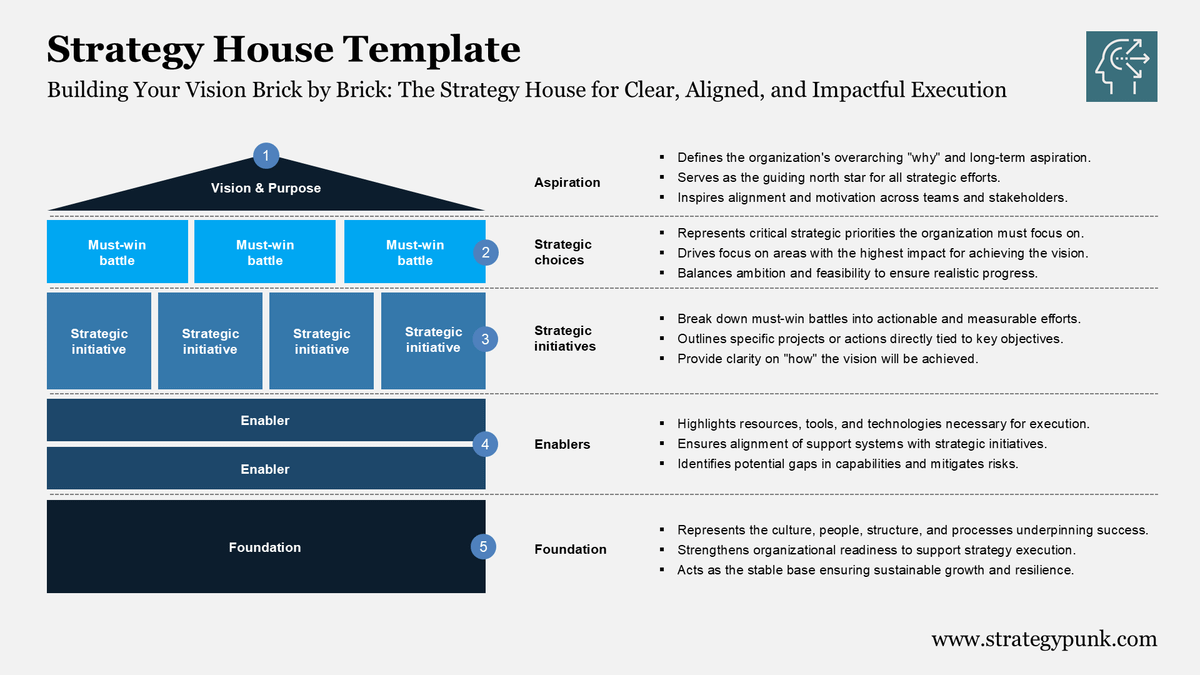
The roof carries the ambition. The pillars carry the priorities. The foundation carries the enablers. One page. One picture. One shared language.
Most teams misuse it. They label pillars as Sales, Operations, R&D, and then each function adds its own priorities. The result is not a strategy. It is a budget request framed. Pillars must represent cross-functional outcomes. "Win the mid-market segment" cuts across product, sales, marketing, and operations. "Sales" does not.
The discipline is not in building the house. It is used as a filter. Every budget request, every urgent initiative, every shiny new project gets routed through three questions. Does this serve as a pillar? Does this strengthen an enabler? If yes, where does it sit? If not, why are we discussing it?
The house gives a CEO a way to say no without it feeling arbitrary. Over time, it reveals strategic drift. If most new requests land outside the pillars, either the market has shifted or the organization is losing focus. Both are CEO problems. Both items need to be addressed before the quarter closes.
2. The Win Growth Matrix
 StrategyPunk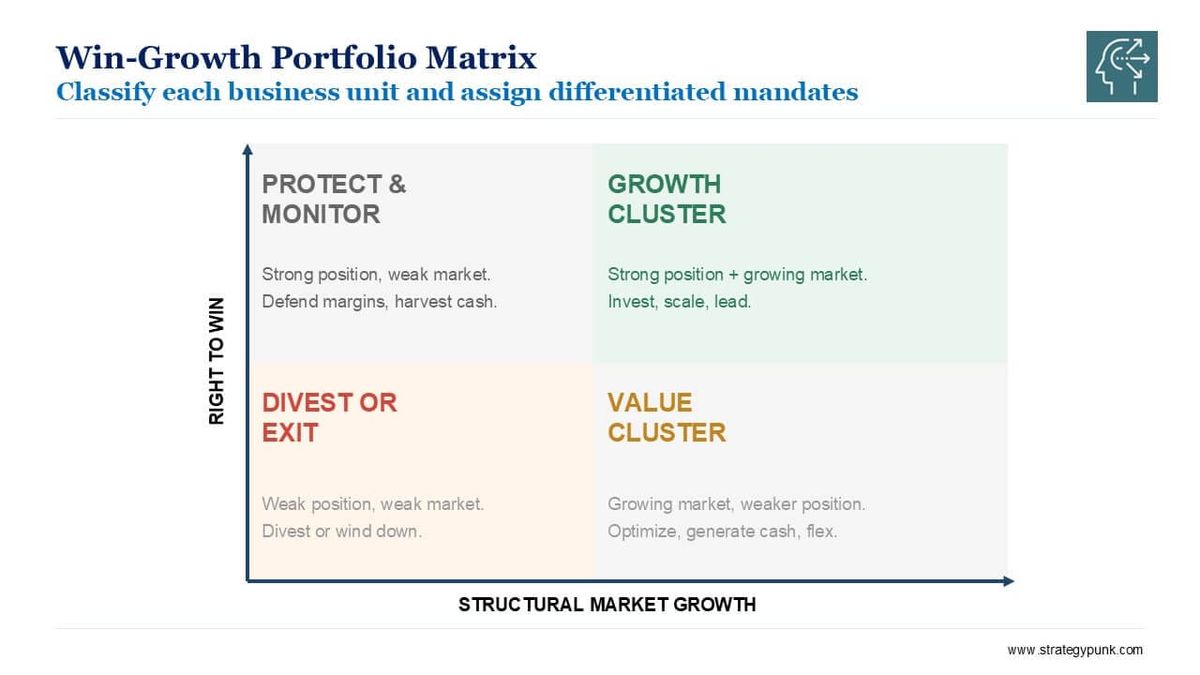
The classic portfolio view sorts business units into core and growth. That binary fails. It starves strong units in flat markets and overfunds weak units in growing ones. Capital drifts. Returns compress. The portfolio loses coherence without anyone making a single bad call.
The Win Growth Matrix plots each unit on two axes that actually drive value. Structural market growth on one side. Right to win on the other. Four clusters emerge. Each cluster gets a differentiated mandate.
Grow clusters earn aggressive investment, faster decision rights, and a higher tolerance for execution risk. Value clusters earn optimization mandates, cash discipline, and selective bets to shift them upward. Hold clusters earn cost containment and patient capital. Exit clusters earn a clock.
The power lies in the word "differentiated". Having the same KPIs across a mixed portfolio means strong units subsidize weak ones, and the CEO never knows. Different KPIs per cluster force honesty. A growth cluster missing revenue is a different problem from a value cluster missing margin. Treating them the same destroys both.
Review the matrix annually. Positions shift. Markets evolve. The map is not the territory, but it is the only map that survives contact with the board.
3. Porter's Five Forces
 StrategyPunk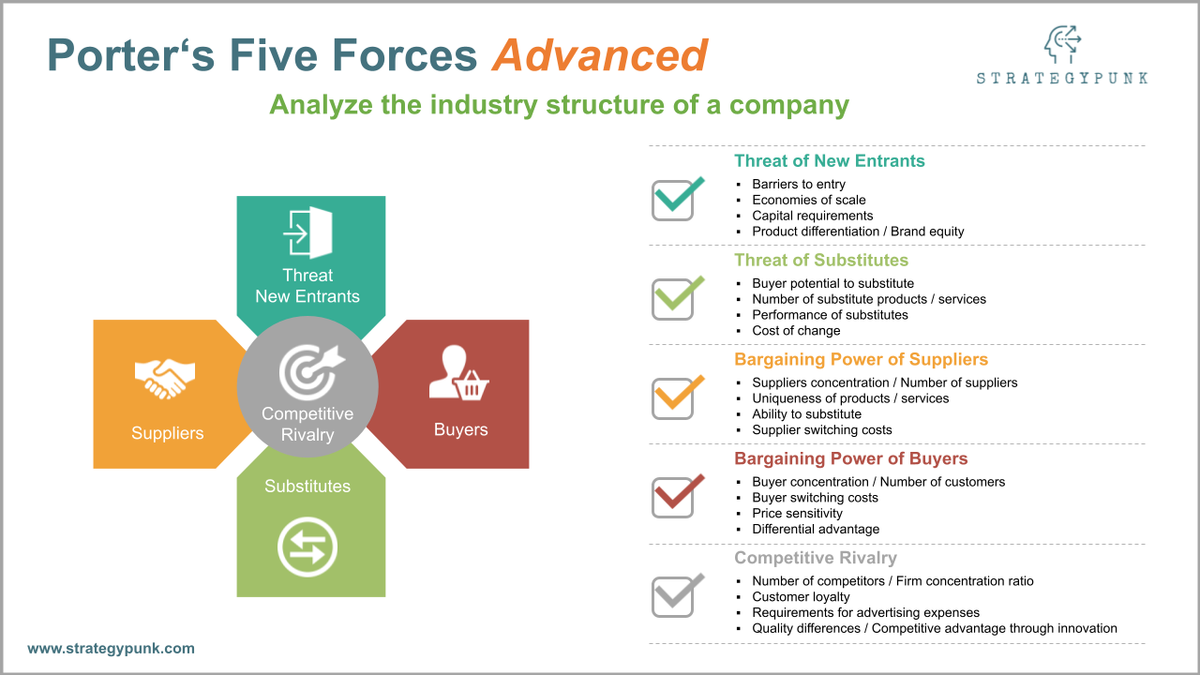
Porter's frame answers the question most CEOs never pause to ask. Why does this industry make money, or fail to? Five forces shape the answer. Buyer power. Supplier power. Threat of substitutes. Threat of new entrants. Competitive rivalry.
The trap is treating rivals as the only enemy. Margin gets eaten just as efficiently by powerful buyers, demanding suppliers, and substitutes from adjacent industries. The airline that beats its peers on capacity utilization still loses to the consolidated fuel supplier and the customer who refuses to pay more than the cheapest fare on the comparison engine.
Substitutes are the most underweighted force. They rarely look like competitors until they are. Streaming did not beat cable by being cheaper. It beat cable by solving the same job from outside the category.
A CEO using Porter well asks three questions every planning cycle. Where is our profit pool vulnerable? Who else is trying to claim it? What structural moves widen the moat? Market share targets without a Porter view are vanity metrics. They reward growth that does not compound into earnings.
4. McKinsey Three Horizons
 StrategyPunk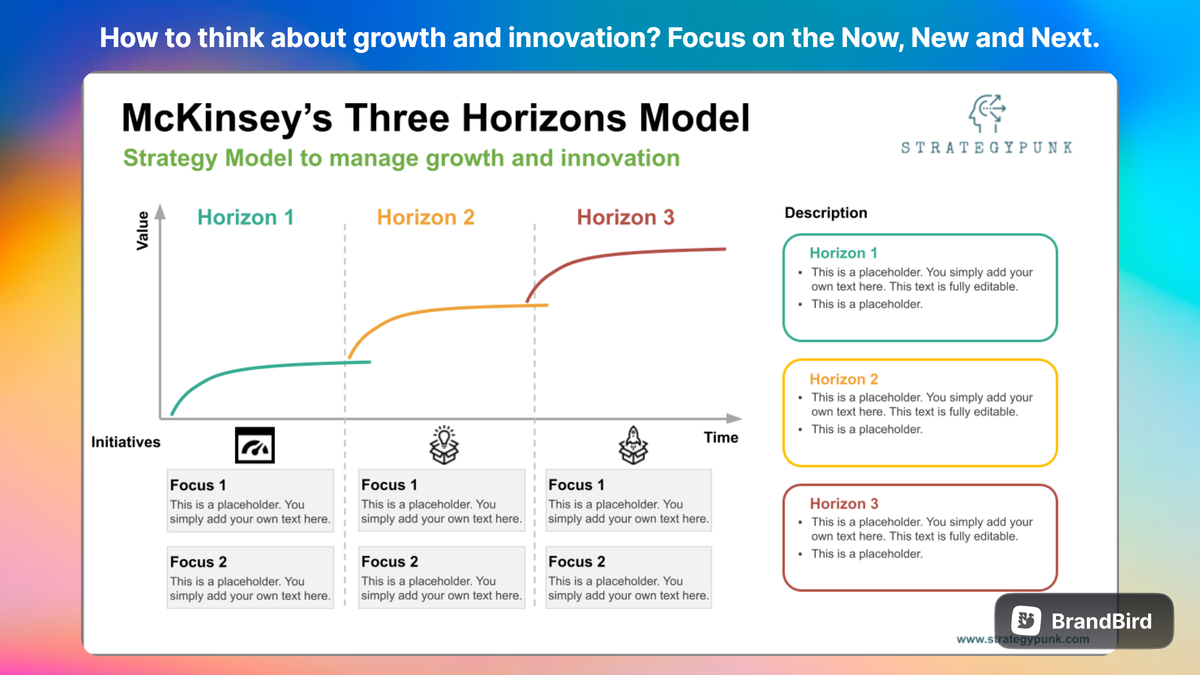
Now. New. Next. Three time horizons. Three different funding logics. Three different governance models.
Horizon 1 defends and optimizes the core. Horizon 2 develops emerging businesses that are expected to scale within a few years. Horizon 3 seeds the bets that may define the company a decade out. The framework looks simple. The discipline is brutal.
Most companies starve H2S and H3S and call it "focus". The numbers look fine for a few quarters. Then the core matures, H2 has no pipeline, H3 has no seedlings, and the CEO is left to explain a flat curve to the board, with no growth story to anchor the narrative.
The framework forces explicit allocation. How much capital, how much management attention, how much risk tolerance sits in each horizon? The split does not have to be 70:20:10. It has to be deliberate. Embedded in the budget. Visible on a single page. Owned by leaders with the authority to make calls without H1 vetoing them on quarterly variance grounds.
CEOs who treat the three horizons as a calendar rather than a portfolio collapse them into one timeline. That is how good companies become slow ones.
5. Playing to Win
 StrategyPunk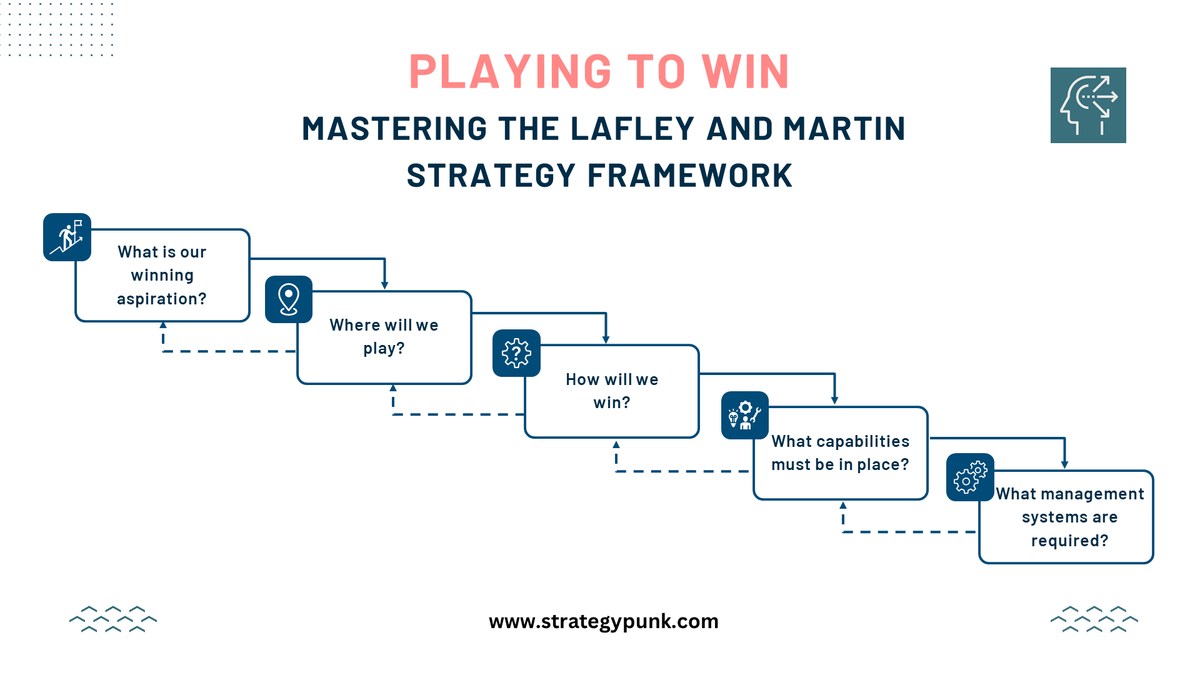
Lafley and Martin built five cascading choices. Winning aspiration. Where to play. How to win. Core capabilities. Management systems. Each choice constrains the next. Break the chain, and the strategy unwinds.
The aspiration is not a vision statement. It is a definition of winning specific enough to be measured. "Be the most admired" fails the test. "Double profit pool share in the premium segment within five years" passes.
Where to play forces geography, segment, channel, and product line choices. How to win names the source of advantage. Cost. Differentiation. Network. Speed. Capabilities and systems make the strategy operational. The whole cascade fits on one page.
The strength of the framework is that it surfaces incoherence. If the aspiration is global premium leadership but the where-to-play is regional and budget-tier, the strategy is unlikely to succeed before launch. CEOs use the cascade in two settings: annual planning. And mid-year, when the market punishes the company for something, the cascade should have flagged six months earlier.
Playing to Win does not generate the choices. It doesn't allow the CEO to claim the choices have been made when they haven't.
6. Market Attractiveness vs Ability to Win
 StrategyPunk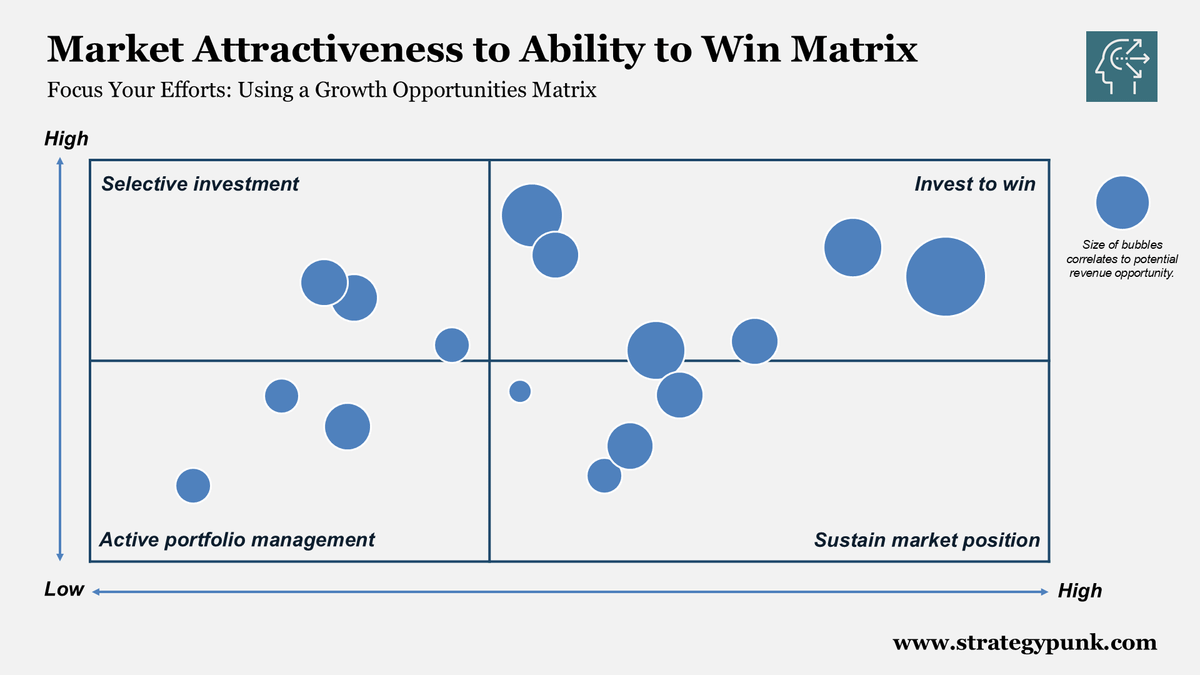
Two axes. Market attractiveness on one. Ability to win on the other. Four quadrants. Four postures.
The top right combines attractive markets with strong positions. Invest to win. Top left is the seduction trap. Attractive markets where the company cannot credibly compete. Selective investment, partnerships, or restraint. Bottom right is the cash position—strong stance in a flat market. Optimize and harvest. Bottom left is the exit signal. Weak in a weak market. Redeploy the capital.
The matrix earns its place in CEO meetings because it prompts candid discussion. Most leadership teams overestimate their ability to win. They confuse aspiration for capability. The framework demands evidence. Customer wins. Cost position. Talent depth. Distribution reach.
Pair it with the Win Growth Matrix as a stress test. If a business unit lands in different quadrants across the two frames, one of the analyses is wrong. Reconciling the difference is where the real strategy conversation begins. CEOs who skip that reconciliation often skip it because they'd rather not hear the answer.
7. The Strategic Coherence Matrix
 StrategyPunk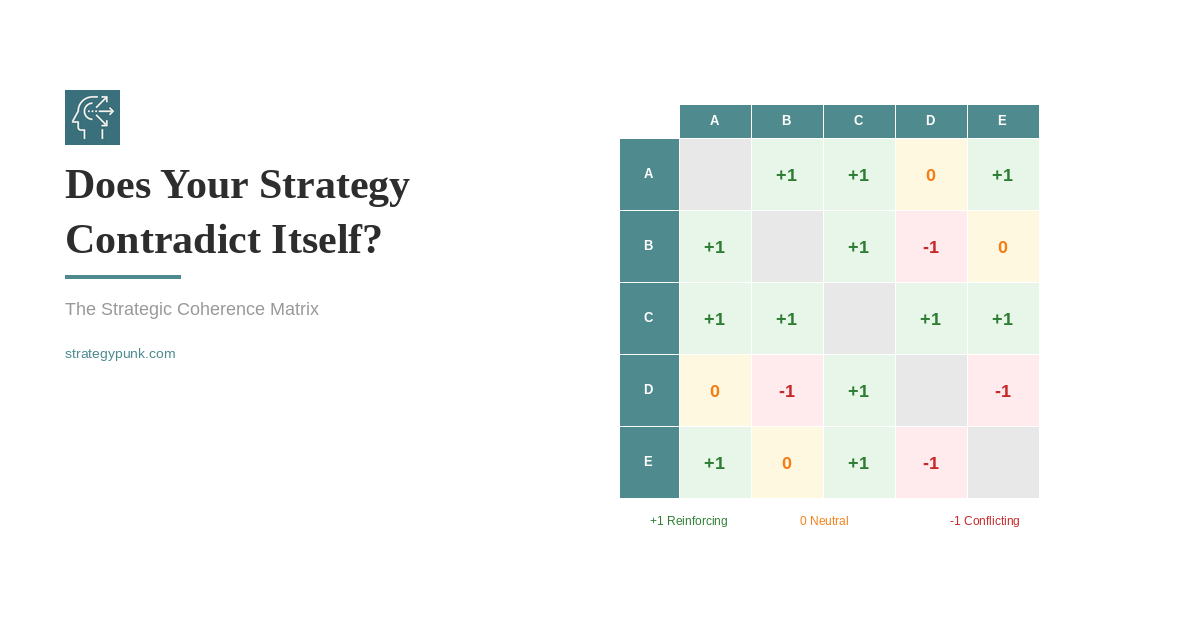
Most strategies fail not because the individual choices are wrong, but because the choices contradict each other. The Strategic Coherence Matrix is the cross-check.
List the major strategic decisions on both axes. Pricing, channel mix, talent investment, capacity plan, product roadmap, geographic footprint, brand position. Score each pair for alignment. The matrix lights up the conflicts.
Premium pricing plus a discount channel partner. Innovation aspiration plus a hiring freeze. Global ambition plus a domestic-only leadership team. Each one is the sort of contradiction that survives in PowerPoint and dies in the field. The matrix surfaces them in the room, before the budget locks.
A CEO running this exercise once a year catches the strategic drift that no individual function will flag, because every function is doing what makes local sense. Coherence is the CEO's job. Nobody else has the view.
The Coherence Matrix is not glamorous. It is plumbing. But strategies do not collapse because the roof leaks. They collapse because the plumbing was never inspected.
8. The Strategy Bridge (TOWS)
 StrategyPunk
SWOT generates four lists. Strengths, weaknesses, opportunities, threats. Lists are not strategies. The Strategy Bridge, often called TOWS, takes the same inputs and crosses them.
Strengths crossed with opportunities yield the offensive plays. Where leverage meets a moving market. Strengths crossed with threats yield the defensive plays. Where the firm protects what it has. Weaknesses crossed with opportunities yield improvement bets—the capabilities to build now to capture markets later. Weaknesses crossed with threats yield the survival agenda. The things to avoid or fix before they become existential.
The frame turns description into a directive. It also generates a natural sequencing. SO moves fund growth. ST moves protect the base. WO moves run medium term. WT moves are urgent and unglamorous.
CEOs who run the bridge well leave the room with a portfolio of moves and a clear logic for why each one was chosen. CEOs who run only SWOT leave with a list and a feeling. One translates into execution. The other translates into another offsite.
9. Why How What Now
 StrategyPunk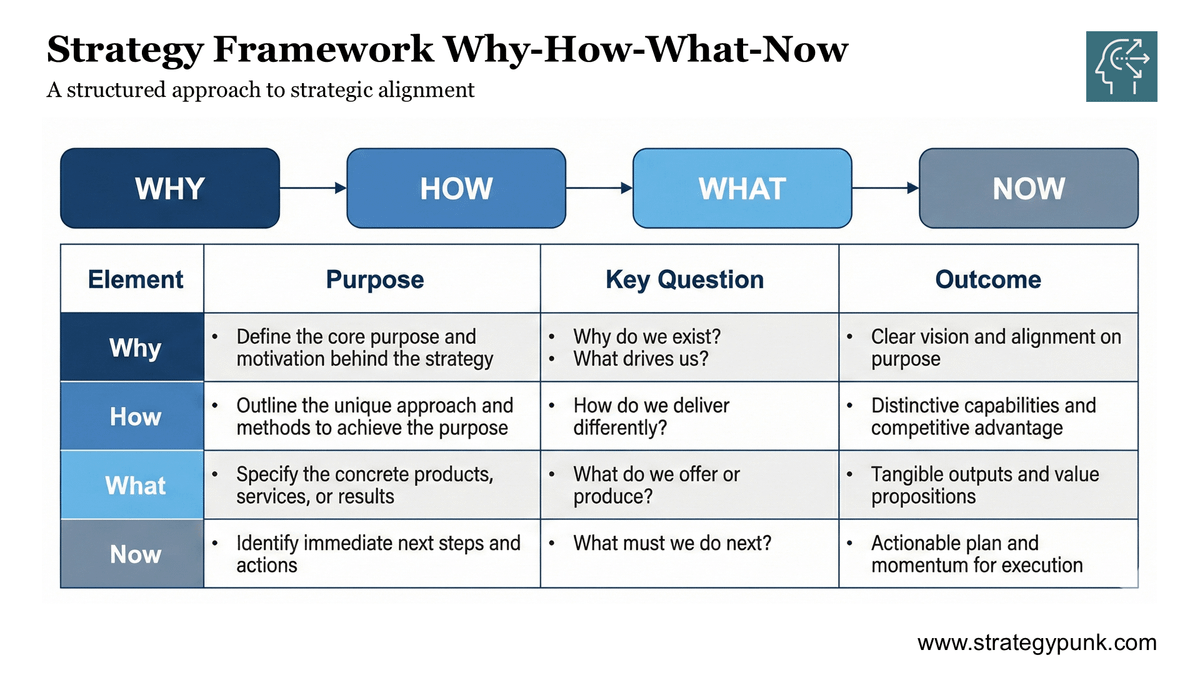
A strategy that does not connect to a calendar is theater. The Why-How-What-Now framework closes the gap.
Why name the purpose? The reason the company exists is not just to make money. How does the operating model name? The system that produces the outcome. What names the initiatives? The discrete bets the company is making this year. Now name the next quarter. The two or three things that have to ship before the next review.
The framework is unsentimental. It cuts the strategy into pieces that a team can actually hold. Most companies have a "Why" and a "What"—the "How" is implicit and inconsistent. The Now floats free of both. The framework forces the four to line up.
CEOs use it to test alignment. If the Why and the Now point in different directions, the company is running on inertia. If the How doesn't produce the What, the operating model needs a change, not more effort. If the Now keeps slipping, the issue is rarely capacity. It is rarely focused. Most often, it is that the "why " was never sharp enough to filter out the noise.
10. The CEO Resilience Framework
 StrategyPunk
The frameworks above tell a CEO what to decide. This one tells the CEO who has to be in the chair when the decisions land.
Three traits separate CEOs who endure from those who flame out. Emotional awareness. Comfort with discomfort. Cross-functional empathy.
Emotional awareness is the ability to notice the unintended consequences of one's own behavior. Most CEOs underweight it because operational signals are louder. The damage shows up months later in the team's body language before it shows up in the numbers.
Comfort with discomfort is the willingness to hold tension without rushing to relieve it. The hardest stretch of any strategy is the middle, where the old model still pays the bills, and the new model has not yet proven itself. CEOs who collapse this stretch by reverting to the comfortable answer kill the transition.
Cross-functional empathy comes from operating across the whole organizational machine. A CEO who spent two decades in finance and never sat next to product, sales, or supply chain will misjudge talent and misread bottlenecks. The fix is intentional lateral friction. Sit in the rooms where you are the least informed person. Stay long enough to understand the trade-offs.
Strategy frameworks change. The capacity to hold them does not.
A Working Set, Not a Library
Frameworks are not the strategy. They are the language.
The CEOs who outperform are not the ones with the most frameworks on the wall. They are the ones who reach for the right one at the right moment, and discard it the second it stops paying its rent. Ten is a working set. Memorize them. Practice them. Then forget them, until a board question, a market shift, or a quiet Monday morning makes one of them indispensable.
That is when the framework earns its place. Not on the wall. In the decision.