SBI Feedback Model: Free PPT Template & Guide [2026]
Vague feedback triggers defensiveness and kills growth. Learn how the SBI model helps leaders deliver precise, high-impact feedback — with a free PDF & PPT worksheet.

![SBI Feedback Model: Free PPT Template & Guide [2026]](https://storage.ghost.io/c/e1/13/e113a418-b417-4712-85d0-9c926515c271/content/images/size/w1200/2026/05/Folie1-9.PNG)
1. Why Feedback is a Strategic Imperative
In high-stakes environments, feedback isn't just a managerial duty—it drives organizational performance and shapes your culture. As a leader, your ability to deliver precise, high-quality feedback is what separates a culture of growth from one of stagnation.
The biggest trap leaders fall into is vagueness. Subjective or vague feedback doesn't just confuse people; it acts as a social threat. When feedback is poorly structured, it can trigger a "fight or flight" response, shutting down the recipient's ability to actually process what you're saying.
To fix this, replace judgment with facts. Developed by the Center for Creative Leadership (CCL), the Situation-Behavior-Impact (SBI) model is the definitive tool for removing subjectivity. It ensures your professional development conversations stay objective, actionable, and built on trust.
2. The Anatomy of the SBI Model
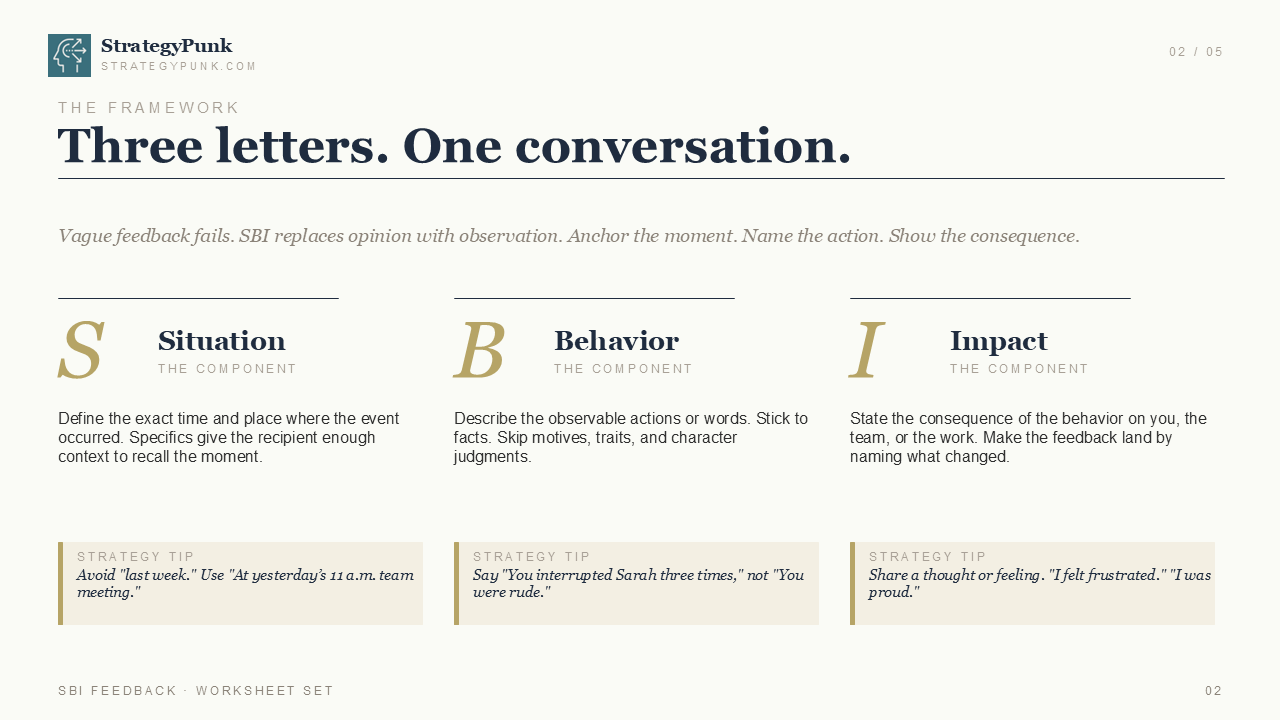
The SBI model breaks down a feedback event into three observable parts, allowing the recipient to visualize exactly what happened.
| Component | Definition | Core Objective |
|---|---|---|
| Situation | The specific context (time and place) of the event. | To anchor the recipient’s memory and help them visualize the occurrence. |
| Behavior | The actual, observable actions or words demonstrated. | To provide a factual account without interpreting motives or personality. |
| Impact | The thoughts, feelings, or consequences resulting from the behavior. | To explain the "ripple effect" and inspire action. |
3. How to Apply SBI in Real-Time
Step 1: The Situation (Setting the Scene)
Context is everything. Be surgically precise about the "where" and "when."
- Do: "At the 11 a.m. team meeting today..." or "During the customer service call with the Johnson account yesterday afternoon."
- Don't: "Last week..." or "Recently..."
- The Logic: Generalities confuse and make feedback feel like it's coming out of nowhere. Specificity removes the need for the recipient to defend themselves or "reconstruct" the scene.
Step 2: The Behavior (Isolating the Variables)
Focus only on observable behavior. If you can't see it or hear it, it's an interpretation.
- Stick to Facts: Avoid hearsay. Speak only from your personal experience to maintain authority.
- Avoid Labels: Instead of calling someone "unprofessional," describe the action. Say: "You fumbled with your figures and notes during the sales presentation."
- Stay Neutral: Don't assume you know what the other person is thinking.
Step 3: The Impact (Closing the Loop)
Explain the consequences of the behavior on you, the team, or the organization.
- Use Feeling Words Strategically: For negative impact, use words like "troubled" or "worried." For positive impact, use "happy" or "impressed."
- The "Absorb" Factor: By describing your true feelings and the results—rather than passing judgment (e.g., "You were lazy")—the listener is far more likely to absorb the feedback without getting defensive.
- Quantify the Ripple Effect: Explain how the behavior affected stakeholders or timelines (e.g., "The delay caused frustration for team members waiting to finish their tasks").
4. Advanced Technique: The SBI-I Model and the Intent Gap
Sophisticated leaders take this a step further with SBI-I (Situation-Behavior-Impact-Inquiry/Intent). This turns a one-way statement into a two-way coaching conversation.
The Center for Creative Leadership notes: "People often judge themselves by their intent, but others judge them by their impact."
To close this gap, ask about their intent. Asking, "What was your intention behind that action?" reveals if they had a valid reason for their behavior that you didn't consider. It uncovers the gap between what they meant to do and the actual results, creating an objective discussion rather than a lecture.
5. SBI in Action: Management Case Studies
Scenario 1: The High-Performer (Positive)
- Situation: "At the client meeting on Monday afternoon,"
- Behavior: "You ensured the meeting started on time, provided handouts in advance, and answered each client's question with correct research."
- Impact: "I am proud of the job you did; it put the organization in a good light and makes me confident we will secure the account."
Scenario 2: The Disruption (Corrective)
- Situation: "During yesterday’s virtual team meeting regarding budget projections,"
- Behavior: "You interrupted Sarah three times while she was presenting."
- Impact: "This disrupted the flow of the meeting and made Sarah appear flustered, which undermined her credibility with stakeholders."
Scenario 3: The Operational Lag (Corrective)
- Situation: "Regarding the TPS reports and project deliverables due last Friday,"
- Behavior: "You asked for feedback only the day before the deadline, which was later than the agreed-upon timeline."
- Impact: "I had to work over the weekend to support you, which was stressful. If you could loop me in sooner, I could provide higher-quality feedback and reduce team stress."
6. Why SBI Outperforms Other Frameworks
| Framework | Focus Area | Strategic Contrast with SBI |
|---|---|---|
| SBI vs. STAR | Achievement & Interviews | STAR (Situation, Task, Action, Result) looks backward to document past achievements. SBI looks forward to modify behavior and provide real-time coaching. |
| SBI vs. Radical Candor | Relationships | Radical Candor is relationship-focused and highly subjective. SBI is structured, objective, and works across all personality types. |
| SBI vs. Milad Afkhami's Portfolio Model | Evaluation Cycles | Afkhami’s model accumulates data over long periods for formal reviews. SBI addresses specific incidents in real-time, correcting behavior as it happens. |
7. The Preparation Checklist for Executives
Before delivering feedback, make sure it meets these standards:
- Macro-Preparation: Look at the individual’s work beyond the last few days. Identify their biggest opportunities for long-term improvement.
- Verify Direct Evidence: Speak only from your own observation. Never use "I've heard..."
- Isolate Variables: Address what the person did, not who they are.
- Drive Actionability: Frame the conclusion so they know exactly what to do next. Use the "Keep-Stop-Start" lens: "Do more of X, less of Y, and keep doing Z."
- Purpose over Judgment: Remember the goal is development, not evaluation.
8. Building a Culture of Continuous Improvement
Mastering the SBI model turns feedback from an emotionally charged event into a strategic asset. By focusing on observable behaviors and measurable impacts, you remove the subjectivity and emotional barriers that block professional growth.
When you scale SBI across an organization—integrating it into 360-degree feedback, one-on-ones, and daily interactions—you establish a common language of accountability. This ensures communication stays clear, defensiveness drops, and every piece of feedback becomes a catalyst for positive change.
Put It Into Practice
Reading about SBI is one thing. Using it consistently in real conversations is another.
To make it easier to apply, we've built two ready-to-use resources: an SBI Feedback Worksheet and an SBI Framework Template you can run through before any feedback session — whether it's a quick one-on-one or a formal review.
The worksheet walks you through each component step by step, with prompts to help you prepare your Situation, Behavior, and Impact before the conversation. The PPT template is designed for team training or manager onboarding, so you can introduce SBI across your organization without having to start from scratch.
There are three versions, each suited to a different type of conversation.
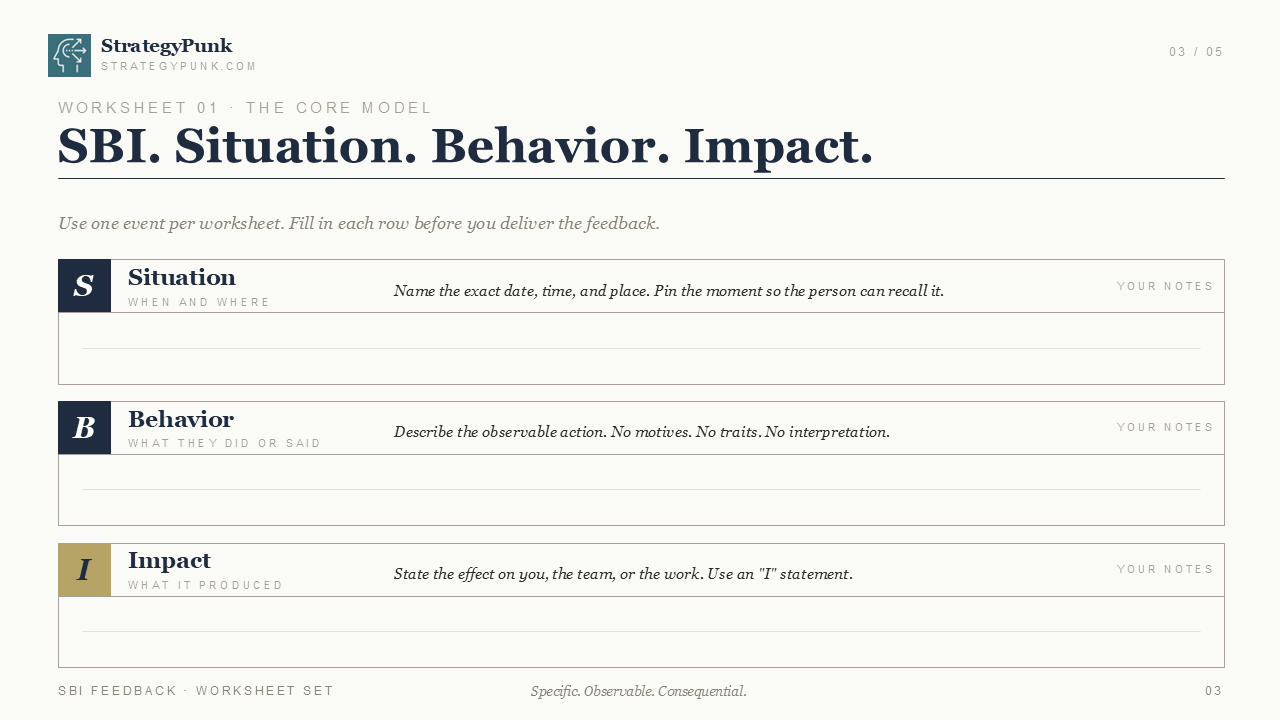
Worksheet 01 — The Core Model: SBI
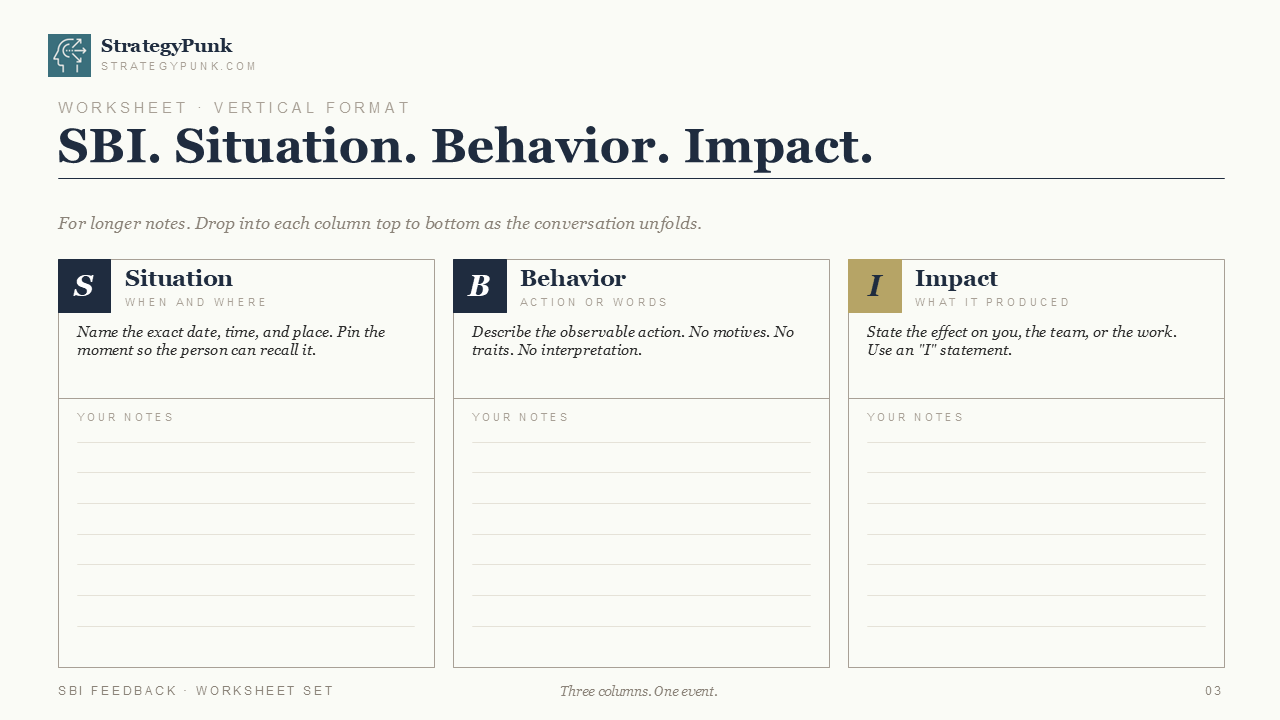
Worksheet 01a — The Core Model: SBI (Vertical Design)
Worksheet 01b — The Core Model: SBI (Vertical Design Colour)
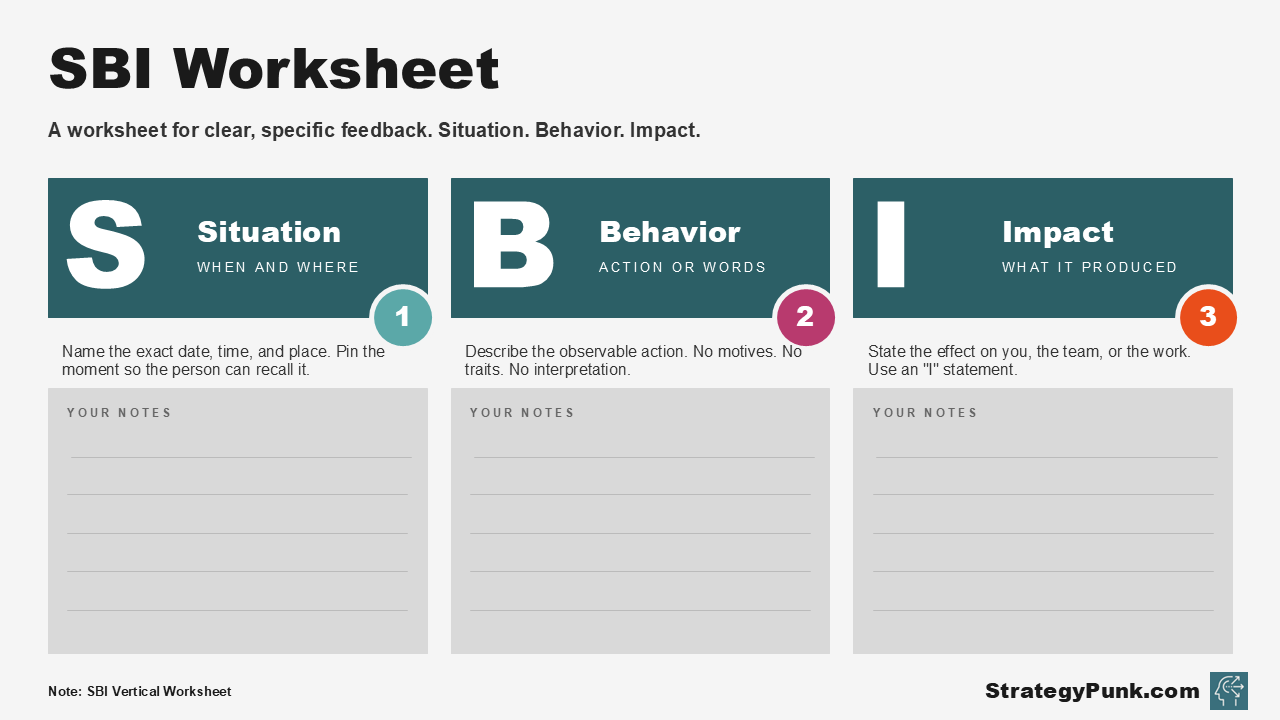
This is the foundation. Use it for any feedback conversation where your goal is to describe what happened and why it mattered. It walks you through the exact date, time, and place (Situation), the observable action with no interpretation attached (Behavior), and the effect on you, the team, or the work (Impact). One event per worksheet. Fill it in before the conversation, not during.
Worksheet 02 — Add Intent: SBII
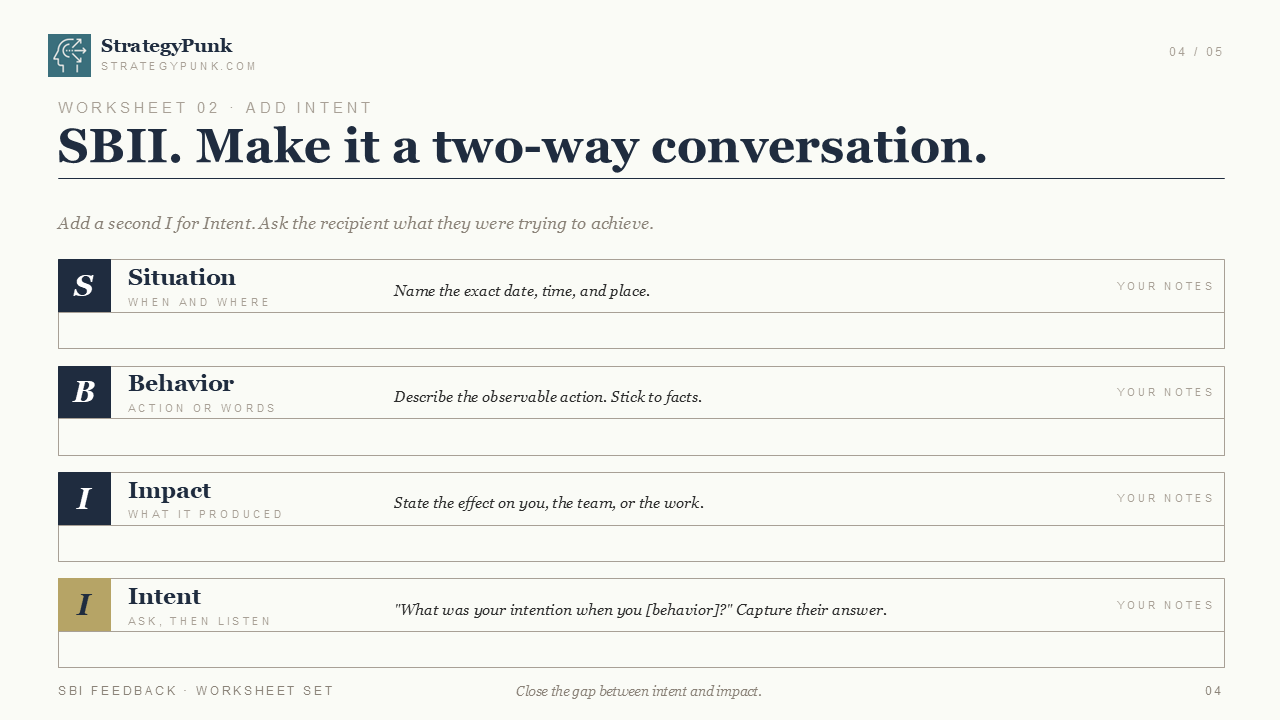
Use this version when the behavior surprised you or when you suspect there's a gap between what the person intended and what actually happened. After you've stated the Impact, you ask: "What was your intention when you [behavior]?" Then you listen. This single question shifts the dynamic from a one-way evaluation to a real conversation — and often surfaces context you didn't have.
Worksheet 03 — Close with Action: SBIN
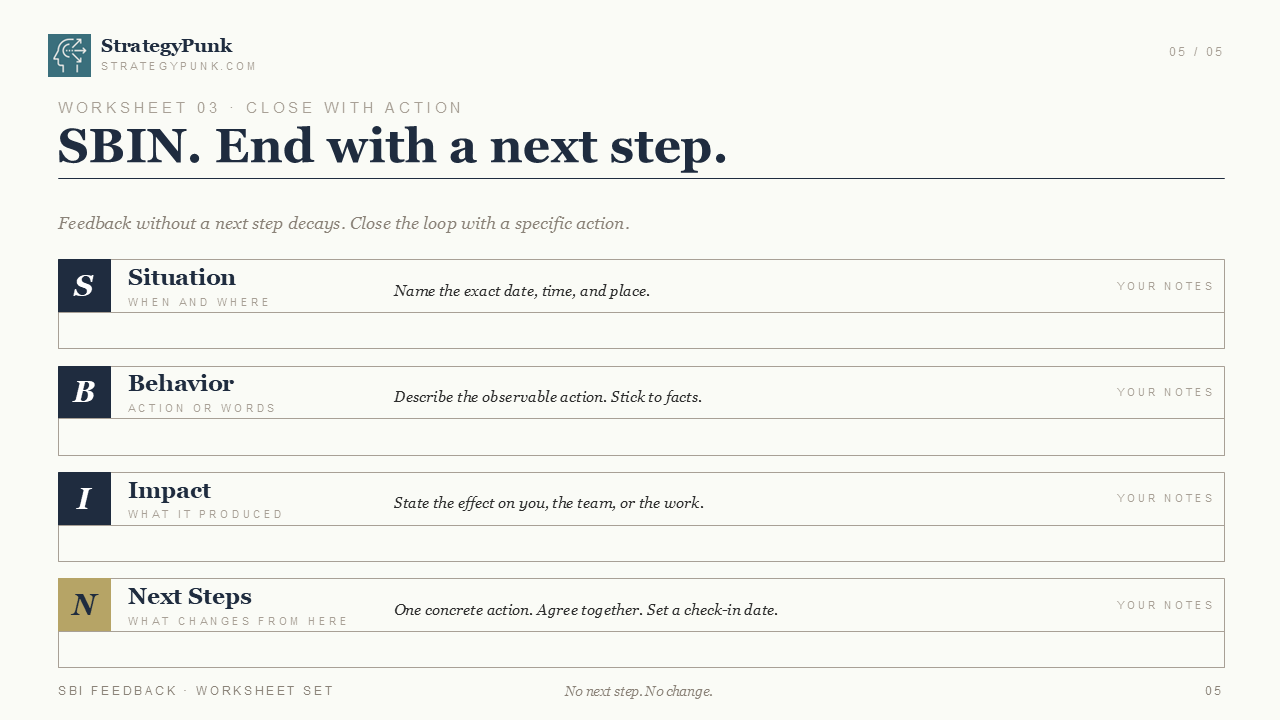
Feedback without a next step rarely changes anything. This version adds a fourth row — Next Steps — where you agree on one concrete action and set a check-in date. Use it for corrective feedback where you want a clear behavioral change, not just acknowledgment. As the worksheet puts it: No next step. No change.
All three worksheets are included in the download. Both the PDF and the PPT template are free. Sign up or log in to access them.