Berkshire Hathaway SWOT Analysis: The $330 Billion Question
A strategic teardown of Berkshire Hathaway. We analyze the unprecedented $330 billion cash pile, the impending succession, and what the future holds for the ultimate compounding machine.

Berkshire Hathaway is not just a company. It is a compounding machine designed to operate across decades. Sitting at a market capitalization of roughly $1.1 trillion, it stands as a monolith in the financial and conglomerate sectors. But when you look under the hood, the mechanics of this giant reveal a fascinating interplay of unparalleled strengths and looming existential questions.
Patience is the strategy. Capital is the weapon.
Let us break down Berkshire Hathaway's strategic position through a comprehensive SWOT analysis, distilling the most impactful and counterintuitive takeaways.
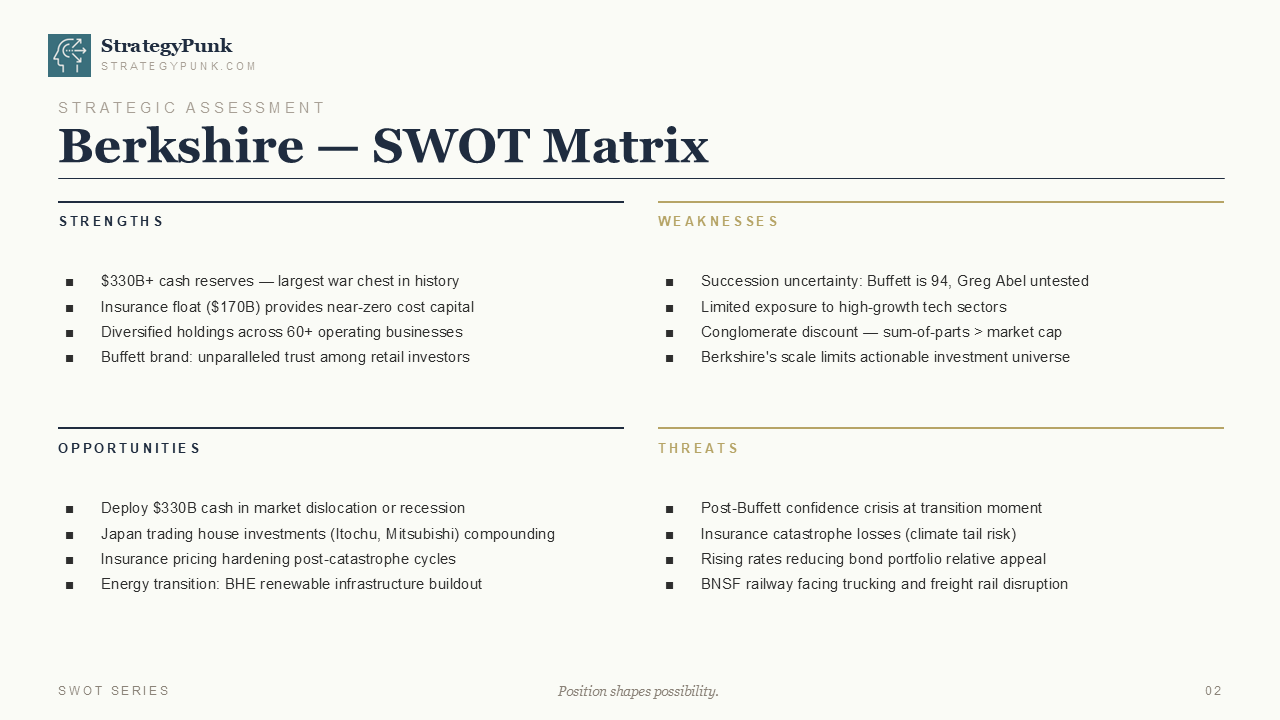
Strengths: The Ultimate Financial Fortress
The foundation of Berkshire rests on a balance sheet that defies conventional corporate finance.
The $330 Billion War Chest
Berkshire holds over $330 billion in cash reserves. This is the largest corporate war chest in history. In an era where companies rush to deploy capital or return it via buybacks, holding this much cash is a deliberate, contrarian bet. It is dry powder waiting for a generational dislocation.
The Magic of Insurance Float
The engine powering this machine is the $170 billion insurance float. This provides near-zero-cost capital. While competitors rely on debt or equity markets, Berkshire gets paid to hold other people's money. This structural advantage allows them to fund acquisitions and investments without the typical cost-of-capital constraints.
Extreme Diversification
With over 60 operating businesses spanning railroads, energy, retail, and manufacturing, the conglomerate is insulated from sector-specific downturns. When one sector struggles, another compensates.
The Cult of Trust
The brand itself is a massive intangible asset. Retail investors possess unparalleled trust in the leadership. This loyalty provides a stable shareholder base that does not panic during market volatility, giving management the runway to make long-term bets.
Weaknesses: The Gravity of Scale and Time
Even a trillion-dollar fortress has structural vulnerabilities. The most pressing issues stem from the very things that made the company successful: time and size.
The Succession Question
The leadership is 94 years old. While Greg Abel is designated as the successor and is highly capable, he remains untested in the top seat. The market knows the transition is inevitable, but uncertainty lingers. How will the culture and capital allocation strategy shift when the architect is no longer in the room?
The Tech Blind Spot
There is notable limited exposure to high-growth tech sectors. Aside from a massive, concentrated bet on Apple, the portfolio leans heavily into traditional economy businesses. This limits participation in the rapid value creation driven by software and artificial intelligence.
The Conglomerate Discount
Public markets often struggle to value complex entities. The sum of the parts is likely greater than the current market cap. Investors apply a conglomerate discount, punishing the stock for its opacity and sprawling nature.
The Curse of Size
Scale limits the actionable investment universe. When you manage over a trillion dollars in assets, a billion-dollar acquisition barely moves the needle. Berkshire requires massive, elephant-sized deals to generate meaningful returns. There are very few targets globally that fit their criteria and size requirements.
Opportunities: Deploying the Arsenal
The future growth of Berkshire hinges on its ability to exploit market inefficiencies and macro trends.
The Generational Buying Opportunity
The primary opportunity is deploying the $330 billion cash pile. They are waiting for a market dislocation, a recession, or a financial crisis. When credit markets freeze and asset prices collapse, Berkshire becomes the buyer of last resort. They can dictate terms and acquire premium assets at distressed valuations.
The Japan Compounding Play
The investments in Japanese trading houses like Itochu and Mitsubishi have been a masterclass in value investing. These assets provide steady compounding returns, dividend growth, and geographic diversification outside the United States.
Hardening Insurance Markets
Following recent catastrophe cycles, insurance pricing is hardening. Premium rates are rising. As a major player in reinsurance and property casualty insurance, Berkshire stands to benefit significantly from this pricing power, expanding their float and underwriting profits.
The Energy Transition
Through Berkshire Hathaway Energy, there is a massive opportunity in the renewable infrastructure buildout. The transition to clean energy requires trillions in capital. BHE is uniquely positioned to deploy capital into regulated utilities and renewable projects, securing guaranteed returns for decades.
Threats: Navigating Tail Risks
The threats facing Berkshire are largely external, driven by macroeconomic and climate factors, alongside the internal challenge of transition.
The Transition Confidence Crisis
The most acute threat is a post-transition confidence crisis. When the inevitable leadership change occurs, the market will demand proof that the new regime can execute. Any misstep in the immediate aftermath could trigger multiple rounds of compression and shareholder flight.
Climate Driven Catastrophe Risk
As an insurance giant, climate tail risks are a direct threat to the bottom line. Increased frequency and severity of natural disasters could lead to massive catastrophe losses at Geico and Gen Re, threatening underwriting profitability.
The Interest Rate Environment
Rising interest rates present a double-edged sword. While they improve returns on cash, they reduce the relative appeal of the existing bond portfolio. A sustained high-rate environment changes the calculus for capital allocation.
Freight Disruption
BNSF, one of the crown jewels of the portfolio, faces ongoing disruption. Competition from trucking and evolving freight rail dynamics threatens volume and pricing power. Maintaining operating efficiency in a changing logistics landscape is a persistent challenge.
The Strategic Bet: Three Things to Monitor
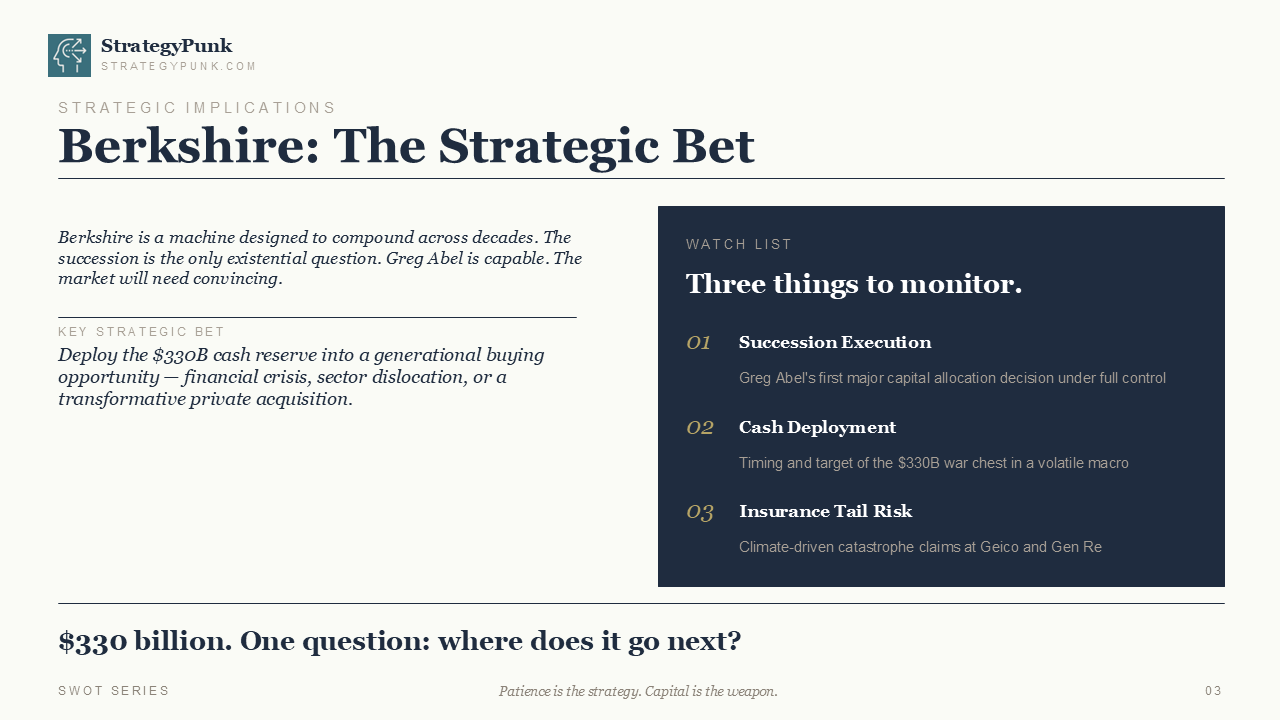
Berkshire is a machine designed to compound across decades. The succession is the only existential question. Greg Abel is capable. The market will need convincing.
The ultimate strategic bet is deploying the massive cash reserve into a generational buying opportunity. Whether it is a financial crisis, a sectoral dislocation, or a transformative private acquisition, how we deploy this capital will define the company's next era.
As an observer or investor, keep a close eye on these three critical areas:
- Succession Execution: Watch Greg Abel's first major capital allocation decision under full control. This will signal his risk appetite and strategic direction.
- Cash Deployment: Monitor the timing and target of the $330 billion war chest in a volatile macroeconomic environment.
- Insurance Tail Risk: Track climate-driven catastrophe claims at Geico and Gen Re to assess the resilience of the float engine.
The Final Verdict
$330 billion. One question: where does it go next?
Berkshire Hathaway has built an empire by being greedy when others are fearful. Right now, they are sitting on the sidelines with the largest cash pile in corporate history. They are not waiting for a good deal. They are waiting for an inevitable crisis.
When the next major market dislocation arrives, will the new leadership have the conviction to deploy that capital with the same ruthless efficiency as their predecessors?
Download the Full SWOT Analysis
Get the complete visual breakdown and strategic insights.