Boeing SWOT Analysis: 5 Brutal Truths About the Aerospace Giant's Future
Boeing has burned $50B+ in cash and still survives. Here's what the SWOT analysis reveals about the strategy behind the world's most consequential turnaround. Free PDF SWOT Analysis.

Introduction
Is Boeing too big to fail, or just too entrenched to fix?
For decades, Boeing represented the pinnacle of American engineering. Today, the aerospace titan finds itself navigating one of the most precarious corporate turnarounds in modern history. But framing this as a "turnaround" misses the mark entirely. As the latest strategic analysis reveals, Boeing is not in a turnaround story — it is in a survival story.
Based on a comprehensive strategic assessment, the picture is stark, counterintuitive, and critically important. It's a narrative of an impenetrable duopoly acting as a lifeline while internal culture acts as a liability.
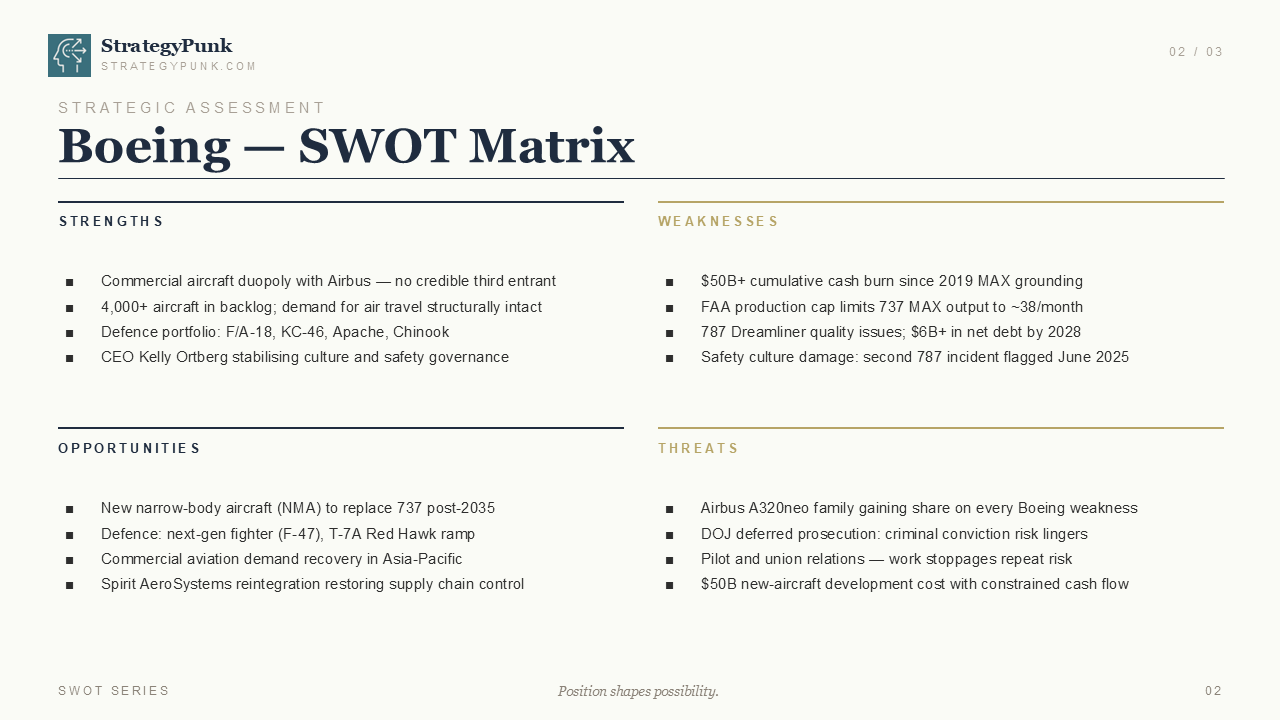
Before diving into the deepest strategic takeaways, here is a snapshot of the core forces currently shaping Boeing's trajectory:
| Strengths | Weaknesses |
|---|---|
| Commercial duopoly with Airbus (no credible third entrant) | $50B+ cumulative cash burn since 2019 MAX grounding |
| 4,000+ aircraft backlog; structural demand intact | FAA production cap limits 737 MAX output to ~38/month |
| Defence portfolio (F/A-18, KC-46, Apache, Chinook) | 787 Dreamliner quality issues; $6B+ net debt by 2028 |
| CEO Kelly Ortberg stabilising culture & governance | Safety culture damage: second 787 incident flagged June 2025 |
| Opportunities | Threats |
|---|---|
| New narrow-body aircraft (NMA) to replace 737 post-2035 | Airbus A320neo family gaining share on every Boeing weakness |
| Defence ramp-up (next-gen fighter F-47, T-7A Red Hawk) | DOJ deferred prosecution: criminal conviction risk lingers |
| Demand recovery in the Asia-Pacific region | Pilot and union relations (repeat work stoppage risk) |
| Spirit AeroSystems reintegration restoring supply chain control | $50B new-aircraft development cost amid constrained cash flow |
If you're watching the aerospace sector or simply studying top-tier corporate strategy, here are the five most impactful takeaways that define Boeing's path forward.
1. The Duopoly is the Ultimate Safety Net
You might assume that a company burning through over $50 billion in cash since 2019 would be facing imminent collapse. Yet, Boeing survives. The reason? A structural duopoly in commercial aircraft with Airbus, with virtually no credible third entrant.
This isn't just a competitive advantage; it is an existential shield. The global demand for air travel remains structurally intact, and with a massive backlog of over 4,000 aircraft, Boeing has guaranteed future revenue streams — if they can actually build the planes. This duopoly protects the franchise from the natural consequences of its catastrophic missteps. Airbus alone cannot absorb the world's demand for commercial aircraft. The market needs Boeing to exist, effectively granting the company a structural immunity that few other corporations will ever experience.
"The duopoly is the lifeline. The culture is the liability."
2. The Production Cap Paradox
In most industries, selling the product is the hard part. For Boeing, the challenge is entirely reversed. The FAA has imposed a production cap, limiting 737 MAX output to approximately 38 aircraft per month.
This creates a fascinating, albeit painful, paradox. Boeing has the demand, but it lacks the regulatory trust to meet it. The path to unlocking critical cash flow — the very lifeblood needed to fund future innovations — hinges entirely on surpassing that 38-per-month threshold. Restoring production to 47 per month is the key strategic bet. It highlights a counter-intuitive reality: Boeing's growth is currently dictated not by market forces, but by government oversight and internal quality assurance. Until the FAA grants production approval, Boeing's financial engine remains choked.
3. The $50 Billion Dilemma of the Next Generation
While Boeing fights fires in the present, the future is rapidly approaching. Airbus's A320neo family is systematically gaining market share on every Boeing weakness. To counter this, Boeing desperately needs a New Midsize Airplane (NMA) to replace the 737 post-2035.
Herein lies the massive strategic bind: developing a new aircraft costs roughly $50 billion. How does a company with $6 billion in net debt projected by 2028, constrained cash flow, and ongoing legal overhangs fund a $50 billion program without diluting shareholders into oblivion? This is the strategic needle Boeing must thread. The NMA launch decision and its funding structure are arguably the most critical long-term choices facing CEO Kelly Ortberg. It's a bet the company cannot afford to get wrong, yet cannot afford to delay.
"Restore 737 MAX production to 47/month, generate positive free cash flow, and fund a new narrow-body without diluting shareholders into oblivion."
4. The Reintegration of Spirit AeroSystems
For years, the prevailing wisdom in manufacturing was to outsource and adopt lean supply chains. Boeing's current predicament proves the danger of taking that philosophy too far. One of the most significant opportunities identified in the SWOT matrix is the reintegration of Spirit AeroSystems.
By bringing this crucial supplier back in-house, Boeing is attempting to restore direct control over its supply chain and, more importantly, its quality control. It's a tacit admission that the outsourcing model compromised the very engineering integrity upon which Boeing was built. This move signals a massive shift from financial engineering back to actual engineering. This step is necessary and costly, but it will ensure the foundation is stable enough to move forward. The lesson for any strategist is uncomfortable but clear: when you outsource accountability, you eventually outsource your reputation.
5. The Lingering Shadow of Legal and Cultural Liability
Strategy often focuses on numbers — backlogs, production rates, development costs. But Boeing's deepest vulnerabilities are intangible. The damage to safety culture is profound, underscored by a second 787 incident flagged as recently as June 2025.
The legal overhang is a dark cloud that refuses to dissipate. The DOJ deferred prosecution outcome, and the MAX 9 liability settlements represent significant, unpredictable risks. You can fix a supply chain, and you can eventually design a new airplane. But repairing a broken safety culture and regaining the trust of regulators, pilots, and the flying public is a generational challenge. The risk of pilot and union work stoppages only adds friction to a machine that desperately needs to run smoothly. CEO Kelly Ortberg's mandate to stabilize culture and safety governance is not a soft HR initiative — it is a hard prerequisite for every other strategic goal on the list.
The Path Back
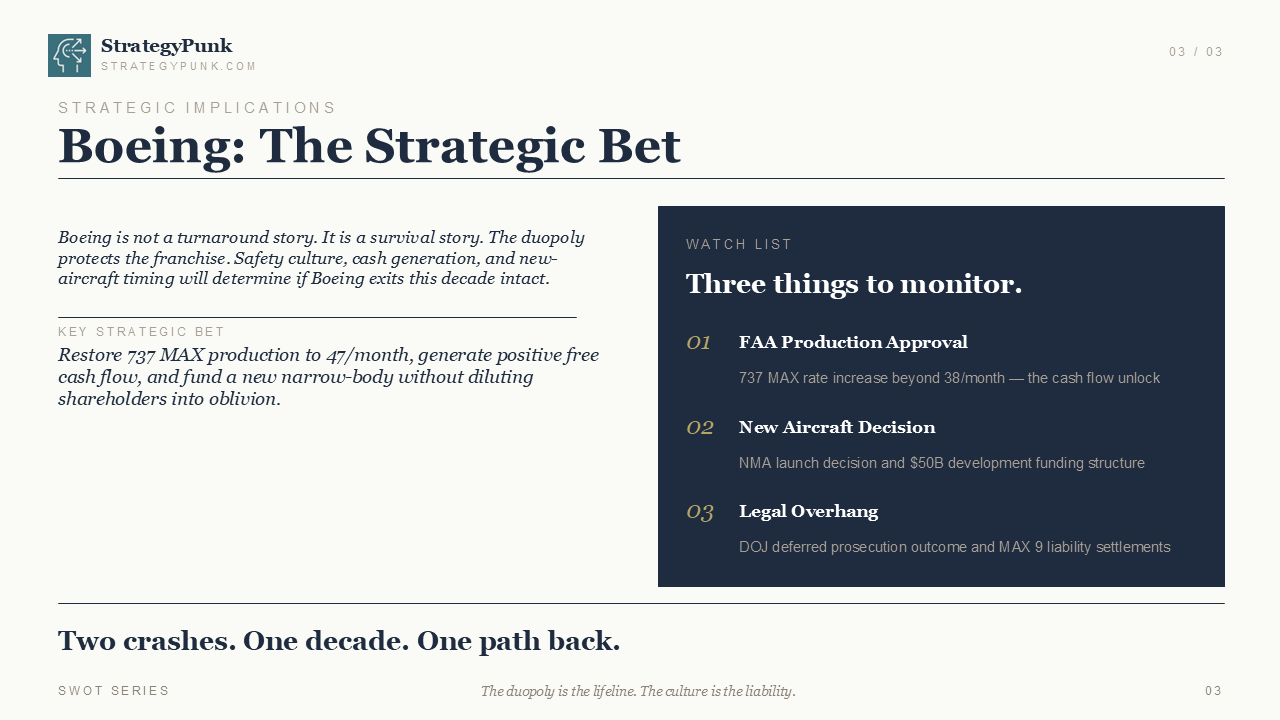
Two crashes. One decade. One path back.
Boeing's situation is a masterclass in the limits of corporate resilience. The strategic bet is clear: restore 737 MAX production, generate positive free cash flow, and fund the next generation of aircraft without breaking the balance sheet. Three things to watch closely: FAA production approval, the NMA launch decision, and the DOJ prosecution outcome.
The duopoly ensures Boeing will likely still exist at the end of this decade. But what kind of company it will be — a thriving innovator or a permanently hobbled duopolist — remains the ultimate strategic cliffhanger.
Will Boeing's culture finally catch up to the strength of its market position? That is the multi-billion dollar question.
Download the Full Boeing SWOT Analysis
The full Boeing SWOT deck is available as a free PDF. It includes the complete strategic matrix, key implications, and three critical watchlist items every analyst should track.
Download the Boeing SWOT Analysis (PDF)
Want More Analyses Like This?
Every week, StrategyPunk breaks down the strategic position of the world's most consequential companies — the same way a senior partner would brief a board. No filler, no hype, just the frameworks and insights that actually matter.
Join thousands of strategists, executives, and consultants who read StrategyPunk every week.
Subscribe for free → If you found this useful, share it with a colleague who follows the aerospace sector. The best strategy conversations start with the right questions.