Future-back strategy framework (free PDF guide)
Most strategic roadmaps fail because they project the present into the future. Discover how the Future-Back Strategy framework flips the script, helping you define a bold destination ten years out and reverse-engineer the exact initiatives needed to dominate your market. Free PDF.

Reverse Engineering the Future: Why Your Strategic Roadmap is Pointing the Wrong Way
Most leadership teams build strategy by standing in the present and peering into the fog of the future. They take what they know today - their current capabilities, their existing P&L, their familiar competitors—and extrapolate forward. It’s safe. It’s logical. And it’s exactly why incumbents get disrupted.
If you want to own your market in a decade, you have to stop projecting forward and start working backward.
This is the essence of Future-Back Strategy, a concept rooted in frameworks like EY's strategic roadmap. It requires you to define a bold, uncompromising destination ten years out, and then ruthlessly sequence the waves of initiatives required to get there. It’s not about predicting the future; it’s about choosing a destination and reverse-engineering the path.
Here is how to stop iterating on the present and start building the future.
The Three Horizons of Transformation
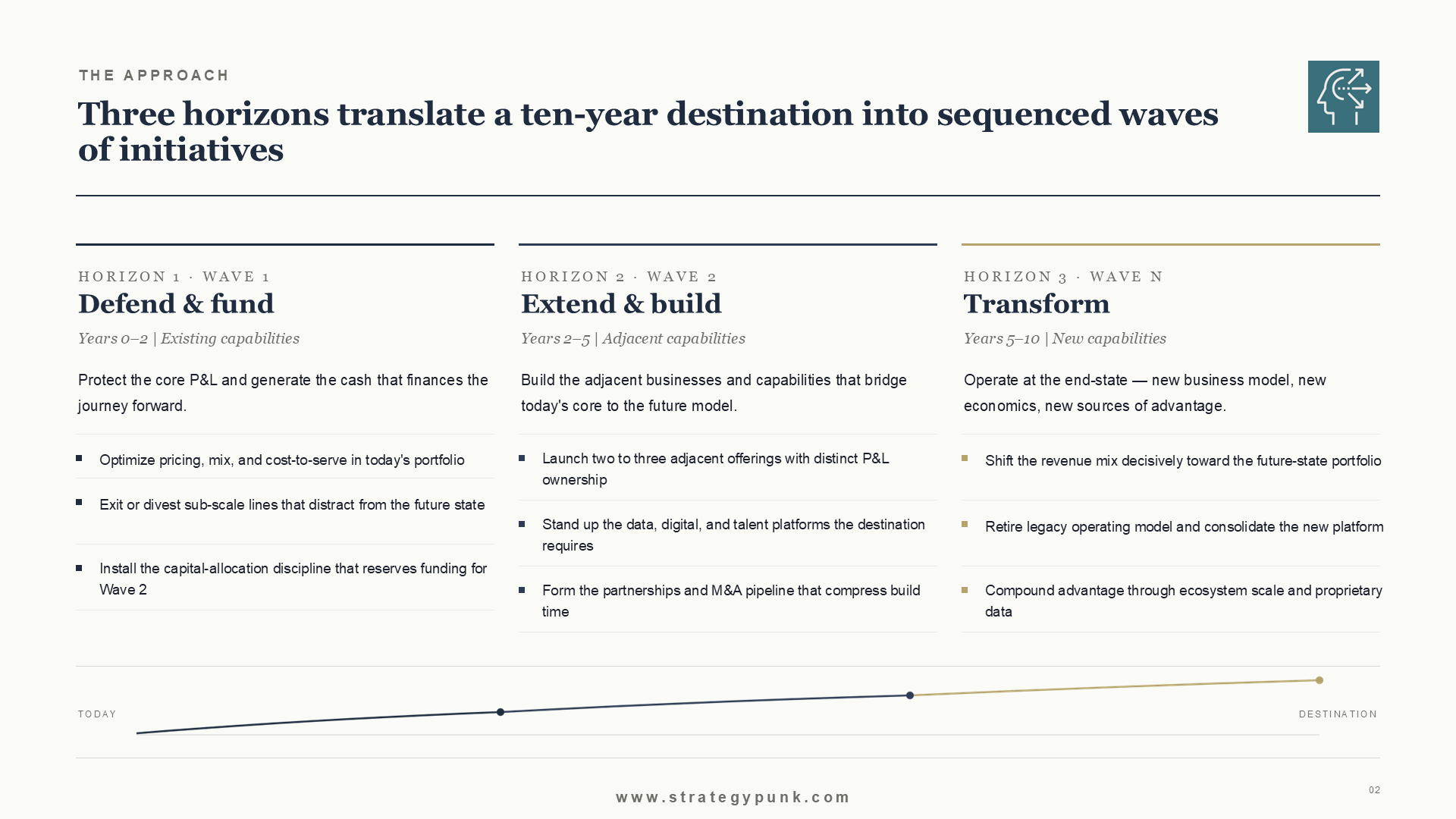
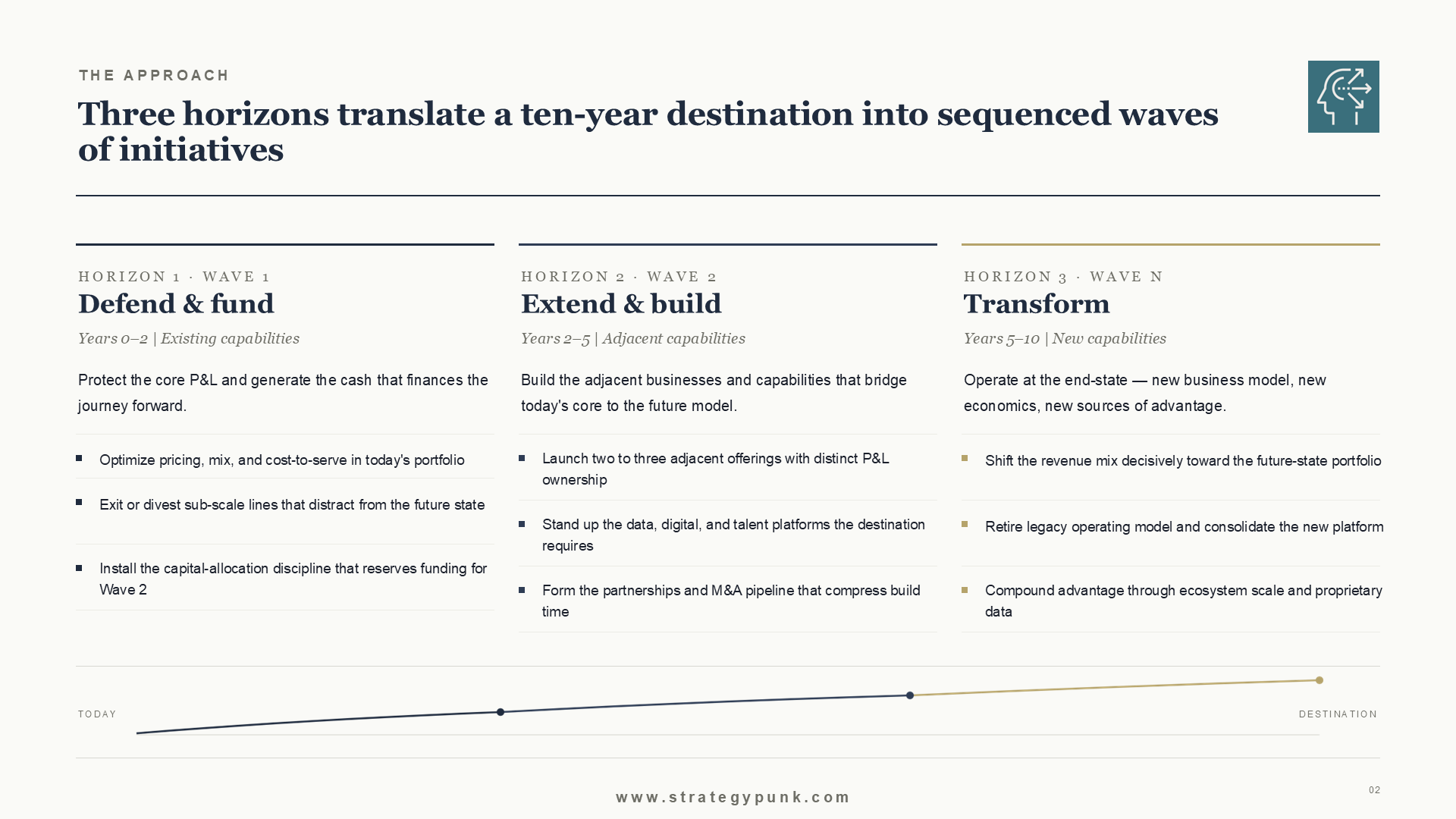
A ten-year vision is just a hallucination without a sequence. The future-back approach translates a distant destination into manageable, sequenced waves of initiatives. You don’t jump straight to the end state. You build bridges.
Wave 1: Defend & Fund (Years 0-2)
You cannot fund the future if you bleed out in the present. Wave 1 is about protecting your core P&L and generating the cash required to finance the journey forward. This means optimizing pricing, exiting sub-scale lines that distract from the future state, and installing brutal capital-allocation discipline. You aren't transforming yet; you are building the war chest.
The reality check: If your current portfolio is bleeding cash or attention, your future vision is already dead on arrival.
Wave 2: Extend & Build (Years 2-5)
This is where the pivot begins. You start building adjacent businesses and capabilities that bridge today’s core to the future model. You launch new offerings with distinct P&L ownership. You stand up the data, digital, and talent platforms the destination requires. You form partnerships and M&A pipelines to compress build time.
The reality check: This phase feels messy. You are operating two different business models simultaneously. The tension between the legacy core and the new adjacencies will test your leadership team’s resolve.
Wave N: Transform (Years 5-10)
You are now operating at the end-state. You have a new business model, new economics, and new sources of advantage. Your revenue mix shifts decisively toward the future-state portfolio. You retire the legacy operating model and consolidate onto the new platform. You compound your advantage through ecosystem scale and proprietary data.
The reality check: This isn't a pivot; it's a completely new enterprise.
The Five Dimensions of Evolution
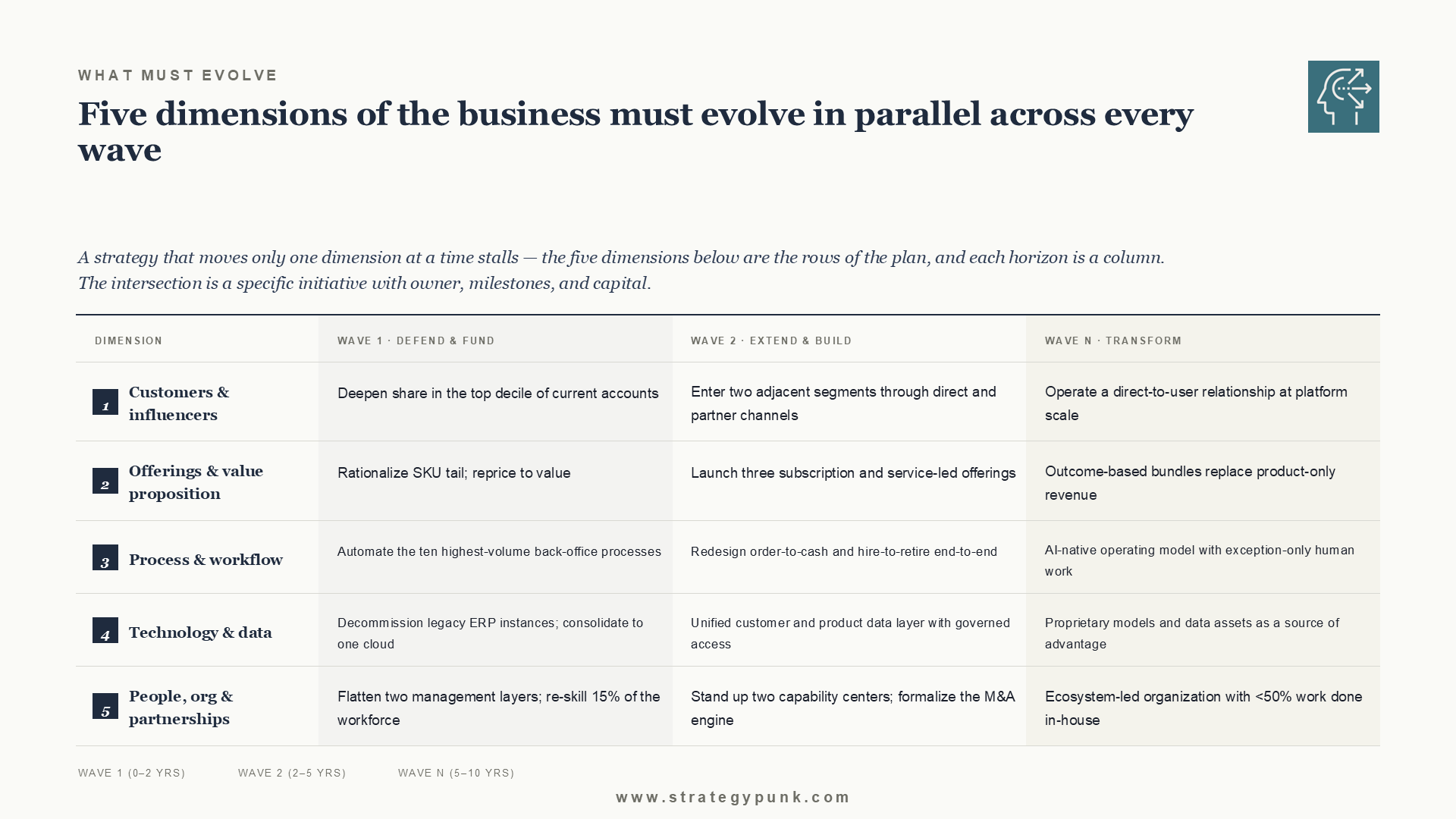
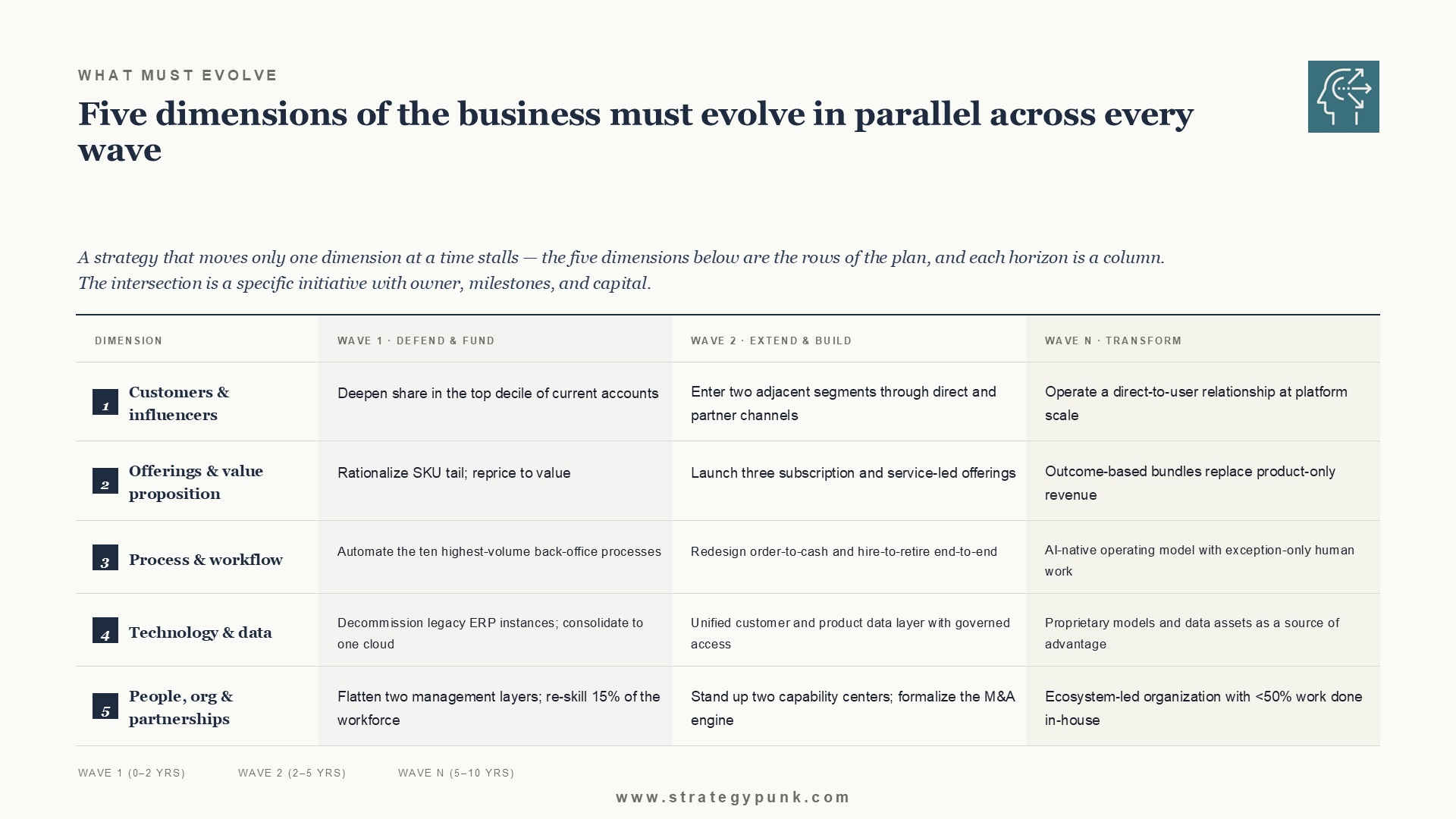
A strategy that moves only one dimension at a time stalls. To execute a future-back strategy, five dimensions of the business must evolve in parallel across every wave. If these are the rows of your plan, and the horizons are your columns, the intersection is a specific initiative with an owner, milestones, and capital.
1. Customers & Influencers
You don't just find new customers; you change how you relate to them. In Wave 1, you deepen your share of current accounts. By Wave 2, you enter adjacent segments. By the final wave, you operate a direct-to-user relationship at platform scale.
2. Offerings & Value Proposition
Stop selling products and start selling outcomes. You begin by rationalizing your SKU tail and repricing to value. Then, you launch subscription and service-led offerings. Ultimately, outcome-based bundles replace product-only revenue entirely.
3. Process & Workflow
Efficiency is the prerequisite for transformation. You start by automating high-volume back-office processes. Then, you redesign end-to-end workflows like order-to-cash. The destination? An AI-native operating model with exception-only human work.
4. Technology & Data
Legacy tech debt will anchor you to the past. Decommission legacy ERP instances and consolidate to the cloud immediately. Build a unified customer and product data layer. The end state requires proprietary models and data assets to act as your primary source of competitive advantage.
5. People, Org & Partnerships
You cannot build the future with an organizational chart from the past. Flatten management layers and aggressively re-skill the workforce. Stand up capability centers and formalize an M&A engine. The final destination is an ecosystem-led organization where less than 50% of the work is done in-house.
The Final Word: Where Are You Standing?
"A strategy that moves only one dimension at a time stalls."
The most dangerous place for a leadership team to stand is in the comfort of the present. Future-back strategy forces you to stand in the future and look back at the inadequacies of today. It is uncomfortable, demanding, and entirely necessary.
Are you projecting your past into the future, or are you pulling the future into your present?
Want the complete breakdown?
Future-Back Strategy Framework PDF
Download the full Future-Back Strategy Framework PDF for free. Just sign up for the Strategypunk newsletter below to get instant access to the guide, plus weekly insights on strategy, operating models, and transformation.
Sign up / Log in to Download the Free PDF Guide