SWOT Analysis: Free PowerPoint Template
A free SWOT template is useful. Knowing how to actually run the analysis is what makes it valuable. Five editable PowerPoint layouts plus a complete guide to SWOT sessions, the TOWS matrix, and framework integration.

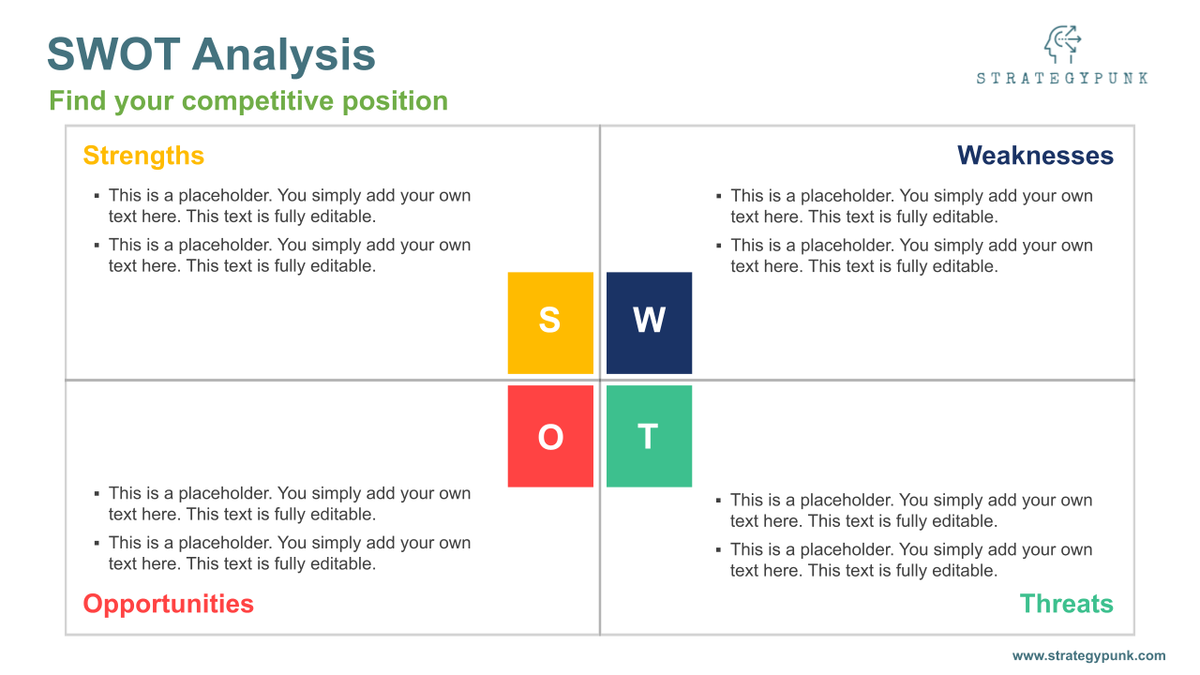
This PowerPoint slide deck contains five layouts for completing a SWOT analysis.
What Is a SWOT Analysis?
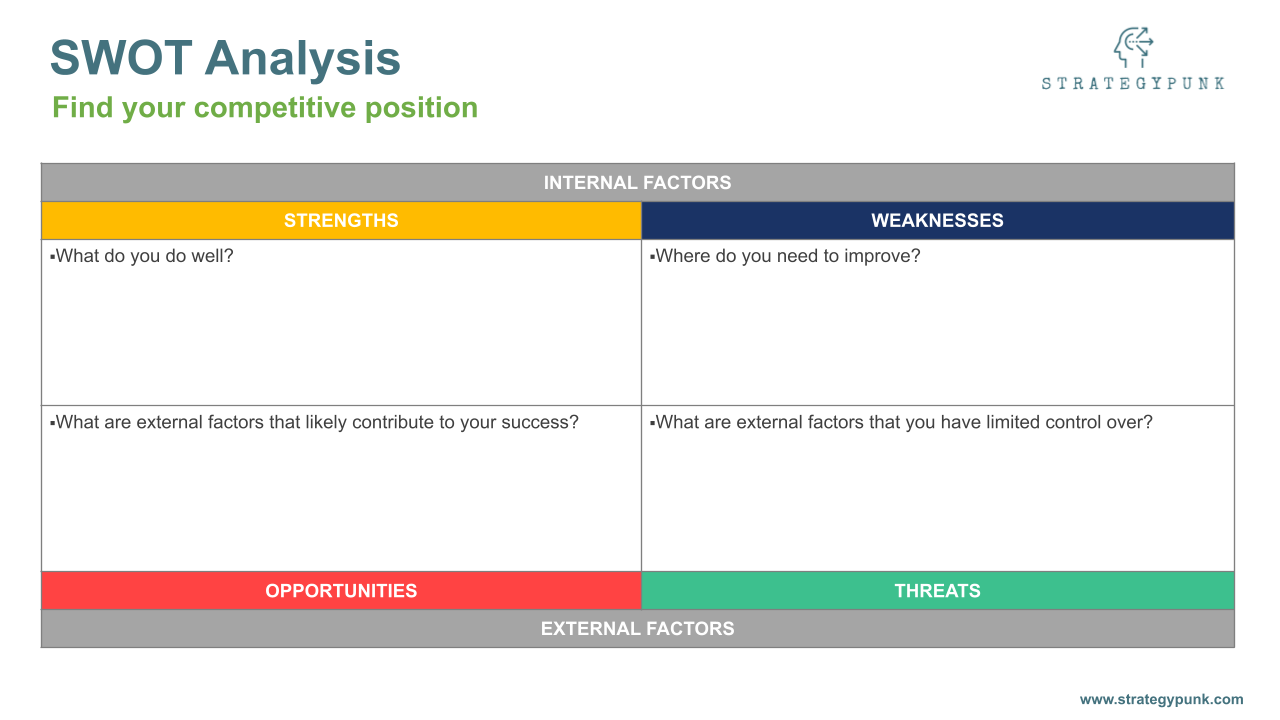
A SWOT analysis maps four categories of factors that determine your competitive position.
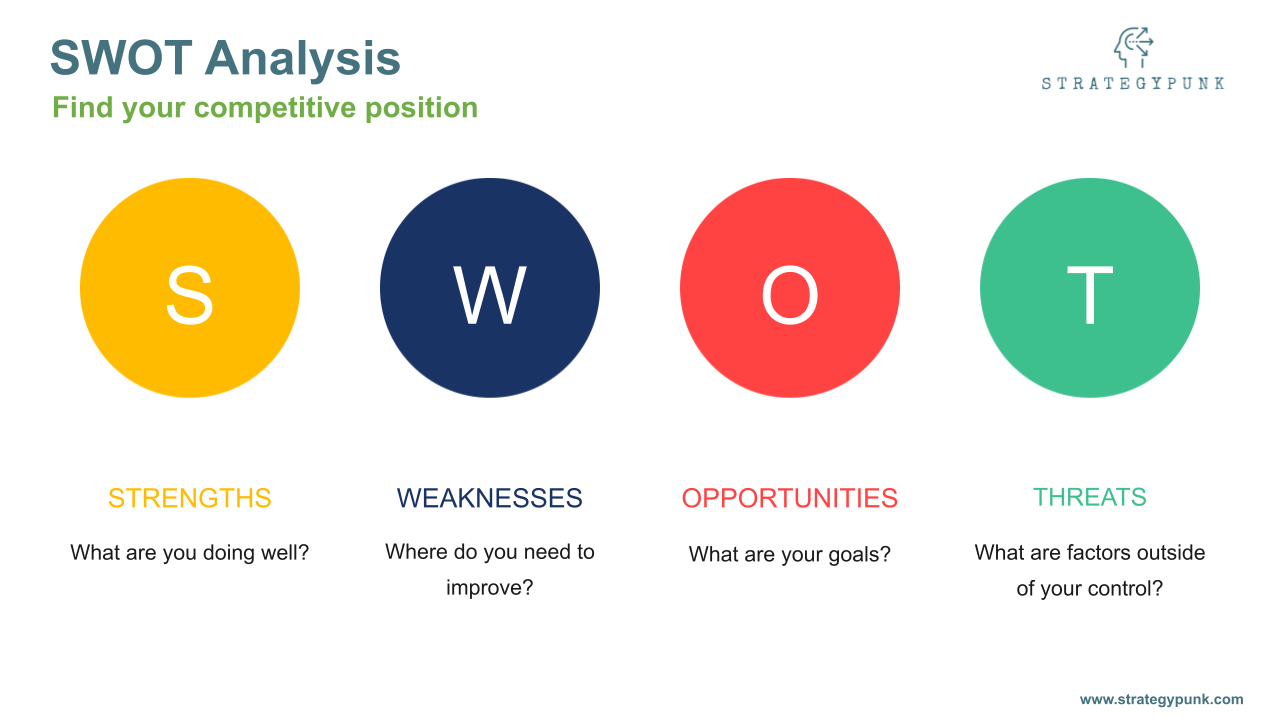
Strengths and Weaknesses are internal. You control them. They include resources, capabilities, processes, culture, brand equity, cost structure, and talent.
Opportunities and Threats are external. You do not control them. They include market trends, regulatory shifts, competitor moves, macroeconomic conditions, technology disruptions, and supply chain dynamics.
When analyzed together, these four quadrants give you a structured snapshot of where your organization stands today and where it could go next.
Why SWOT Still Works
Simple does not mean shallow. SWOT persists because it forces structured thinking before strategic decisions. Research suggests that organizations that use SWOT as part of their planning process are significantly more likely to achieve strategic goals than those that skip structured analysis altogether.
Its power lies in three things. First, it is universally understood. Every stakeholder in the room knows the framework. Second, it scales. You can SWOT a product, a business unit, a geography, a career, or an entire company. Third, it creates a shared language for cross-functional teams to align on priorities before committing resources.
That said, SWOT on its own is a diagnostic tool, not a strategy. It tells you where you are. It does not tell you what to do. The most common mistake is treating a completed SWOT as the end product rather than the starting point.
How to Run a SWOT Session That Actually Works
Most SWOT analyses fail not because the framework is weak but because the process is sloppy. Here is how to avoid the typical pitfalls.
1. Start Outside In
Begin with Opportunities and Threats before turning to Strengths and Weaknesses. This reduces the natural bias of anchoring everything to internal capabilities. When you start with the external environment, you ground the conversation in market reality rather than organizational comfort.
2. Involve the Right People
A SWOT built by one person in an office is a personal opinion dressed up as analysis. Pull in perspectives from across functions: sales, operations, finance, product, and customer support. External voices matter too. Advisors, board members, key customers, and suppliers all see blind spots that internal teams miss.
3. Use Evidence, Not Assertions
Data or a concrete example should back every item in your SWOT. Instead of writing "strong brand" as a strength, write "NPS of 78 vs. industry average of 52" or "80% unaided brand recall in target segment." Specificity turns a SWOT from a brainstorm into an analytical tool.
4. Prioritize Ruthlessly
A SWOT with twenty items per quadrant is noise. After the initial brainstorm, force rank each factor by impact and likelihood. Keep the top three to five per quadrant. The rest goes into a parking lot for future monitoring.
5. Time Box It
A SWOT analysis represents a point in time. Conditions change. Review it quarterly, especially in fast-moving industries. What was an opportunity six months ago may now be a threat.
The TOWS Matrix: From Diagnosis to Strategy
This is where most teams stop. They complete the four quadrants, admire their work, and move on. That is a waste.
The TOWS matrix, developed by Heinz Weihrich in 1982, builds on your SWOT analysis by systematically pairing internal and external factors to generate concrete strategic options.
Here is how it works. You create a 2x2 grid with Opportunities and Threats across the top and Strengths and Weaknesses down the left side. This produces four strategy types.
SO Strategies (Strengths x Opportunities): Use your strengths to capitalize on opportunities. This is your offensive play. Example: a company with proprietary technology (strength) entering a market with rising demand for that technology (opportunity).
ST Strategies (Strengths x Threats): Use your strengths to neutralize threats. Example: a company with deep customer relationships (strength) defending against a new entrant (threat) by locking in long-term contracts.
WO Strategies (Weaknesses x Opportunities): Address weaknesses to unlock opportunities. Example: investing in digital capabilities (fixing weaknesses) to capture growing online demand (an opportunity).
WT Strategies (Weaknesses x Threats): Minimize weaknesses and avoid threats. This is your defensive play. Example: exiting a declining market segment in which you lack a competitive advantage.
The TOWS matrix forces you to stop describing your situation and start deciding what to do about it. It bridges analysis and action.
Quantified SWOT: Adding Scoring for Prioritization
For teams that want more rigor, consider scoring each factor. Assign two dimensions to every item in your SWOT.
For Strengths and Weaknesses, rate each on importance (how much does it matter to competitive success?) and performance (how well does the organization perform on this factor?). Both on a 1-5 scale.
For Opportunities and Threats, rate each on attractiveness/severity (how significant is the potential impact?) and probability (how likely is it to materialize?). Again, 1 to 5.
Multiply the two scores for a weighted priority ranking. This transforms subjective lists into a structured prioritization exercise, making it much easier to allocate resources to the factors that matter most.
Connecting SWOT to Other Frameworks
SWOT works best when it feeds into or draws from other strategic tools. Here are the most productive combinations.
PESTEL + SWOT: Run a PESTEL analysis first to map Political, Economic, Social, Technological, Environmental, and Legal forces. These feed directly into your Opportunities and Threats quadrants with structured external intelligence.
Porter's Five Forces + SWOT: Five Forces analysis reveals the structural dynamics of your industry. The output sharpens your view of Threats (intense rivalry, buyer power, substitutes) and Opportunities (weak supplier power, high barriers to entry that protect your position).
Business Model Canvas + SWOT: Work through each element of the Canvas and do a mini-SWOT for each. Evaluate strengths and weaknesses for each building block. Consider what trends might create opportunities or threats. This produces a much more granular and thorough SWOT than a blank sheet brainstorm.
Value Chain Analysis + SWOT: Map your value chain activities and assess each for competitive strengths and weaknesses. This grounds the internal half of your SWOT in operational reality.
Common Use Cases for This Template
People use these presentations across a wide range of contexts: business plans, corporate strategy reviews, investor pitches, M&A due diligence, board presentations, team workshops, annual planning cycles, product launches, market-entry assessments, and business-school case studies.
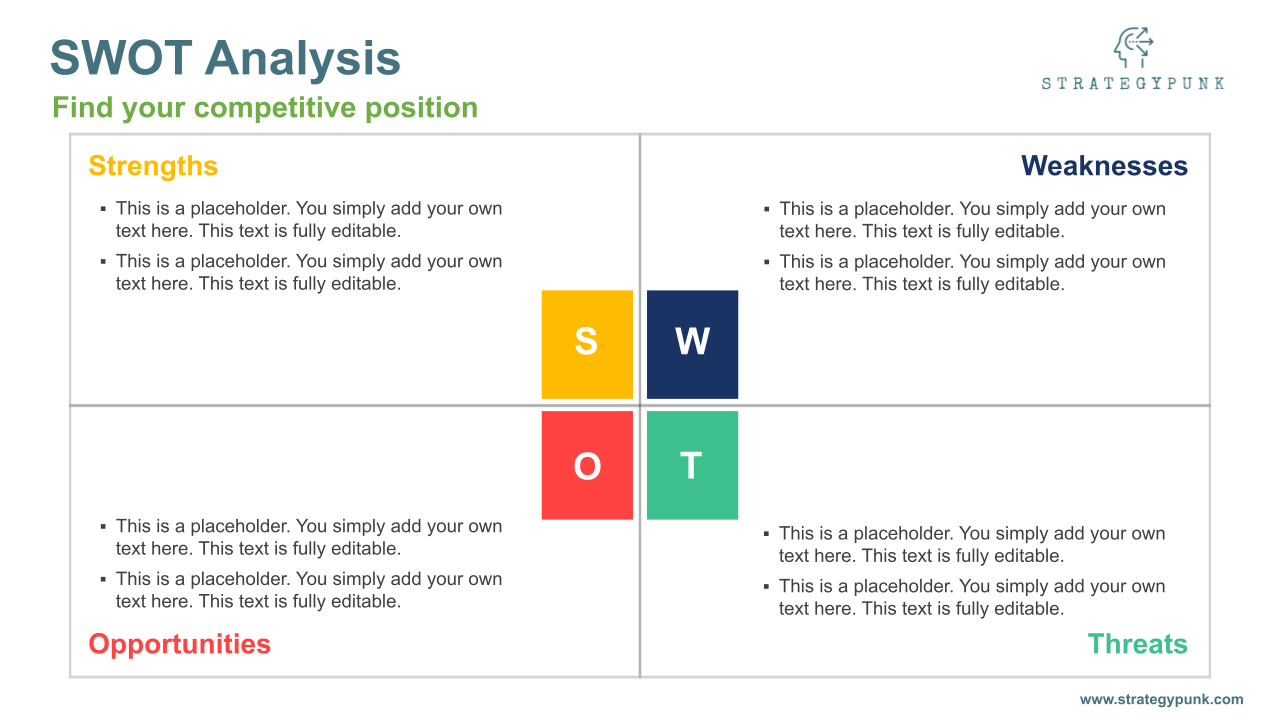
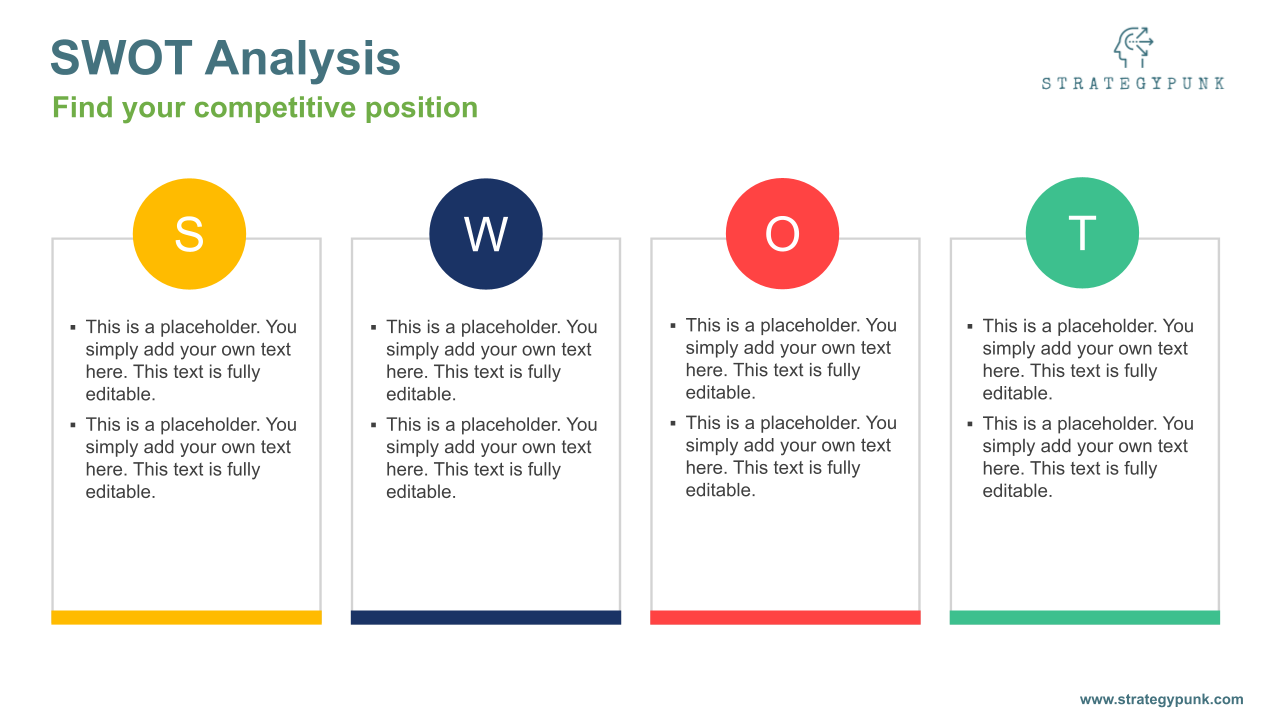
The five layouts in this deck give you flexibility. Use the grid layout for standard four-quadrant analysis. Use the list layout when you need more space for detail. Use the visual layout for executive presentations where design matters.
Pro Tips and Common Pitfalls
Go specific. "Good location" is not a strength. "Located in a high foot traffic area with 70% of the target demographic within a 10-minute drive" is a strength.
Be honest about weaknesses. This is where real growth opportunities hide. The temptation to soften weaknesses or reclassify them as "areas for improvement" undermines the entire exercise.
Separate facts from opinions. If a team member says, "Our product quality is declining," ask for the data. Returns rates, NPS trends, and warranty claims. Facts sharpen the analysis. Opinions dilute it.
Do not confuse internal and external. A new competitor entering your market is a threat, not a weakness. Your inability to respond to that competitor is a weakness. Keep the categories clean.
Include contradictory evidence. Strategy is complex and often ambiguous. A factor can be both a strength and a weakness depending on context. Acknowledging this increases credibility and keeps the team alert to changing conditions.
Review quarterly. A SWOT is not a one-time exercise. Update it as conditions evolve, especially after major market shifts, leadership changes, or new competitive entries.
Download the free PowerPoint or Google Slides Template
Once you have downloaded the template, make it your own. The best SWOT analyses come from really digging into what makes your business unique.
Do not just stick to the basic format. Combine it with the TOWS matrix to move from analysis to action.
Free SWOT Analysis Template in Google Slides:


Free SWOT Analysis Template in PowerPoint format: