How to Give Feedback the Netflix Way.
Most feedback cultures are designed around the giver's comfort. Netflix built something different. This guide breaks down the actual Netflix model: the 4A Framework, the 10 principles behind it, what Netflix explicitly rejects, and where the model breaks down. Free PDF guide included.

Most feedback cultures are designed around the giver's comfort. People soften the message, bury the criticism between two compliments, and walk away feeling they did a good job. The recipient is left confused about what actually needs to change.
Netflix built something different. Not a set of manners tips, but a cultural architecture where candor is an expectation and feedback flows in all directions — peer to peer, up and down.
This post breaks down the actual Netflix model: what it is, why it works, and where it breaks down.
Why Netflix takes feedback seriously
Netflix's talent philosophy is built on a single premise: a high-performing team beats a large average one. That premise only holds if people improve fast. And people only improve fast if they receive accurate, timely feedback.
The Keeper Test makes this explicit. Netflix managers ask themselves: "If this person told me they were leaving, would I fight hard to keep them?" If the answer is no, they begin an honest conversation — now, not at the annual review. The Keeper Test only functions in a culture where candid feedback is normal. Without it, the question becomes unanswerable.
Reed Hastings and Erin Meyer lay this out in No Rules Rules (2020). Patty McCord, Netflix's original Chief Talent Officer, goes further in Powerful (2018), arguing that most feedback conversations fail because neither party is honest about what they actually see.
The 4A Framework
Netflix's feedback model has a name. It is called the 4A Framework. Four principles, two for the giver, two for the receiver.
Aim to Assist
The motivation behind feedback must be growth, not frustration. Before giving feedback, ask yourself: Am I doing this to help this person improve, or am I venting? If it is the latter, the conversation will not land. People can tell the difference.
This does not mean softening the message. It means the intent has to be genuine. Feedback delivered with honest intent is absorbed differently from feedback used as a performance tool.
Actionable
Vague feedback is not feedback. "You need to be more strategic" tells the recipient nothing. "In the leadership meeting last Tuesday, you brought up three operational problems and no proposed solutions. Next time, come with a point of view," tells them something they can act on.
Every piece of feedback should name a specific behavior, in a specific context, with a specific alternative. Without that structure, the receiver has nowhere to go.
Appreciate
This one sits on the receiver's side. The instruction is simple: listen. Do not interrupt. Do not get defensive. Do not start building your counterargument while the other person is still speaking.
Saying "thank you" at the end of difficult feedback is not a weakness. It signals that the conversation was safe to have, which makes the next one easier. Organizations that normalize the appreciation step build feedback loops. Those who skip it do not.
Accept or Discard
Here is the most counterintuitive part of the Netflix model. The receiver is not obligated to act on the feedback.
Netflix treats feedback as information, not instruction. You listen to it, you consider it, and then you decide what to do with it. If the feedback misses the mark or conflicts with a better-informed view, you can set it aside. You may want to explain why, to close the loop, but you are not required to comply.
This principle prevents feedback culture from becoming a power game. When people know they retain agency over how they use the input, they are more willing to hear it.
For a deeper breakdown of the 4A model with a free PowerPoint template, see the full 4A Framework guide.
10 Principles of Netflix Feedback Culture
The 4A Framework defines the rules. These 10 principles define the habits that make those rules stick.
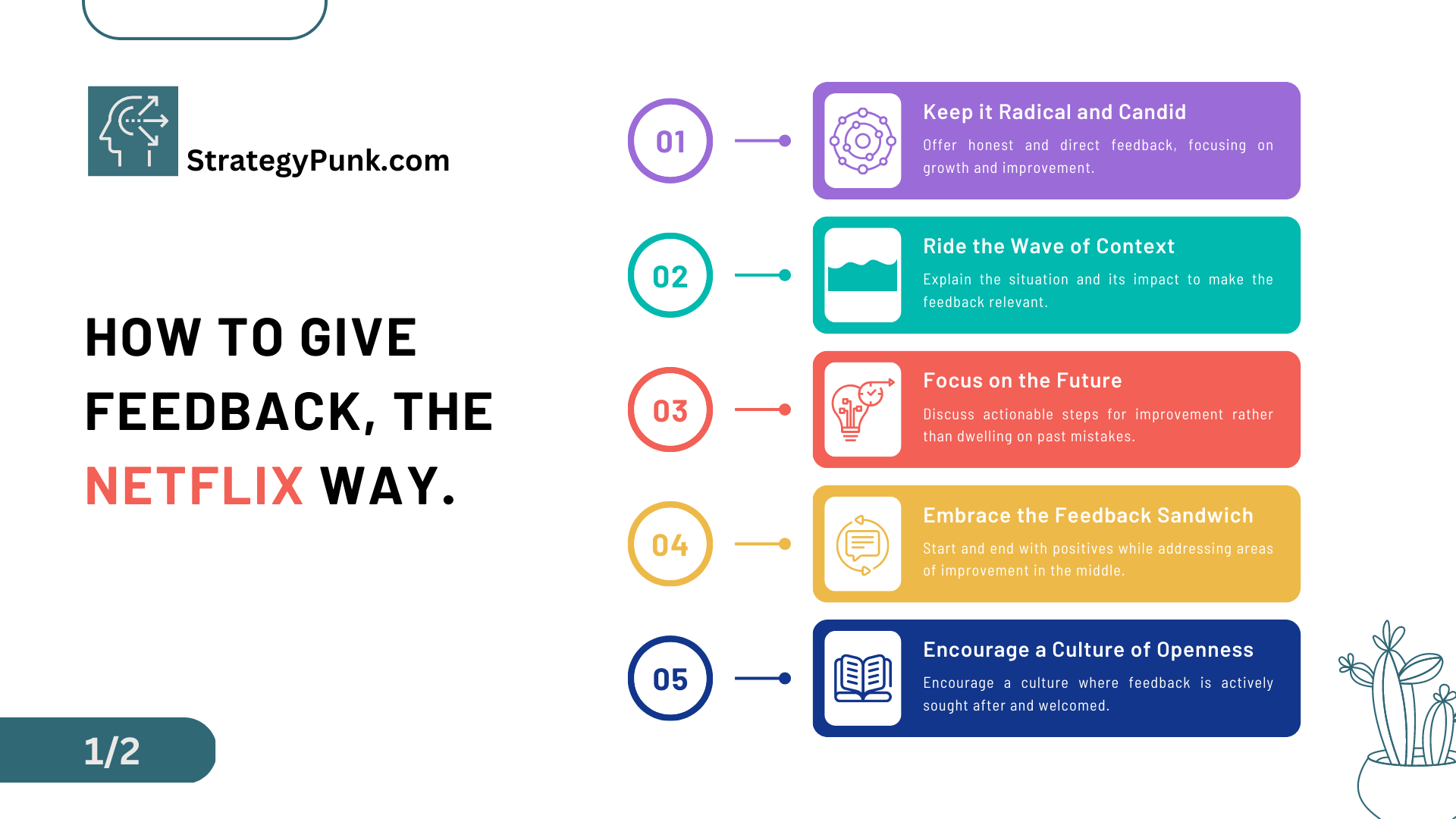
1. Be Radically Candid
Say what you actually think. Not a softened version, not a diplomatic approximation. Netflix expects specificity and directness as a baseline professional standard, not as a personality trait reserved for the bold.
2. Provide Context First
Before delivering feedback, anchor it. Describe the situation, the stakes, and why the behavior matters. Context transforms feedback from a personal judgment into a professional observation. Without it, even accurate feedback feels like an ambush.
3. Focus on the Future
Dissecting past mistakes in detail serves the giver, not the receiver. The useful question is: what should this person do differently next time? Keep the conversation forward-facing. Name the behavior, describe the impact, then move directly to the alternative.
4. Drop the Sandwich
Netflix explicitly rejects the praise-criticism-praise structure. Wrapping critical feedback in reassurance dilutes the message and signals that the giver lacks confidence. If you have something important to say, say it clearly. The packaging is for you, not for them.
5. Build a Culture of Openness
Feedback is not an event. It is a norm. Netflix treats it as a continuous practice, not a quarterly exercise. This means feedback flows in all directions — peer-to-peer, upward, and downward — and is expected of everyone, not just managers.
6. Time It Well
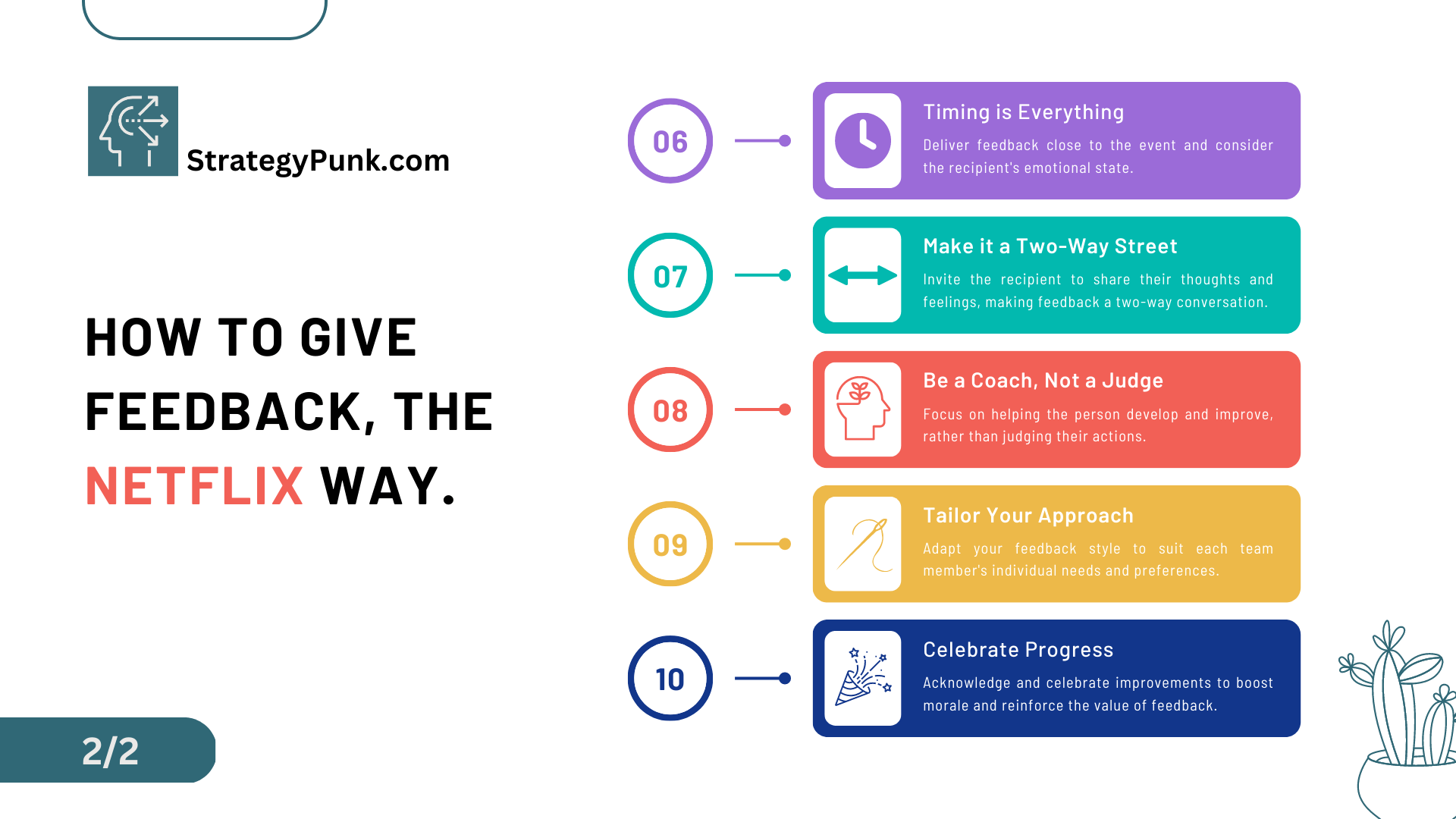
Feedback lands best close to the moment it refers to. Delayed feedback becomes abstract. Urgent feedback delivered at the wrong emotional moment becomes noise. Aim for soon, but choose the setting deliberately. A public correction rarely produces the outcome you want.
7. Make It a Two-Way Conversation
Delivering feedback is not a monologue. After you have said your piece, stop and listen. Ask what the other person saw in the situation. Their perspective may contain information you do not have. The conversation is more useful than the verdict.
8. Coach, Do Not Judge
Focus on behavior and capability, not character. The question is not "what is wrong with this person" but "what would help this person perform better." Ask open questions. Guide toward self-reflection. The goal is improvement, not accountability theater.
9. Adapt to the Individual
People receive feedback differently. Some want blunt and brief. Others need context before they can hear the substance. Learn how your team members process difficult information and adjust accordingly. The framework does not change. The delivery does.
10. Acknowledge Progress
Candid feedback cultures can drift toward only surfacing problems. Recognizing genuine improvement is not cheerleading — it is information. It tells people which behaviors to repeat, reinforces the value of the feedback loop, and signals that the system works in both directions.
How it compares to other frameworks
Netflix is not the only serious feedback model out there. Here is how it stacks up against two common alternatives.
SBI (Situation, Behavior, Impact) is a widely used structure developed by the Center for Creative Leadership. It shares Netflix's emphasis on specificity — name the situation, describe the observable behavior, explain the impact. What it lacks is the receiver's side. SBI is purely a delivery model. It does not tell the receiver what to do with the information. The 4A Framework addresses both sides of the conversation.
Radical Candor, Kim Scott's model, adds a relational dimension: care personally and challenge directly. It is closer in spirit to Netflix, but Radical Candor can become an excuse for aggression when the "care personally" half is underdeveloped. The 4A Framework's "Aim to Assist" check functions as a built-in intent filter that Radical Candor leaves implicit.
If you use the GROW Coaching Model in your development conversations, 4A maps naturally onto it. The "Options" and "Will" stages of GROW work best when the feedback that precedes them has been delivered cleanly and specifically.
When the Netflix model breaks down
The 4A Framework assumes a baseline of psychological safety. In low-trust environments, candor is not experienced as helpfulness. It is experienced as an attack.
Netflix built its feedback culture over time, in a context where high performance was already the norm and employment was understood to be conditional on contribution. Dropping the 4A Framework into a team with no trust foundation or a history of using feedback as punishment produces a different outcome.
The "Accept or Discard" principle also requires organizational maturity. In hierarchical structures, telling a senior leader you are discarding their feedback requires a level of confidence most people do not have. The model works best in flat, high-accountability cultures. In more traditional structures, "Accept or Discard" may need to be introduced gradually.
The Corporate Athlete Framework is worth pairing here. Giving and receiving difficult feedback is cognitively and emotionally demanding. Leaders who treat it as just another task tend to do it poorly. Protecting the energy required for honest conversation is a real precondition.
Building the habit
Netflix does not rely on annual reviews. Feedback is continuous, informal, and expected in both directions.
A few structural habits that support this:
Live 360s. Netflix has a standard practice in which team members give each other written feedback in an open format. Not anonymous, not routed through HR. Named, direct, and shared.
Solicited feedback. Asking "what is one thing I could do better?" after a key meeting or project makes feedback normal rather than exceptional.
Manager modeling. None of these scales will work unless leaders demonstrate the behavior first. A manager who never publicly accepts critical feedback from a direct report is signaling that the model only applies downward.
If you want a structured tool for this, the 2x2 Feedback Matrix is a useful diagnostic to identify where your current feedback culture sits on the quality-frequency matrix.
The real test
The 4A Framework is easy to endorse and hard to practice. The "Aim to Assist" check requires genuine self-awareness. "Actionable" requires preparation. "Appreciate" requires ego control. "Accept or Discard" requires organizational trust.
Most feedback cultures stall not because people lack the framework, but because they have not done the cultural groundwork that makes honesty safe.
The real test of Netflix-style feedback is not whether you can deliver it. It is whether your team can receive it without flinching. That is a leadership problem before it is a communication problem.
FREE PDF Template: Netflix Feedback Guide
Download the free PDF guide that breaks down how to apply Netflix-style feedback in your team. Practical, printable, and ready to use.
Sources: Reed Hastings and Erin Meyer, No Rules Rules (2020); Patty McCord, Powerful (2018); Netflix Culture Memo (2024 revision).