Patagonia Strategy Playbook: 8 Lessons from their SWOT
How does a brand tell customers not to buy its products, yet build a billion-dollar empire? We break down Patagonia's SWOT analysis to reveal 8 counter-intuitive strategic lessons.

Introduction
Have you ever wondered how a brand can actively tell its customers not to buy its products, yet continue to grow into a billion-dollar apparel empire?
For decades, Patagonia has defied conventional business logic. They don’t just sell jackets; they sell a philosophy. But behind the environmental activism and the anti-consumerist marketing lies a fiercely intelligent, calculated business strategy. We recently got our hands on a comprehensive strategic diagnostic of Patagonia—a deep-dive SWOT and TOWS matrix that strips away the marketing halo to reveal the structural mechanics of their success.
What we found wasn't just a list of strengths and weaknesses. It was a masterclass in turning constraints into competitive moats and using mission as a shield against market volatility.
Here are the top eight most impactful, surprising, and actionable takeaways from Patagonia’s strategic playbook that you can apply to your own business strategy.
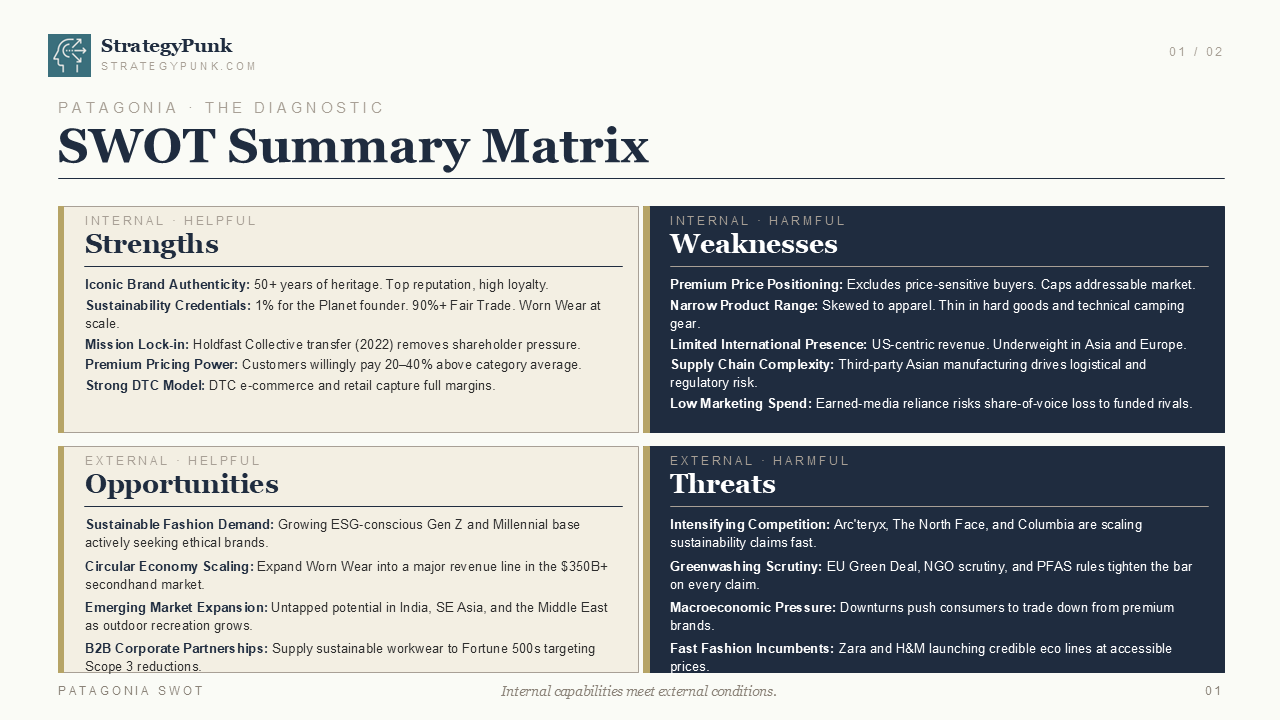
Patagonia SWOT Summary Matrix
1. Mission Lock-In is the Ultimate Defensive Moat
Most companies view their mission statement as a marketing tool or an HR retention tactic. Patagonia views it as structural armor.
In 2022, founder Yvon Chouinard transferred ownership of the company to the Holdfast Collective and the Patagonia Purpose Trust. This wasn't just an act of unprecedented philanthropy; it was a brilliant strategic maneuver called "Mission Lock-in."
By removing shareholder pressure entirely, Patagonia structurally immunized itself against the short-termism that plagues its publicly traded rivals. When competitors face margin pressure, they often compromise on sustainability or quality to appease Wall Street. Patagonia cannot be forced into this trade-off.
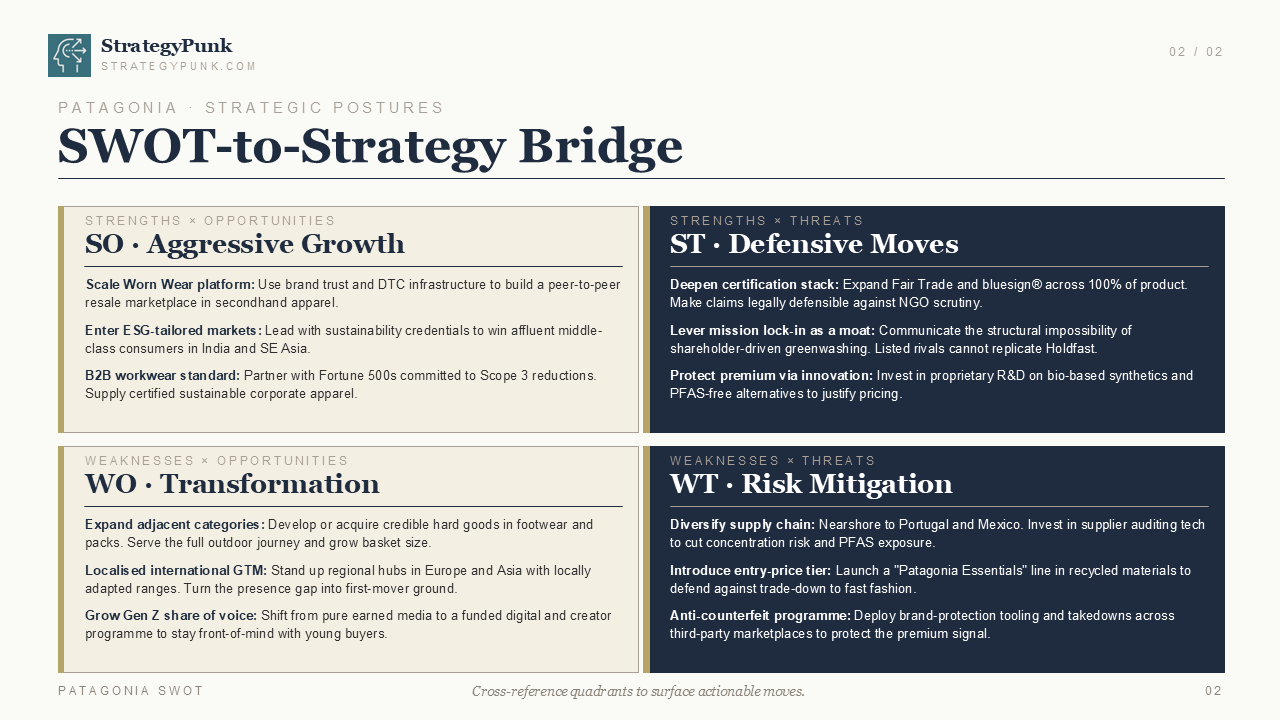
"Communicate the structural impossibility of shareholder-driven greenwashing. Listed rivals cannot replicate Holdfast."
This is a profound lesson in competitive advantage. If your competitors are structurally bound to maximize quarterly profits, a commitment to long-term value creation (whether through sustainability, quality, or employee welfare) becomes a differentiator they cannot afford to copy.
2. Premium Pricing Power Excludes
Patagonia’s products are expensive. They position at a premium, which excludes highly price-sensitive buyers and limits their total addressable market. Conventional wisdom says you should lower prices to capture more market share. Patagonia says no.
Customers are willing to pay a 20% to 40% premium over the category average for the Patagonia badge. This pricing power isn't just about margins; it’s a filtering mechanism. It self-selects a highly loyal, less price-elastic customer base that values authenticity and durability over fast fashion trends.
This premium positioning also funds their "Defensive Moves." To justify the high price tag and protect the premium signal against macroeconomic downturns, Patagonia must continue investing in proprietary R&D, including bio-based synthetics and PFAS-free alternatives. High prices demand high innovation, creating a virtuous cycle of product superiority.
3. The "Earned Media" Trap and the Gen Z Imperative
Here is a surprising weakness: Patagonia spends very little on traditional marketing. They rely heavily on earned media—press coverage generated by their activism, documentaries, and PR stunts.
While this reinforces their authenticity, it poses a hidden risk: a loss of share of voice to heavily funded rivals. Competitors like Arc'teryx, The North Face, and Columbia are rapidly scaling their sustainability claims and backing them with massive ad budgets.
To address this, the strategic diagnostic recommends shifting from earned media to a funded digital and creator program to capture Gen Z.
Younger, ESG-conscious consumers are the growth engine for sustainable fashion, but they don't consume traditional PR. They live on TikTok and Instagram. Even a brand as iconic as Patagonia needs to adapt its go-to-market strategy to stay front of mind with the next generation of buyers, showing that authenticity alone isn't enough if no one is listening.
4. Turning the Circular Economy into a Core Revenue Line
Sustainability is usually a cost center for apparel brands. For Patagonia, it is a massive growth opportunity.
The secondhand apparel market is exploding, projected to reach over $350 billion. Patagonia’s "Worn Wear" program—where they repair, buy back, and resell used gear—is currently a niche initiative. The strategic recommendation? Scale it aggressively.
By leveraging their immense brand trust and robust Direct-to-Consumer (DTC) infrastructure, Patagonia can build a dominant peer-to-peer resale marketplace. This isn't just about saving the planet; it's about capturing revenue twice on the same garment. It transforms a potential threat (consumers buying less new stuff) into a highly profitable, brand-accretive business line.
5. The B2B Trojan Horse: Corporate Workwear
When you think of Patagonia, you picture alpine climbers and trail runners, not corporate middle managers. Yet, one of their most lucrative opportunities lies in the B2B space.
Fortune 500 companies are under immense pressure to hit ESG targets and reduce their Scope 3 emissions (the indirect emissions that occur in a company's value chain). Certified sustainable corporate apparel—think the ubiquitous tech-bro fleece vest, but ethically made—is a large, untapped market.
By becoming the standard for B2B sustainable workwear, Patagonia can secure large, recurring revenue streams while helping other corporations meet their climate goals. It’s a brilliant example of leveraging a core strength (sustainability credentials) to enter an entirely new, highly profitable adjacent market.
6. The Risk of a Narrow Product Range
Despite its massive cultural footprint, Patagonia is surprisingly thin in certain categories. They are heavily skewed toward apparel, with a relatively narrow range of hard goods (such as technical camping gear, footwear, and packs).
This narrowness limits their ability to serve the "full outdoor journey." If a customer buys a Patagonia jacket but has to go to Salomon for boots and Osprey for a backpack, Patagonia is leaving money on the table and diluting the brand experience.
The strategic fix is to develop or acquire credible hard goods brands. Expanding into these adjacent categories increases basket size and deepens customer lock-in, transforming Patagonia from an apparel brand into a comprehensive outdoor lifestyle platform.
7. Nearshoring as a Shield Against Supply Chain Fragility
Like most apparel brands, Patagonia relies on third-party manufacturing in Asia. This supply chain complexity poses significant logistical and regulatory risks, especially as global trade tensions rise and scrutiny of labor practices intensifies.
The strategic diagnostic recommends a decisive risk mitigation tactic: nearshoring.
By diversifying their supply chain and moving production to regions like Portugal and Mexico, Patagonia can cut concentration risk, reduce lead times, and gain tighter control over their environmental standards (such as eliminating PFAS exposure). In a volatile world, supply chain proximity is a competitive advantage.
8. The "Essentials" Line Defense Against Fast Fashion
Macroeconomic pressure is a very real threat. When inflation bites, even loyal customers might trade down from premium brands to cheaper alternatives. Compounding this threat are fast-fashion incumbents like Zara and H&M, who are launching increasingly credible "eco" lines at highly accessible prices.
How does a premium brand defend its turf without diluting its prestige?
The answer lies in introducing an entry-price tier. The diagnostic suggests launching a "Patagonia Essentials" line made from recycled materials. This provides a defensive buffer, lowering the barrier to entry for cash-strapped consumers while maintaining the brand's core sustainability ethos. It prevents customer churn to fast fashion without compromising the premium pricing of their core technical gear.
Patagonia SWOT to Strategy Bridge
The Final Takeaway: Strategy is About Alignment
The brilliance of Patagonia’s strategy isn't found in any single tactic. It’s found in the alignment.
Every strength is leveraged to exploit opportunities or neutralize threats. Their mission isn't just a tagline; it dictates their corporate structure. Their high prices aren't just for profit; they fund the R&D required to stay ahead of greenwashing regulations.
As you look at your own business, ask yourself: Are your strengths merely bullet points on a slide, or are they structural moats that your competitors cannot cross? Are you using your values as a marketing campaign or as an operational filter?
Patagonia proves that you don't have to choose between doing good and doing well. But you do have to be ruthlessly strategic about how you execute both.
Want to dive deeper into the strategic mechanics behind Patagonia's success? Download the full StrategyPunk SWOT and TOWS diagnostic PDF below.