The Power/Interest Grid: The Stakeholder Canvas Every Strategist Needs
This post breaks down the Power/Interest Grid quadrant by quadrant. Free PDF and editable PowerPoint canvas included.

Most professionals think stakeholder management means keeping people happy. That's not a strategy. That's customer service with a better job title.
Real stakeholder management is about power. It's about knowing, precisely and honestly, who can kill your project, who can accelerate it, and who will do nothing either way. It's about allocating your scarcest resource — attention — with surgical precision, not based on who shouts loudest or who sits highest on the org chart.
The Stakeholder Analysis and Mapping framework, built around the classic Power/Interest Grid, has been around for decades. McKinsey uses it. Every business school teaches it. And almost everyone applies it wrong.
Here's what most people miss, and what a good stakeholder map actually reveals.
The Grid Is Simple. Your Thinking Around It Probably Isn't.
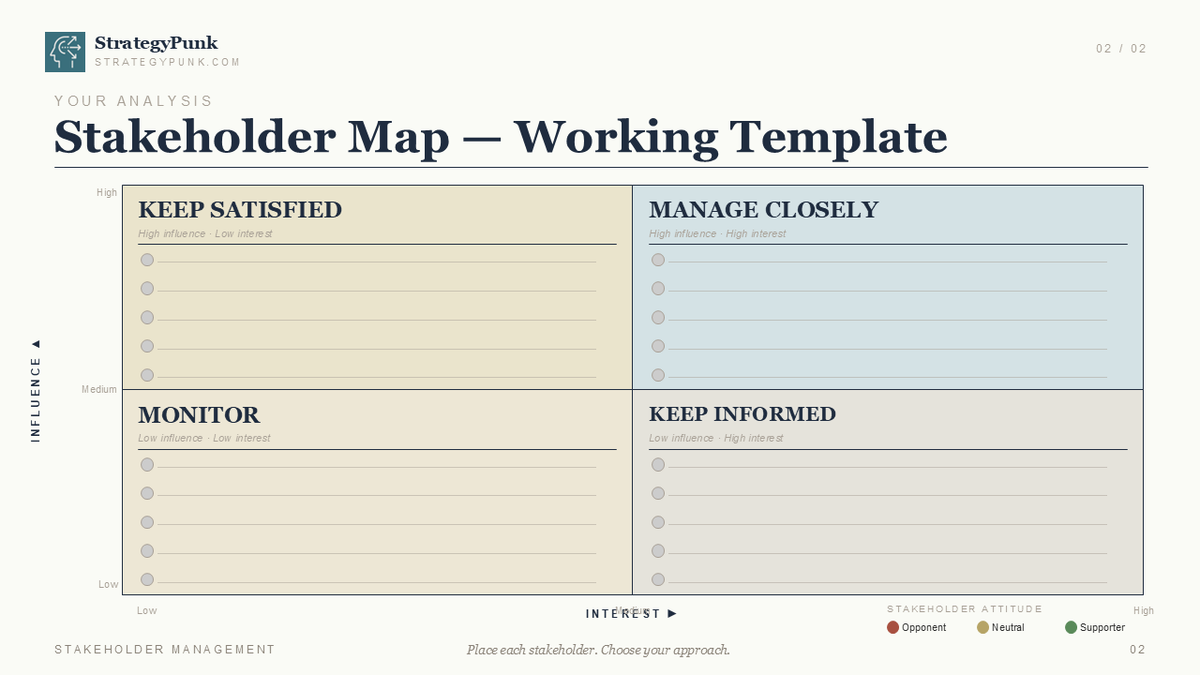
The Power/Interest Grid plots stakeholders on two axes: Influence (their ability to affect your project or initiative) and Interest (how much they actually care about the outcome). The result is four quadrants, each demanding a different management approach.
Keep Satisfied: high influence, low interest. Manage Closely: high influence, high interest. Monitor: low influence, low interest. Keep Informed: low influence, high interest.
Clean and logical. But here's where people get tripped up. They treat the grid as a filing exercise. They put names in boxes, feel organized, and move on. The map sits in a PowerPoint deck and never gets updated.
That's not stakeholder management. That's stakeholder theater.
The point of the map is to change your behavior. Every quadrant demands a fundamentally different approach, not just a different communication frequency. If you leave the exercise with the same relationship strategy for everyone on the list, you wasted the afternoon.
Your Most Dangerous Stakeholder Is Probably in the Wrong Box.
Here's the counter-intuitive one. The "Keep Satisfied" quadrant — high influence, low interest — sounds benign. They're not engaged, so that you can coast, right?
Wrong. These are your silent vetoes.
A CFO who doesn't follow your product roadmap closely but can kill the budget in a single meeting. A board member who doesn't attend your weekly reviews but whose offhand comment to the CEO can restructure your entire initiative. A regulatory body that has no particular interest in your timeline but holds absolute authority over your license to operate.
These stakeholders are dangerous precisely because of their low interest. They don't engage with nuance. When they do engage, it's because something has gone wrong or because someone else has briefed them first. And if someone else got there first, they've already framed the story.
The strategic move here is proactive, targeted briefings. Not newsletters. Not update decks. Specific, curated information designed to answer the question they'll eventually ask before they ask it. You manage expectations with this group not by over-communicating, but by ensuring that when they do pay attention, they see exactly what you want them to see.
Clarifying the escalation path matters too. When a decision hits their desk, they should already know the context. Surprises make powerful, disinterested people reactive and unpredictable.
Co-Creation Beats Consultation Every Time.
The Manage Closely quadrant is where most strategic action occurs. High influence, high interest. These are your real stakeholders: the ones paying attention and capable of moving mountains.
The instinct is to communicate well with this group. Hold meetings. Share updates. Keep them in the loop. That's the floor, not the ceiling.
The best stakeholder managers practice co-creation, not consultation. There's a meaningful difference. Consultation means you've already formed a view and you're asking for input. Co-creation means you bring these people in before the view is formed. They help shape the direction. Which means when the direction is announced, they're already invested in it.
This requires real discipline, because co-creation is slower and messier than just deciding and informing. But the time you spend on the front end is repaid in reduced resistance, faster downstream decision-making, and stakeholders who actively defend the outcome because it's partly theirs.
Understand their personal wins too, not just their official mandate. A VP whose team is under headcount pressure has different concerns than their org chart suggests. A board member running for re-election cares about optics in a way their formal role doesn't capture. These personal stakes are where the real leverage lives.
The Monitor Quadrant Is Where Initiatives Go Quietly Wrong.
Low influence, low interest. You barely need to think about this group: periodic check-ins, minimal effort. Move on.
That's the conventional wisdom. And it creates a specific, recurring failure mode.
Stakeholders move. Their influence shifts as organizations restructure. Their interest spikes when your initiative unexpectedly intersects with something they care about. The person who was a passive observer in Q1 becomes a vocal critic in Q3, and you have no relationship capital with them because you wrote them off.
The Monitor quadrant is not a parking lot. It's an early warning system if you treat it right.
You don't need to invest heavily here. A periodic light-touch check-in — a quarterly email, a brief mention in an all-hands — keeps the relationship warm without burning meaningful time. More importantly, it means you'll notice when something shifts before it becomes a problem.
Track this group via proxy, too. Team members often have better peripheral visibility than leaders. Someone on your team probably knows that the quiet stakeholder in row three just changed roles, joined a key committee, or started asking pointed questions in another forum. Build the intelligence network. Don't rely on your own direct observation.
The "Keep Informed" Quadrant Is Your Most Underused Asset.
Low influence, high interest. Standard advice: communicate transparently, gather feedback, and explain the impacts of change. Reasonable. Also radically undersells what this group can do for you.
These stakeholders are your ground-truth sensors.
High-influence stakeholders sit far from the operational reality of what you're doing. They see summaries of summaries. The "Keep Informed" group is often closer to the coalface — frontline managers, subject-matter experts, operational leads, and engaged customers. When they have a high interest in your initiative, they're paying close attention to what actually happens, not what gets reported upward.
That makes them invaluable for two things. First, feedback. They'll tell you what's actually working and what's being gamed, over-simplified, or ignored at the implementation level, things that your "Manage Closely" stakeholders may never surface because they're getting cleaned-up information. Second, early warning. When something is starting to go wrong, these are the people who will notice it first. If you've built a real communication channel with them — not just a one-way broadcast — you'll find out before it escalates.
There's a longer game here too. Influence shifts. The engaged junior analyst becomes a director in three years. The operational manager joins the leadership team. Today's "Keep Informed" stakeholder is tomorrow's "Manage Closely" one. The relationship you invest in now, when the stakes are lower, costs almost nothing. The relationship you have to build in a crisis, after you've ignored someone for two years, costs a great deal more.
Attitude Is as Important as Position.
Where a stakeholder sits on the grid tells you how to engage. Their attitude tells you what kind of engagement to prepare for.
Every stakeholder is an Opponent, Neutral, or Supporter. And this dimension cuts across all four quadrants, completely reshaping your approach.
A Supporter in the "Manage Closely" quadrant is a force multiplier. Involve them early, give them the language to advocate on your behalf, and let them carry your message into rooms you don't have access to. A well-briefed internal champion can neutralize opposition you'd never be able to reach directly.
An Opponent in the "Keep Satisfied" quadrant is one of the most dangerous configurations possible. High power, low engagement, and already disposed against you. They're not asking questions, so you're not getting a chance to address their concerns. They're forming views in the absence of your input.
The mistake most people make is treating Opponents as problems to be managed around. The better move, almost always, is to understand why they oppose. Opposition is usually rational from their perspective. If you can figure out what they're actually protecting — budget, status, existing relationships, a competing initiative — you have something to work with. You can redesign the proposal, offer a different framing, or address the underlying concern directly.
Neutrals are not safe to ignore either. They're up for grabs. Someone else is probably working on them.
The Map Is Dynamic. Most People Treat It Like a Photograph.
Here's the final, most important point. Stakeholder mapping is not a one-time exercise at the start of a project. It's an ongoing practice.
Organizations change. People move. Priorities shift. An initiative that started as a quiet operational improvement can evolve into a strategic priority that suddenly attracts executive attention from people who previously had no interest in it. A supporter can become a critic after a personnel change or a budget cut that changes their incentives. An opponent can become an ally after a well-timed conversation or a change in circumstances.
If your stakeholder map from the project kickoff is the same map you're using in month six, it's no longer accurate. It's a historical document.
The discipline is to treat the map as a living tool. Revisit it quarterly at a minimum. After any major organizational announcement, revisit it immediately. When a new decision-maker enters the picture, update it. When a project milestone passes and the political landscape shifts, update it.
Build this into your practice, not as a separate task, but as a natural output of the regular check-ins and relationship maintenance you're already doing. If you're paying attention to your stakeholders, updating the map should require almost no additional effort.
The Bottom Line
Stakeholder management separates the strategists from the operators. Operators deliver work. Strategists ensure the right people see it, support it, and can't easily kill it.
The Power/Interest Grid is not a complicated framework. It's a thinking tool. The complexity lies in the honest assessment it demands: placing stakeholders where they actually sit, not where you'd like them to be; acknowledging who really holds power in your organization; and being rigorous about what each relationship requires.
Most failures of good strategy are not failures of analysis or planning. They're failures of political execution — the right answer deployed without the right stakeholder map.
Here's the question worth sitting with: if you built an honest map of your current stakeholders today, how many would be in the wrong quadrant relative to how you've been treating them?
Download the Stakeholder Mapping Canvas
If you want to run this exercise with your team, I've put together a ready-to-use canvas you can download for free.
The pack includes two files. The first is a reference slide showing the full Power/Interest Grid, the four-quadrant strategies, action principles by zone, and the Opponent/Neutral/Supporter attitude overlay. The second is a clean working template with write-in rows for each quadrant, designed to be printed or edited directly in PowerPoint.
Both are formatted in the StrategyPunk visual system: clean, presentation-ready, and built for a real working session rather than a slide deck that nobody opens more than once.
Download the Free PDF
Print-ready reference and blank canvas.
Download the Free PowerPoint
Fully editable .pptx for team workshops or internal use.
No sign-up required. Download, use, adapt.